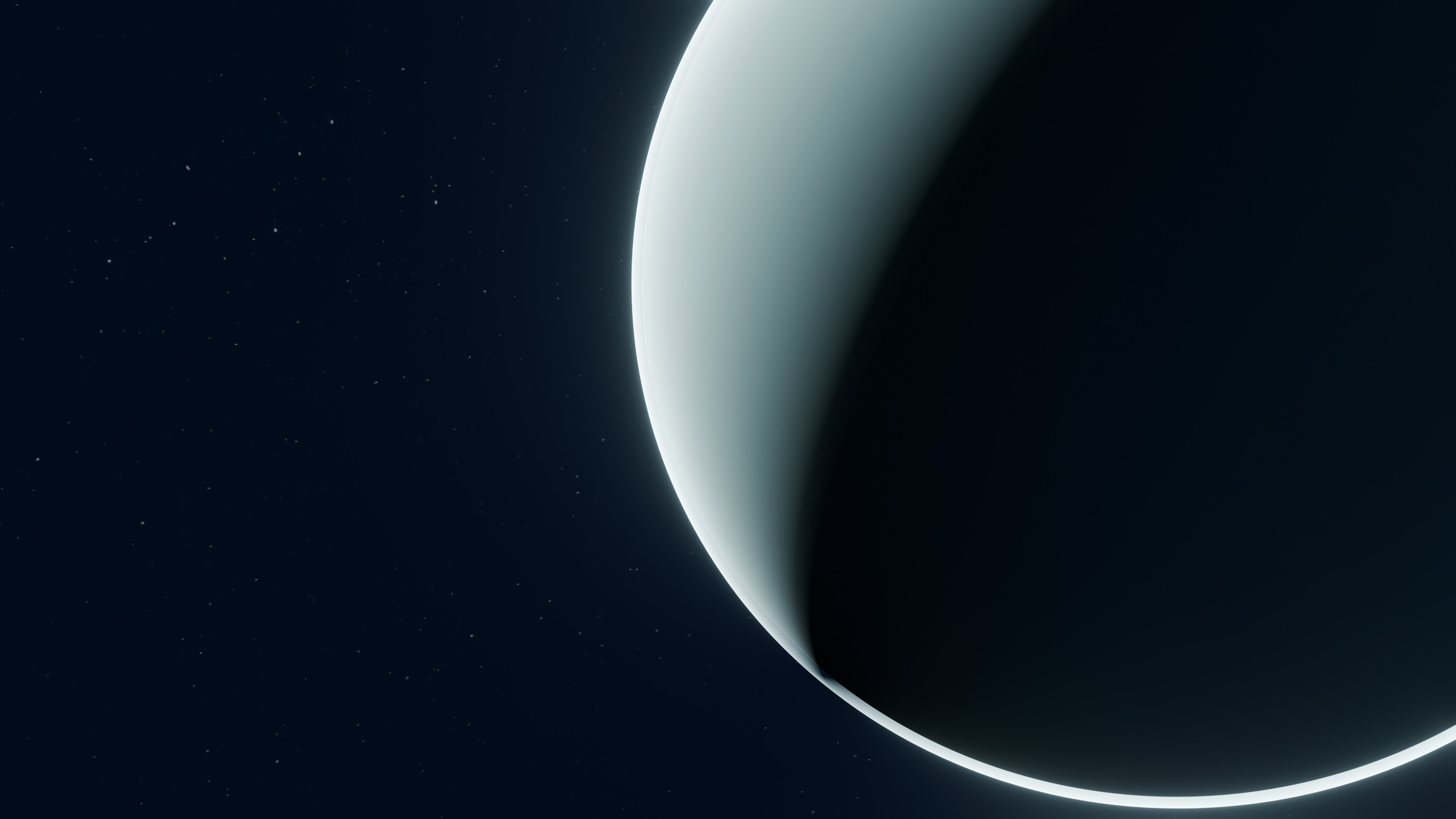
Quick facts
- Diameter
- 51,118 km4 times Earth
- Mass
- 8.68 × 10²⁵ kg14.5 times Earth
- Gravity at the cloud tops
- 8.87 m/s²89% of Earth
- Average distance from the Sun
- 2.87 billion km19.2 times Earth's distance
- Year
- 84 Earth yearsit has orbited the Sun about 2.9 times since it was discovered
- Day
- 17 hours 15 minutesspins backwards compared with most planets
- Axial tilt
- 97.8°Earth's is 23.4°
- Temperature at the cloud tops
- about −195 °Cthe coldest atmosphere measured, at about −224 °C, is here
- Atmosphere
- 83% hydrogen, 15% helium, 2% methanemethane gives the cyan colour
- Light from the Sun
- about 0.3% of Earth'ssunlight takes about 2 hours 40 minutes to arrive
- Moons
- 29 knownEarth has 1
- Rings
- 13 knownnarrow and dark
At a glance
Uranus is the seventh planet from the Sun, about four times wider than Earth. Together with Neptune it belongs to a class called the ice giants. Unlike Jupiter and Saturn, which are mostly hydrogen and helium, the ice giants are mostly made of heavier substances that planetary scientists call ices: water, methane and ammonia, though inside the planet they are hot, dense fluids rather than solid ice.
Its most famous feature is its tilt. Uranus spins on an axis tipped over by 98 degrees, so it effectively rolls around the Sun on its side. This gives it the most extreme seasons of any planet.
To the eye of a spacecraft it looked almost featureless, a smooth blue green ball. Modern telescopes show that it actually has bands, bright storms and changing polar caps, and that its weather responds to the slow march of its seasons.
Uranus is one of the least explored planets. Everything we know up close comes from a single flyby by Voyager 2 in January 1986, which is why scientists have made a dedicated mission to Uranus a top priority.
A planet on its side
Uranus takes 84 Earth years to circle the Sun, at an average distance of 2.9 billion kilometres, about 19 times Earth's distance.
Its day is about 17 hours and 15 minutes. In 2025, astronomers using a decade of Hubble images refined this to 17 hours, 14 minutes and 52 seconds, about 28 seconds longer than the Voyager estimate.
Because its axis lies almost in the plane of its orbit, each pole points nearly straight at the Sun for part of the year. Near the solstices, one hemisphere has continuous daylight for about 42 years while the other is in darkness. Near the equinoxes, the Sun shines on the equator and the whole planet has normal day and night cycles.
Voyager 2 arrived just after southern summer solstice, when the south pole faced the Sun. Uranus passed equinox in December 2007 and its northern summer solstice comes in 2028.
How did it get tipped over? The most common idea is that one or more giant collisions with Earth sized bodies knocked it over early in the solar system's history. Another proposes that gravitational interactions with a former moon slowly tilted it. Neither has been proven.
Inside an ice giant
Uranus probably has a small rocky core surrounded by a deep mantle of hot, dense fluid made mostly of water, ammonia and methane, under an outer envelope of hydrogen and helium. The mantle makes up most of the planet's mass.
Under the extreme pressures deep inside, laboratory experiments suggest that methane may break apart and its carbon may form diamonds, which could sink slowly through the mantle. This is an idea supported by experiments, not something anyone has observed on Uranus.
Uranus is puzzling because it gives off very little heat of its own. Jupiter, Saturn and Neptune all radiate considerably more energy than they receive from the Sun. Voyager's measurements suggested Uranus barely did. A 2025 study using decades of data found that it does radiate around 12% more than it absorbs, but that is still much less than its neighbours, and nobody knows why it is so different.
Atmosphere and weather
The atmosphere is mostly hydrogen and helium with about 2% methane. Methane absorbs red light, so sunlight reflected back from the clouds looks cyan. Deeper down there are probably clouds of hydrogen sulphide, which would give the planet a smell of rotten eggs, and of ammonia and water.
Uranus has the coldest atmosphere measured on any planet. At its coldest point, around the tropopause, Voyager 2 recorded about −224 °C, even colder than Neptune, which is much farther from the Sun.
Winds blow backwards relative to the spin near the equator and forwards at higher latitudes, reaching up to about 900 kilometres per hour. As its northern hemisphere has come into sunlight, telescopes have watched a large bright cap of haze develop over the north pole and bright storms come and go.
A lopsided magnetic field
Voyager 2 discovered that Uranus has a strong magnetic field, but one that is strangely arranged. It is tilted by about 59 degrees from the spin axis and its centre is offset by about a third of the planet's radius. Combined with the planet's sideways spin, this makes the magnetosphere twist into a corkscrew shape behind the planet.
The field is probably made by electric currents in the fluid mantle, rather than deep in a metal core as in Earth.
In 2024, scientists looking again at Voyager's data showed the spacecraft arrived just after a burst of solar wind had squeezed the magnetosphere. Under normal conditions Uranus's radiation belts may be quite different from what Voyager measured, which is another reason for a return visit.
Rings
Uranus has 13 known rings. They are narrow and very dark, made of chunks of material darkened by radiation, quite unlike Saturn's bright icy rings.
They were discovered in 1977, before any spacecraft visited, when astronomers watched a star flicker on and off as it passed behind them. They were the second ring system found in the solar system, after Saturn's. Voyager 2 found more, and the Hubble Space Telescope found two faint outer rings in 2003 to 2005.
The rings also lie almost upright to Uranus's orbit, following the tilted equator, so from Earth we sometimes see them face on like a target and at other times edge on.
Moons
Uranus has 29 known moons. The 29th, a small moon about 10 kilometres wide provisionally named S/2025 U 1, was found in 2025 with the James Webb Space Telescope.
Unlike the moons of other planets, which are named after mythology, Uranus's moons are named after characters from the works of William Shakespeare and Alexander Pope: Miranda, Ariel, Umbriel, Titania, Oberon, Puck and many more.
The five largest are Titania and Oberon, each about 1,500 kilometres across, then Umbriel, Ariel and the smaller Miranda. Miranda is one of the strangest objects Voyager saw: a patchwork of grooved terrain and enormous cliffs. Verona Rupes on Miranda may be the tallest cliff known in the solar system, perhaps 20 kilometres high.
Recent studies of Voyager data and new telescope observations suggest some of the larger moons could hide oceans of salty water beneath their icy crusts, possibly Ariel, Umbriel, Titania and Oberon. These are among the questions a future mission would set out to test.
Discovery and naming
Uranus was the first planet discovered with a telescope. William Herschel, a musician and astronomer in Bath, England, spotted it on 13 March 1781. He at first thought it was a comet, but its slow movement and nearly circular orbit soon showed it was a planet, which doubled the known size of the solar system.
Herschel wanted to call it Georgium Sidus, the Georgian star, after King George III. Other astronomers used the name Herschel. The German astronomer Johann Bode suggested Uranus, the Greek god of the sky and father of Saturn, and that name was eventually accepted everywhere by the mid nineteenth century.
Earlier astronomers had seen Uranus without realising it; John Flamsteed recorded it as a star in 1690. Small irregularities in its later motion led astronomers to predict and then discover another planet beyond it, Neptune, in 1846.
Seeing it from Earth
At its brightest Uranus is just visible to the naked eye from a truly dark site, as a faint star. It is much easier to find with binoculars once you know where to look, using a star chart or astronomy app.
Through a small telescope it shows a tiny pale blue green disc, too small to show detail. Larger telescopes, Hubble, Webb and observatories with adaptive optics now track its storms and polar caps.
Uranus moves slowly against the stars, taking about seven years to cross each constellation of the zodiac.
Open questions
What tipped Uranus onto its side, and why does it release so little internal heat?
What is the inside really like, and how is its strange magnetic field generated?
Do its large moons hold liquid oceans? In 2022 the main United States planetary science review recommended a Uranus orbiter with an atmospheric probe as NASA's next flagship mission. As of 2026 it has not been funded or scheduled.
Missions
Only one spacecraft has ever visited Uranus.
- 1986Voyager 2 NASA
Flew past on 24 January 1986, coming within about 81,500 kilometres of the cloud tops. It discovered 10 new moons, two new rings and the planet's magnetic field, and photographed Miranda's cliffs.
- ProposedUranus Orbiter and Probe NASA
Recommended in 2022 as the top new flagship mission, with an orbiter and a probe to dive into the atmosphere. It does not yet have funding or a launch date.
Sources
- NASA Uranus Fact Sheet (NSSDC)
- NASA Science: Uranus
- SwRI: Webb survey discovers new moon orbiting Uranus (August 2025)
- ESA: Hubble pins down the length of a day on Uranus (2025)
- Jasinski et al. 2024, Voyager 2 saw Uranus in an unusual state (Nature Astronomy)
- National Academies: Origins, Worlds, and Life, planetary science decadal survey 2023 to 2032
- NASA Science: Voyager 2
Facts were checked against these sources by a separate review before publishing. Spotted something out of date? Space moves fast, and this page is updated as missions report back.