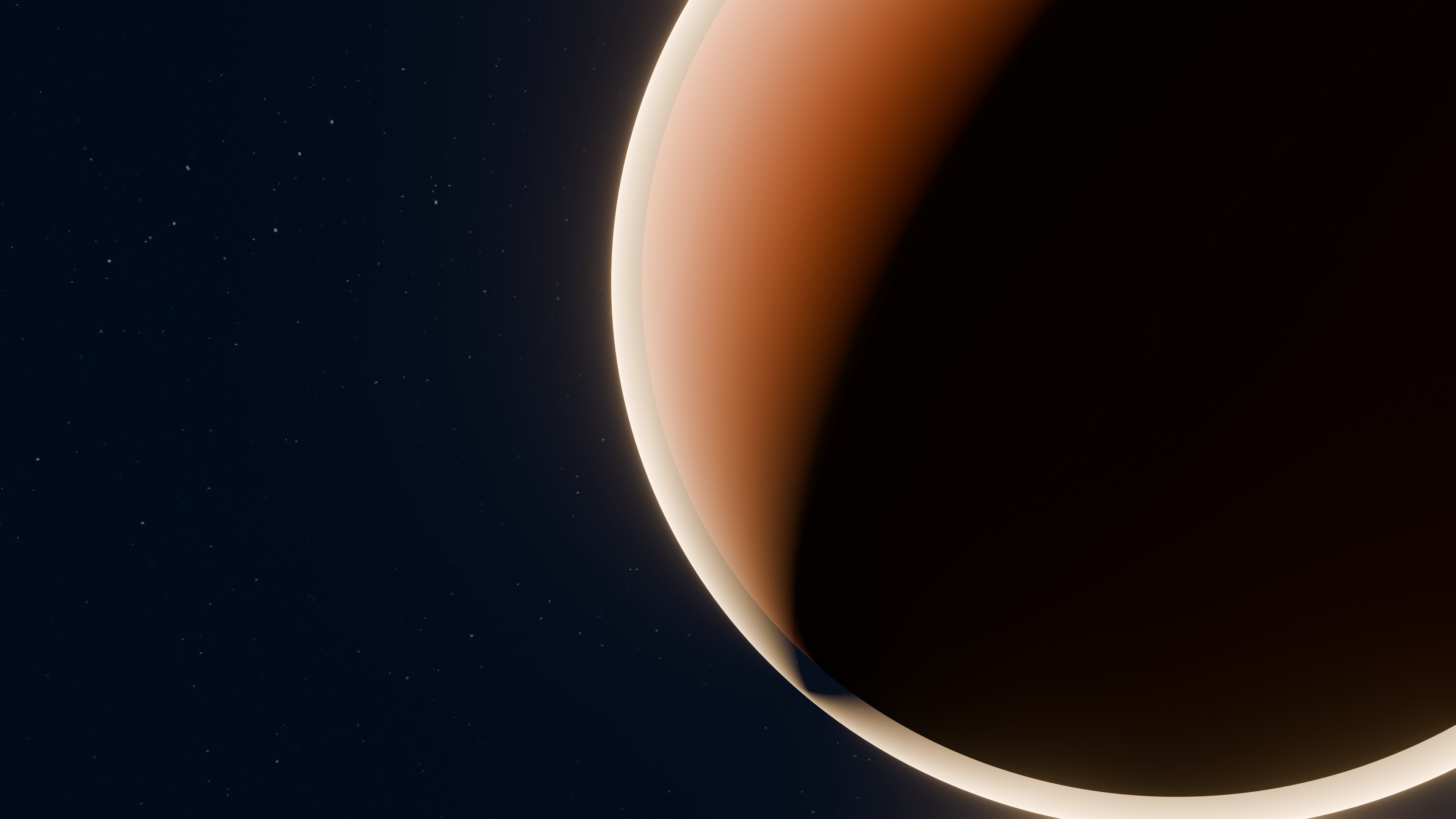
Quick facts
- Diameter
- 5,150 km40% of Earth, larger than the planet Mercury
- Mass
- 1.35 × 10²³ kg2.3% of Earth, 1.8 times our Moon
- Surface gravity
- 1.35 m/s²14% of Earth, a little less than our Moon
- Distance from Saturn
- 1.22 million kmabout 3 times our Moon's distance from Earth
- One orbit (and one day)
- 15.9 Earth daysit always shows Saturn the same face
- Surface temperature
- about −179 °Ccold enough for methane to be liquid
- Surface pressure
- about 1.5 bar50% more than at sea level on Earth
- Atmosphere
- about 95% nitrogen, 5% methane near the groundEarth's is 78% nitrogen
- Largest sea
- Kraken Mare, about 400,000 km²slightly larger than the Caspian Sea
- Year
- 29.5 Earth yearsit shares Saturn's orbit, so each season lasts about 7 years
- Discovered
- 25 March 1655by Christiaan Huygens
- Rank among moons
- second largestafter Jupiter's Ganymede
At a glance
Titan is the largest moon of Saturn and the second largest in the solar system, after Jupiter's Ganymede. It is wider than the planet Mercury, though it has less than half of Mercury's mass because it is made of a mix of rock and ice.
It is the only moon with a thick atmosphere, and the only world other than Earth known to have stable liquid on its surface. At about −179 °C, water is frozen as hard as rock, but methane and ethane, which are gases on Earth, can be liquid. They fall as rain, carve river channels and pool in lakes and seas.
Titan's air is mostly nitrogen, like Earth's, and denser than ours. Its orange haze is made of complex organic molecules formed as sunlight breaks apart methane high in the atmosphere.
In many ways Titan is an Earth like world built from completely different materials, which makes it one of the most interesting places in the solar system to study chemistry that may resemble the early steps towards life.
A thick orange atmosphere
The pressure at Titan's surface is about one and a half times that at sea level on Earth. Because the gravity is low and the air is dense, a person could strap on wings and fly by flapping their arms, though they would need a heated suit and oxygen.
The atmosphere is about 95% nitrogen, with around 5% methane near the surface and smaller amounts of other gases. It extends roughly ten times higher above the surface than Earth's does.
High up, ultraviolet sunlight and particles from Saturn's magnetic field break up nitrogen and methane. The fragments join into larger organic molecules called tholins, which form the thick orange haze and slowly drift down to the surface. The haze is why visible light pictures of Titan show only a fuzzy orange ball.
Methane is constantly being destroyed in this way. Since it should all be used up within tens of millions of years, something must be replacing it, perhaps methane escaping from inside the moon. Nobody is yet sure what.
Weather: methane rain
Titan has a cycle like Earth's water cycle, but with methane. Methane evaporates from lakes and the ground, forms clouds and falls back as rain. Raindrops on Titan would be larger than on Earth and fall slowly, about as fast as snowflakes.
Rain seems to be rare in most places but can be heavy when it comes. In 2004 to 2010, the Cassini spacecraft saw large storms and, afterwards, areas of the surface that had darkened as if wet.
Titan's seasons last about seven Earth years each, because it goes round the Sun with Saturn once every 29.5 years. Clouds and storms move between the hemispheres as the seasons change.
Lakes and seas
Cassini's radar found hundreds of lakes and three large seas, mostly near the north pole. The largest, Kraken Mare, covers about 400,000 square kilometres, slightly more than the Caspian Sea. Ligeia Mare, the second largest, is about 126,000 square kilometres, larger than Lake Superior, and over 160 metres deep in places.
Ligeia Mare is mostly methane, while some smaller lakes appear to be richer in ethane. Cassini also spotted bright features that appeared and disappeared in Ligeia Mare, nicknamed magic islands, which may be waves, bubbles or floating material.
The lakes are concentrated in the north, and scientists think this may be because of Saturn's orbit: southern summers are shorter but more intense, so liquid may be slowly moving north over tens of thousands of years.
The Huygens probe landed on a damp, flat plain near the equator strewn with rounded pebbles of water ice, the kind of scene you might find on a dry riverbed on Earth.
Dunes, mountains and craters
Around Titan's equator stretch vast fields of dunes, up to about 100 metres high and hundreds of kilometres long, covering roughly 15 to 20% of the surface. The sand grains are not silica, as on Earth, but probably organic material from the haze.
Titan also has mountains, valleys carved by flowing liquid, and a small number of impact craters. The thick atmosphere slows or burns up smaller impactors, and rain and wind gradually erode and fill the craters that do form.
Selk crater, about 90 kilometres across, is the target of NASA's Dragonfly mission, because an impact there may once have melted ice into liquid water that mixed with organic material.
Inside: an ocean or slush?
Titan has a rocky core surrounded by layers of ice. For more than a decade, scientists thought there was also a global ocean of liquid water beneath the ice shell, because Cassini found that Titan's shape flexes as it moves around Saturn by more than a solid moon should.
In December 2025 a team led by Flavio Petricca at NASA's Jet Propulsion Laboratory reanalysed the Cassini data and argued against a global ocean. They found Titan loses tidal energy in a way that fits better with a thick layer of slushy ice containing pockets of meltwater.
The question is not settled. Either way, Titan probably has liquid water somewhere inside it, and the organic material raining onto its surface may at times come into contact with it.
Could Titan host life?
Titan has abundant organic molecules, energy and liquid, which has led scientists to wonder whether it could host life of some kind.
Life in its methane seas would have to be completely unlike life on Earth, which depends on liquid water. It is far from clear that such life is possible. A more familiar possibility is the liquid water inside Titan, or water briefly melted by impacts at the surface.
There is no evidence of life on Titan. It is, though, a natural laboratory for studying the kind of chemistry that may have preceded life on the early Earth.
Discovery and naming
The Dutch astronomer Christiaan Huygens discovered Titan on 25 March 1655 using a telescope he had built with his brother. It was the first moon found orbiting Saturn and the sixth known moon in the solar system.
Huygens called it simply Saturn's moon. The name Titan was suggested in 1847 by John Herschel, son of William Herschel, after the Titans of Greek mythology, the siblings of the god Cronus, whom the Romans called Saturn.
In 1944 Gerard Kuiper detected methane in its light, proving that Titan has an atmosphere. Voyager 1 flew close in 1980 and found the atmosphere was thick and mostly nitrogen, but the haze hid the surface completely. Only radar and infrared cameras, carried by Cassini, could see through to the ground.
Seeing it from Earth
Titan is the easiest of Saturn's moons to see. Any small telescope shows it as a star like point near Saturn, at magnitude about 8, and it changes position over its 16 day orbit.
Large telescopes with adaptive optics, and the James Webb Space Telescope, can now follow Titan's clouds from Earth, tracking its weather between spacecraft visits.
Open questions
Does Titan have a global ocean, or slushy ice with pockets of water?
What replenishes the methane in its atmosphere, and how much of it is stored in the lakes, the ground and the interior?
How far has organic chemistry progressed on its surface? NASA's Dragonfly, a nuclear powered rotorcraft, is planned to launch in July 2028 and arrive in 2034, flying from site to site to study the surface up close.
Missions
Four spacecraft have visited Titan, and one has landed.
- 1979Pioneer 11 NASA
The first spacecraft to pass Saturn, it took distant images of Titan and measured its temperature.
- 1980Voyager 1 NASA
Passed about 6,500 km from Titan and found its thick nitrogen atmosphere. The close flyby sent Voyager 1 out of the plane of the planets, so it could not visit Pluto.
- 1981Voyager 2 NASA
Observed Titan from a greater distance on its way to Uranus and Neptune.
- 2004Cassini NASA, ESA and ASI
Orbited Saturn from 2004 to 2017 and made 127 targeted Titan flybys, mapping its surface with radar and discovering its lakes and seas.
- 2005Huygens ESA
Carried by Cassini, it parachuted through Titan's atmosphere on 14 January 2005 and landed, the most distant landing ever made. It sent back data from the surface for about 72 minutes.
- 2028Dragonfly NASA
A rotorcraft lander planned to launch in July 2028 and arrive in 2034. It will fly to dozens of sites, including Selk crater, to study Titan's chemistry.
Sources
- NASA Saturnian Satellite Fact Sheet (NSSDC)
- NASA Science: Titan
- ESA: Cassini Huygens
- NASA: Dragonfly
- University of Washington: Saturn's biggest moon might not have a global ocean (December 2025)
- Stofan et al. 2007, The lakes of Titan (Nature)
- Iess et al. 2012, The tides of Titan (Science)
Facts were checked against these sources by a separate review before publishing. Spotted something out of date? Space moves fast, and this page is updated as missions report back.