Quick facts
- Width at the equator
- 120,536 kmabout 9.5 Earths across
- Mass
- 95 Earthsless than a third of Jupiter
- Average density
- 0.69 g/cm³less than water, the only planet that is
- Gravity at the cloud tops
- 11.2 m/s²about 1.1 times Earth
- Length of a day
- 10 h 33 minmeasured from waves in its rings
- Length of a year
- 29.4 Earth years10,756 Earth days
- Distance from the Sun
- 1.36 to 1.51 billion kmabout 9.6 times farther
- Temperature at the cloud tops
- about −140 °Cat the 1 bar level
- Axial tilt
- 26.7°seasons about 7 years long
- Fastest winds
- about 1,800 km/hnear the equator
- Main rings
- about 280,000 km acrossbut often only about 10 m thick
- Moons
- 293 confirmedmore than any other planet
Saturn at a glance
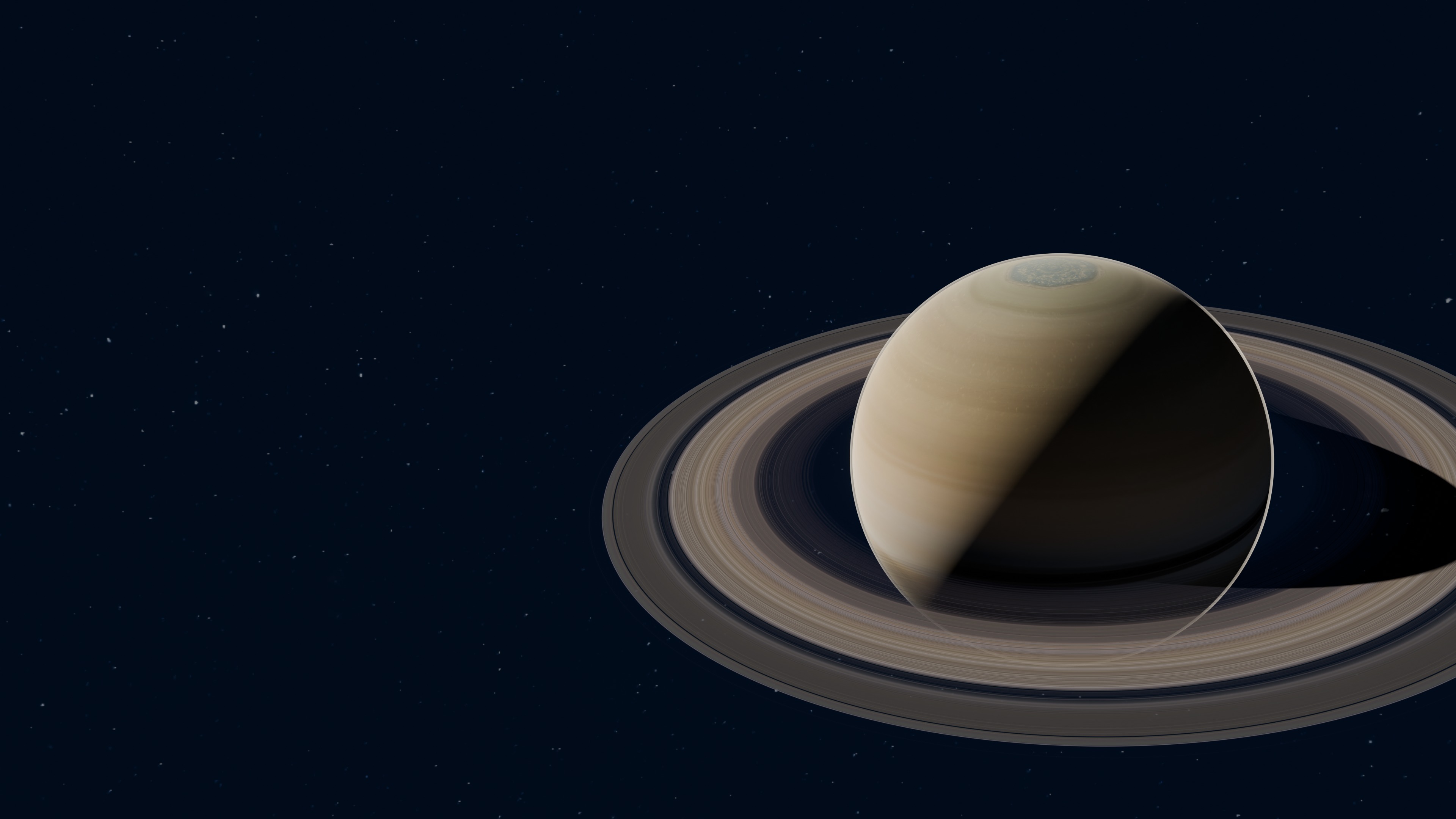
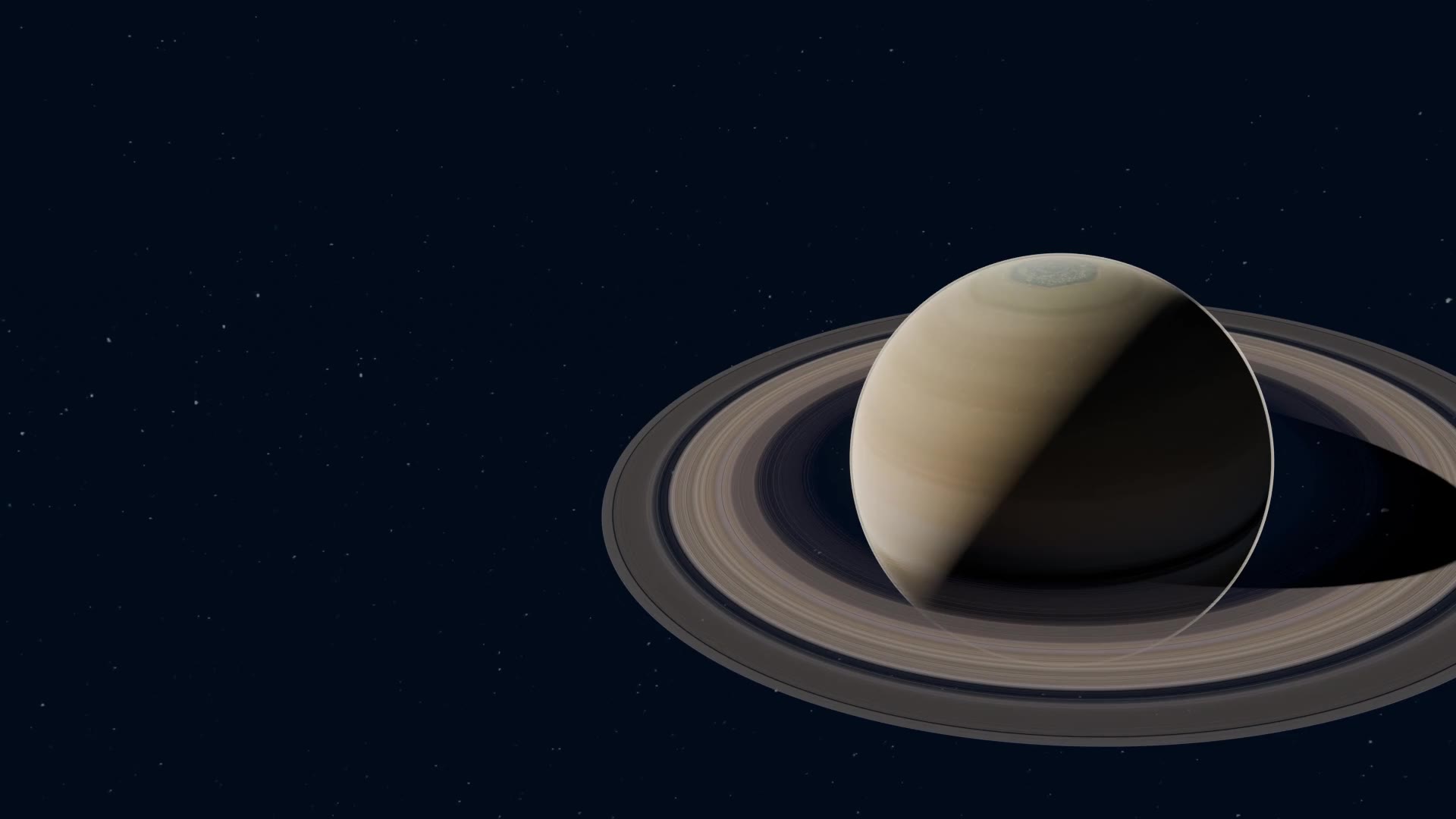
Saturn is the sixth planet from the Sun and the second largest. It is made mostly of hydrogen and helium, like Jupiter, but it has less than a third of Jupiter's mass, so its gravity squeezes it less and it is much less dense.
Its average density is lower than water's, which leads to the old line that Saturn would float in a big enough bathtub. In reality it would fall apart long before then, but the number is real.
Saturn spins so fast that it bulges at the equator. It is about 10% wider across the middle than from pole to pole, a flattening you can see in a small telescope.
Inside Saturn
Like Jupiter, Saturn has no solid surface. Its gas becomes liquid hydrogen with depth, then metallic hydrogen, which generates its magnetic field. Near the middle, Cassini's measurements suggest a large, diffuse core of rock and ice that blends into the layers above.
Finding the length of Saturn's day was surprisingly hard, because its magnetic field is lined up almost perfectly with its spin axis, so it gives no regular wobble to time. In 2019 scientists finally measured it from tiny waves in the rings caused by vibrations inside the planet: 10 hours, 33 minutes and about 38 seconds.
Saturn also gives off more heat than it gets from the Sun. One explanation is helium rain: deep inside, helium may separate from hydrogen and sink in droplets, releasing energy as it falls.
Hexagons and great storms
Saturn's clouds are softer and hazier than Jupiter's, but its winds are faster. Near the equator they reach about 1,800 kilometres an hour.
At the north pole is one of the strangest sights in the solar system: a six sided jet stream, a hexagon wider than Earth, that has held its shape since Voyager first saw it in the early 1980s. At its centre spins a huge cyclone.
About once every Saturn year, roughly every 30 Earth years, a Great White Spot erupts in the northern hemisphere. The most recent, in 2010 and 2011, grew into a storm that wrapped all the way around the planet. Cassini recorded its lightning.
The rings
Saturn's rings are made of countless pieces of almost pure water ice, from grains smaller than sand to chunks as big as houses. The main rings stretch about 280,000 kilometres from edge to edge, yet in most places they are only about ten metres thick. Scaled down to the width of a football field, they would be thinner than a sheet of paper.
They are divided into named rings with gaps between them. The widest gap, the Cassini Division, is about 4,800 kilometres across and is kept fairly clear by the gravity of the moon Mimas. Small shepherd moons patrol the edges of some rings, and moonlets carve waves and propellers into them.
How old the rings are is one of Saturn's great debates. Cassini found them bright and clean, with little dark dust, which suggested they might be only a few hundred million years old. Other researchers argue that the rings could be as old as Saturn and simply stay clean. Either way, they are slowly losing material, raining it down onto the planet.
Because Saturn is tilted, we see the rings from different angles through its 29 year orbit. In March 2025 they lined up edge on to Earth and almost disappeared from view in small telescopes. They are slowly opening up again.
Titan
Titan is Saturn's largest moon and the second largest in the solar system, bigger than the planet Mercury. It is the only moon with a thick atmosphere, mostly nitrogen, with a surface pressure about 1.5 times Earth's.
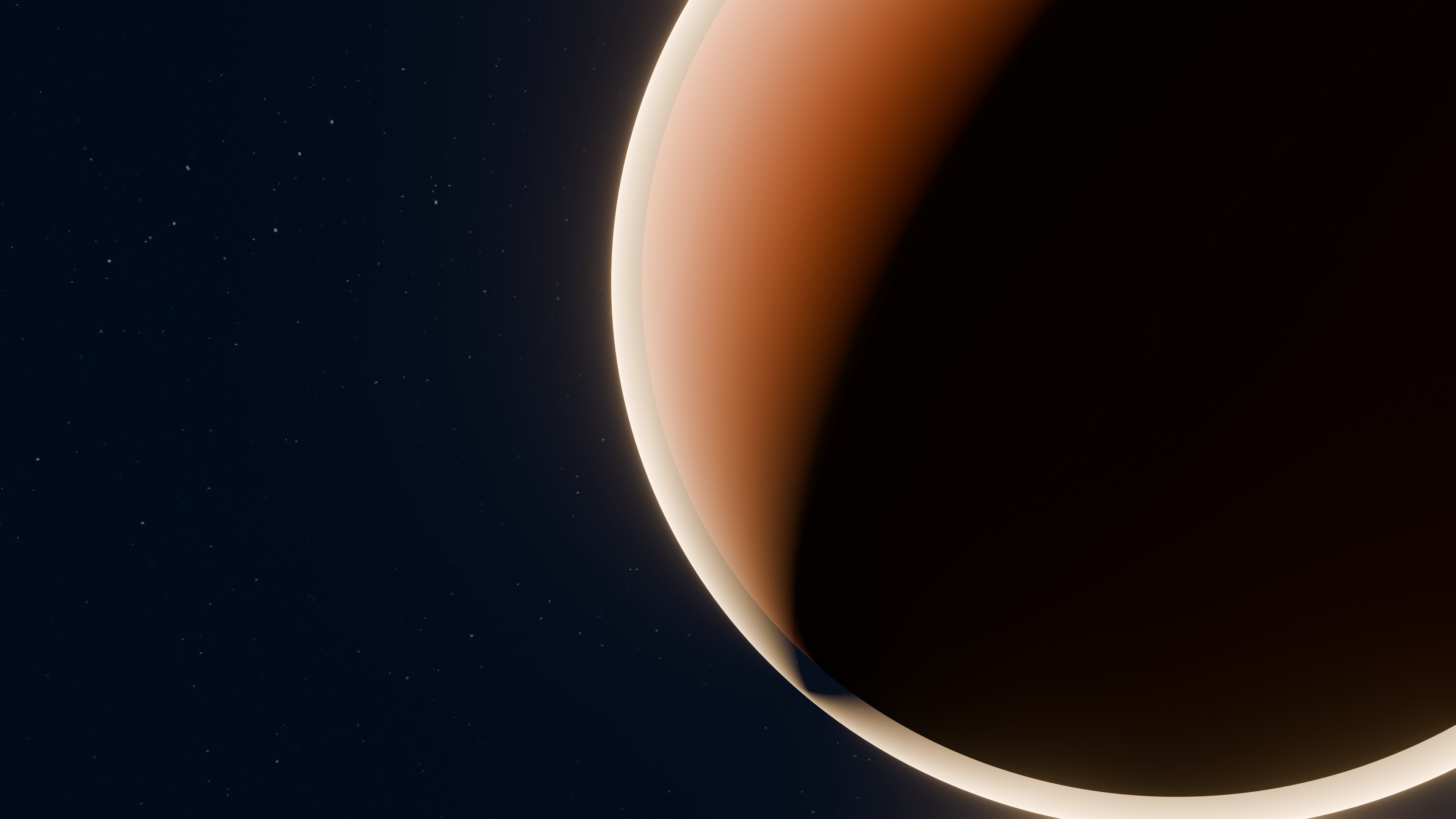
It is also the only world other than Earth known to have stable liquid on its surface. At about −180 °C, the rivers, lakes and seas are made of methane and ethane, and methane falls as rain. Under the surface, Titan may hide water too. Scientists long thought it was a global ocean, but a 2025 study of Cassini data suggests it could be a thick layer of watery slush instead.
In 2005 ESA's Huygens probe, carried by Cassini, parachuted through the haze and landed on Titan, the most distant landing ever made. NASA's Dragonfly, a nuclear powered drone the size of a car, is being built to launch in 2028 and start flying between sites on Titan in 2034.
Enceladus and the other moons
Enceladus is only about 500 kilometres across, but it is one of the most exciting places in the solar system. Cassini discovered jets of water vapour and ice grains bursting from cracks near its south pole, fed by a salty ocean under the ice. Flying through the plumes, Cassini found salts, organic molecules and hints of hydrothermal activity on the seafloor, all ingredients that matter for life.
Those plumes feed Saturn's faint, wide E ring. Mimas, with one giant crater that makes it look like a famous fictional space station, may hide a young ocean of its own. Iapetus has one half as dark as coal and the other as bright as snow.
Saturn has 293 confirmed moons as of August 2026, far more than any other planet, and astronomers keep finding more. Most are small, irregular bodies only a few kilometres across, many orbiting backwards, probably fragments of larger objects broken in collisions long ago.
Seeing Saturn
Saturn looks like a steady, golden star and reaches opposition about every 54 weeks. It was the farthest planet known in ancient times.
Almost any telescope shows the rings, and for many people that first look is unforgettable. With a bit more magnification you can pick out Titan, and sometimes the Cassini Division and the shadow of the globe on the rings.
Open questions
How old are the rings, and how long will they last?
Is there life, or at least the chemistry that comes before life, in the ocean of Enceladus or the lakes and hidden water of Titan?
What drives the north polar hexagon, and why is it so stable?
How does helium rain deep inside shape Saturn's heat, its magnetic field and its history?
Missions
Every spacecraft that has visited Saturn, by the year it arrived, plus the next one heading for Titan.
- 1979Pioneer 11 NASA
The first spacecraft to fly past Saturn, discovering its faint F ring.
- 1980Voyager 1 NASA
Revealed the complex structure of the rings and studied Titan's thick atmosphere up close.
- 1981Voyager 2 NASA
Added detail on the rings and moons on its way to Uranus and Neptune.
- 2004Cassini NASA, ESA and ASI
Orbited Saturn for 13 years, discovered the plumes of Enceladus and the seas of Titan, then dived into Saturn in 2017 after 22 final orbits between the planet and its rings.
- 2005Huygens ESA
Landed on Titan, the first landing in the outer solar system.
- 2028Dragonfly NASA
A rotorcraft lander due to launch in July 2028 and reach Titan in 2034.
Sources
- NASA Saturn Fact Sheet (NSSDC)
- NASA Science: Saturn
- NASA: Cassini mission
- ESA: Huygens
- NASA Science: Saturn's moons
- NASA: Dragonfly
Facts were checked against these sources by a separate review before publishing. Spotted something out of date? Space moves fast, and this page is updated as missions report back.