Quick facts
- Diameter
- 49,528 km3.9 times Earth
- Mass
- 1.02 × 10²⁶ kg17 times Earth
- Gravity at the cloud tops
- 11.15 m/s²114% of Earth
- Average distance from the Sun
- 4.5 billion km30 times Earth's distance
- Year
- 164.8 Earth yearsit completed its first orbit since discovery in 2011
- Day
- 16 hours 7 minutesabout two thirds of an Earth day
- Axial tilt
- 28.3°Earth's is 23.4°, so it has seasons, each about 40 years long
- Temperature at the cloud tops
- about −200 °Cmuch colder than any place on Earth
- Fastest winds
- about 2,000 km/hthe fastest of any planet
- Light from the Sun
- about 0.1% of Earth'ssunlight takes about 4 hours 10 minutes to arrive
- Moons
- 16 knownEarth has 1
- Rings
- 5 main ringsfaint, with bright clumps called arcs
At a glance
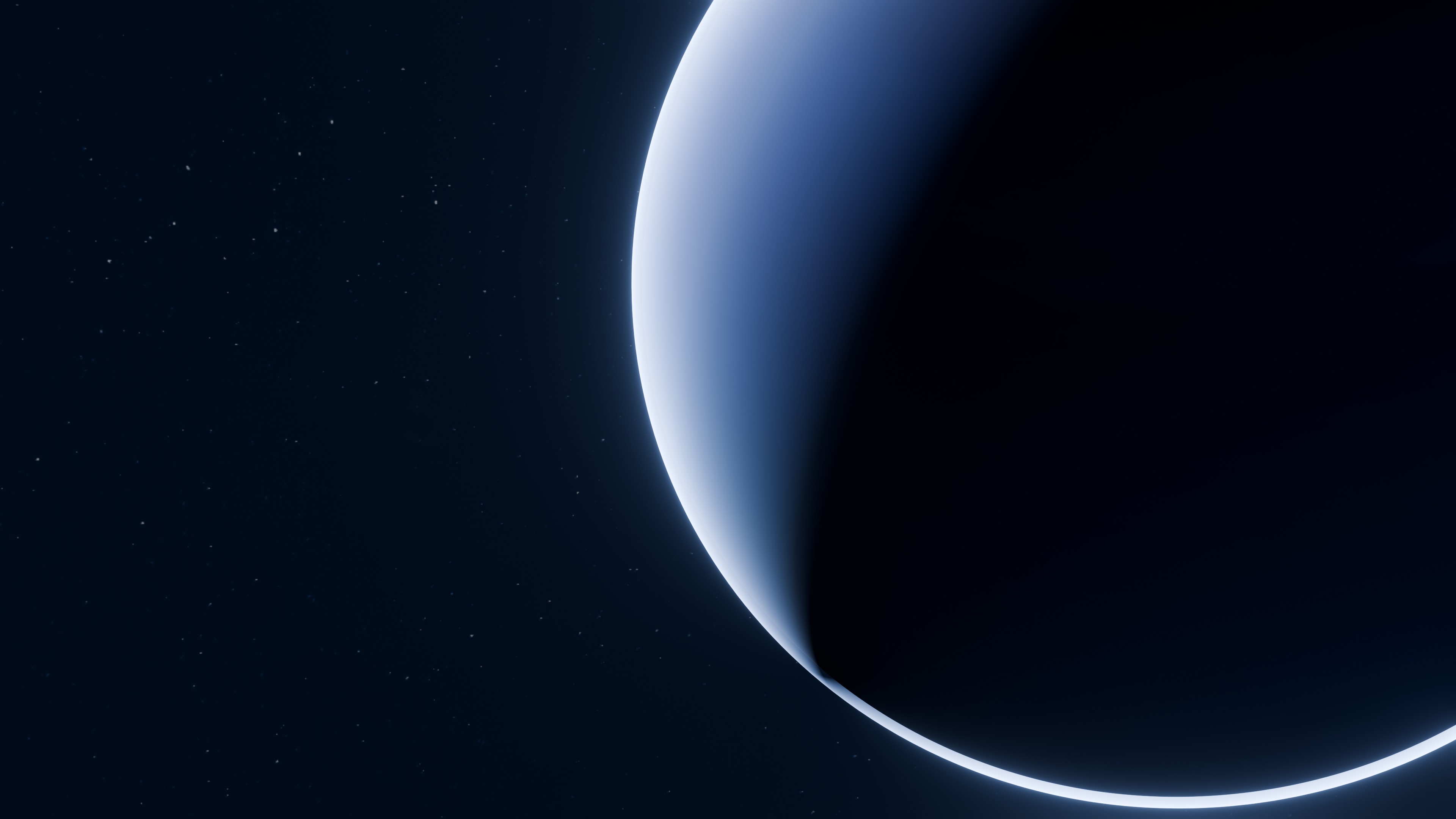
Neptune is the eighth and farthest planet from the Sun, about 30 times farther out than Earth. Like Uranus, it is an ice giant: a world made mostly of water, methane and ammonia around a rocky core, wrapped in a thick atmosphere of hydrogen and helium.
It is slightly smaller than Uranus but more massive, and therefore denser. Its gravity at the cloud tops is a little stronger than Earth's.
For a planet that gets so little sunlight, Neptune is surprisingly active. It has bands of cloud, dark storms that come and go, and winds that blow faster than on any other planet.
It is so far away that it was the first planet found by calculation rather than by chance, and it has been visited by just one spacecraft, Voyager 2, in 1989.
Orbit, day and seasons
Neptune takes almost 165 Earth years to go once round the Sun. It was discovered in 1846, and only in 2011 did it get back to the same point in its orbit, completing its first Neptunian year since anyone knew it was there.
A day on Neptune lasts about 16 hours. Because the planet has no solid surface and its clouds move at different speeds, the length of the day is measured from its magnetic field and interior, not from features in the atmosphere.
Its axis is tilted by 28 degrees, a little more than Earth's, so it has seasons. Each one lasts about 40 years. Its southern hemisphere has been in summer for decades, and telescopes have watched slow changes in temperature and cloud as the seasons turn.
Pluto's orbit sometimes brings it closer to the Sun than Neptune, as it was from 1979 to 1999. The two can never collide, because they are locked in a rhythm: Pluto goes round the Sun twice for every three orbits of Neptune, which keeps them far apart.
Inside
Scientists think Neptune has a rocky core about the size of Earth, surrounded by a hot, dense mantle of water, ammonia and methane, and then an outer layer of hydrogen, helium and methane gas. There is no solid surface to stand on; the gas simply gets thicker and hotter with depth.
Neptune radiates about 2.6 times as much energy as it receives from the Sun. That internal heat, left over from its formation and possibly from material slowly settling inside, helps drive its strong weather. This makes its sibling Uranus, which releases far less heat, all the more puzzling.
Like Uranus, Neptune has a magnetic field that is strongly tilted, about 47 degrees from its spin axis, and offset from the centre of the planet. It is thought to come from currents in the fluid mantle. In 2025 astronomers announced that the James Webb Space Telescope had clearly captured Neptune's auroras for the first time, in infrared observations made in 2023; Voyager 2 had seen only hints of them.
Atmosphere and the fastest winds
Neptune's atmosphere is mostly hydrogen and helium, with a little methane. The methane absorbs red light, giving the planet its blue colour. Voyager's famous images were contrast enhanced, making it look deeper blue than it really is; a 2024 study reprocessing the data showed Neptune is a pale greenish blue only slightly bluer than Uranus.
The winds are the fastest measured anywhere in the solar system, around 2,000 kilometres per hour, faster than the speed of sound on Earth. Near the equator they blow backwards relative to the planet's spin.
In 1989 Voyager 2 photographed a storm roughly the size of Earth, which became known as the Great Dark Spot, along with bright white clouds of methane ice nearby. When Hubble looked in 1994 the spot had vanished. Since then telescopes have seen several other dark spots appear and fade over a few years.
Neptune's clouds also seem to follow the Sun. A 2023 study of almost 30 years of images found the amount of cloud rises and falls with the 11 year solar cycle, and that the clouds had almost disappeared around 2019 to 2020.
Rings
Neptune has five main rings, named after astronomers involved in its discovery: Galle, Le Verrier, Lassell, Arago and Adams. They are dark and faint, made of dust and small particles coated with material darkened by radiation.
The outer Adams ring has a strange feature: bright clumps called arcs, named Liberté, Égalité, Fraternité and Courage. Normally ring material spreads out evenly, so the arcs are probably held in place by the gravity of the small moon Galatea nearby. Observations since Voyager show some arcs fading.
In 2022 the James Webb Space Telescope took the clearest pictures of the rings since Voyager, showing the faint dusty bands that are hard to see from the ground.
Moons and Triton
Neptune has 16 known moons, named after sea gods and nymphs in Greek mythology. The two newest were announced in 2024 after observations with large telescopes in Hawaii and Chile; they are only about 23 and 14 kilometres across. Hippocamp, about 34 kilometres across, was found in Hubble images in 2013.
Triton is by far the largest, about 2,700 kilometres across, a little smaller than our Moon. It is the only large moon in the solar system that orbits backwards, against its planet's spin. That strongly suggests Triton did not form with Neptune but was captured, probably from the Kuiper Belt, where it may have been a world much like Pluto.
Triton is one of the coldest places measured in the solar system, about −235 °C at the surface. Even so, Voyager 2 saw dark plumes rising about 8 kilometres high, possibly geysers of nitrogen gas driven by weak sunlight warming the ice. It also has a very thin nitrogen atmosphere and a young surface with few craters, including a region whose texture is nicknamed cantaloupe terrain.
Triton's backward orbit is slowly shrinking because of tides. In billions of years it will come close enough to be torn apart, perhaps giving Neptune a large ring system.
Nereid, the third largest moon, has one of the most stretched orbits of any moon, swinging from about 1.4 to 9.7 million kilometres from Neptune.
Discovered by mathematics
After Uranus was discovered in 1781, astronomers found it was not quite following the path they predicted. Something seemed to be pulling on it. In the 1840s, the French mathematician Urbain Le Verrier and, independently, the English mathematician John Couch Adams calculated where an unseen planet would have to be to explain this.
Le Verrier sent his prediction to Johann Galle at the Berlin Observatory. On the night of 23 September 1846, Galle, helped by the student Heinrich d'Arrest, found Neptune within about one degree of the predicted position. It was a triumph of Newton's law of gravity.
Seventeen days later William Lassell discovered Triton. Galileo had actually seen Neptune in 1612 and 1613 while observing Jupiter, but recorded it as a star.
The planet was named after Neptune, the Roman god of the sea, a fitting name for a blue world.
Seeing it from Earth
Neptune is never visible to the naked eye. With binoculars and a good star chart it can be found as a faint star; it reaches opposition, its best position, every autumn in these years, in the constellation Pisces.
In a telescope with high magnification it shows a tiny blue disc, about 2 arcseconds across. Large telescopes can just pick out Triton nearby.
Modern instruments such as Hubble, Webb and large telescopes with adaptive optics can track clouds and storms on Neptune from Earth, keeping a long running weather record.
Open questions
Why is Neptune so much more active than Uranus, when they are so similar in size and make up?
How do its winds get so fast with so little sunlight, and what produces its dark storms?
Is Triton still active, and does it hide an ocean beneath its ice? A return mission to the ice giants has been discussed for decades, but no mission to Neptune is currently funded.
Missions
Neptune has been visited by only one spacecraft.
- 1989Voyager 2 NASA
Flew about 4,950 kilometres above Neptune's north pole on 25 August 1989, the closest it came to any planet. It discovered six moons, confirmed the rings, photographed the Great Dark Spot and Triton's geysers, then headed out of the solar system.
Sources
- NASA Neptune Fact Sheet (NSSDC)
- NASA Science: Neptune
- NASA Science: Triton
- Astronomy: New moons of Uranus and Neptune discovered (February 2024)
- Irwin et al. 2024, Modelling the seasonal cycle of Uranus's colour and magnitude, and comparison with Neptune (MNRAS)
- Chavez et al. 2023, Evidence for multi-decadal variability in Neptune's cloud cover tied to the solar cycle (Icarus)
- NASA: Webb captures Neptune's auroras for the first time (2025)
Facts were checked against these sources by a separate review before publishing. Spotted something out of date? Space moves fast, and this page is updated as missions report back.