Quick facts
- Size
- 573 × 557 × 446 kmabout 525 km wide on average, roughly the width of Arizona
- Mass
- 2.59 × 10²⁰ kgabout 9% of the whole asteroid belt
- Surface gravity
- about 0.25 m/s²about 2.5% of Earth
- Average distance from the Sun
- 353 million km2.36 times Earth's distance
- Year
- 3.63 Earth yearsabout 3 years 8 months
- Day
- 5 hours 20 minutesone of the fastest spins among large asteroids
- Axial tilt
- about 27°a little more than Earth's 23.4°, so it has seasons
- Surface temperature
- about −190 °C to −20 °Cwarmest where the Sun is overhead
- Density
- about 3,460 kg/m³rock with an iron core
- Tallest peak
- about 22 kmin the centre of the Rheasilvia basin, more than twice the height of Everest
- Discovered
- 29 March 1807by Heinrich Olbers in Bremen
- Moons
- 0Earth has 1
At a glance
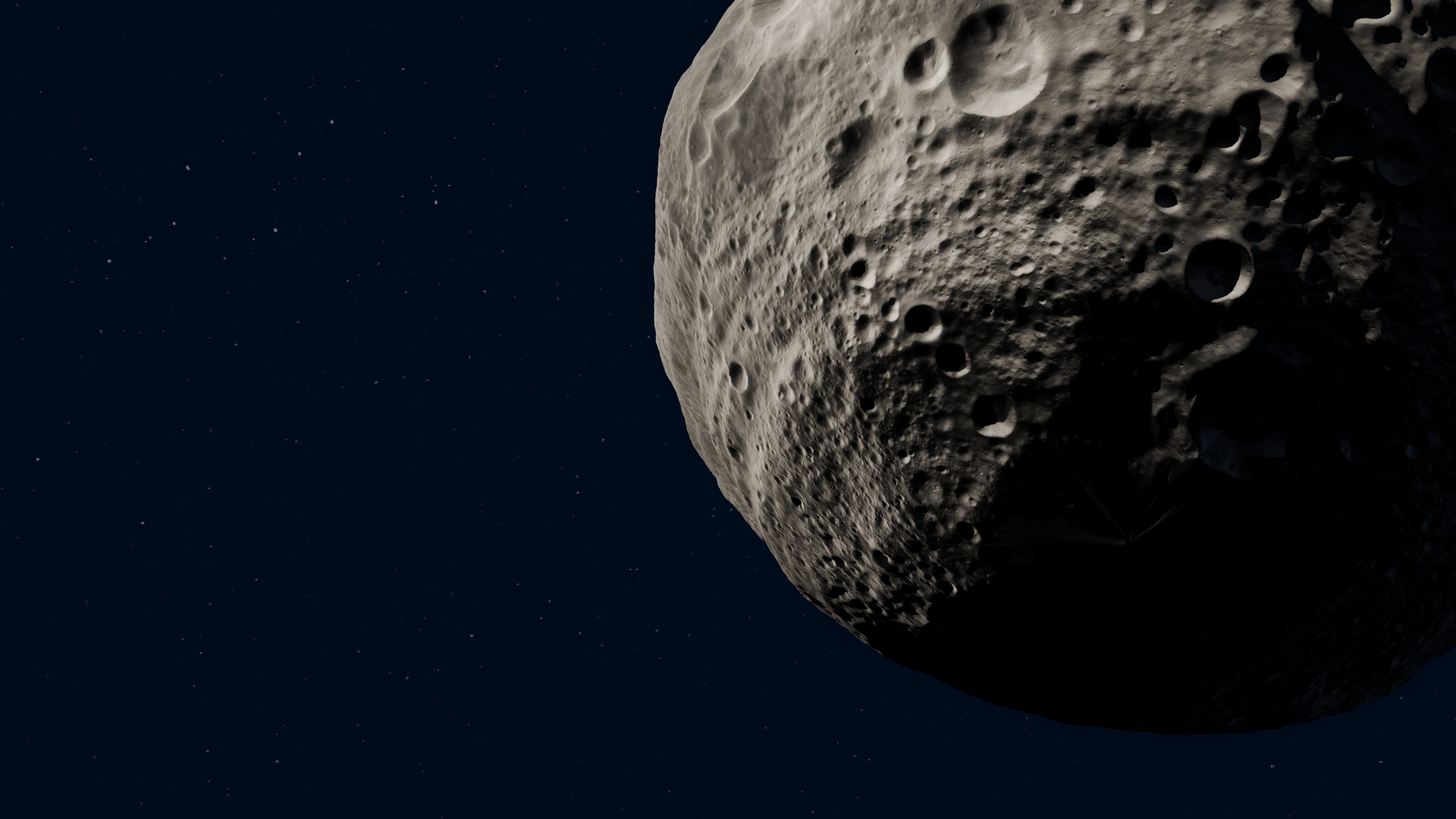
Vesta orbits the Sun in the main asteroid belt, between Mars and Jupiter. At about 525 kilometres across it is the second largest object in the belt after Ceres, and the brightest asteroid seen from Earth.
It is not a typical asteroid. Vesta melted early in its history and separated into layers, an iron core, a rocky mantle and a crust of volcanic rock, just as Earth and the other rocky planets did. That makes it a protoplanet: a building block of the planets that survived more or less intact.
It is not quite round. A colossal impact gouged out much of its southern hemisphere, leaving it shaped somewhat like a squashed walnut. Because it is not in hydrostatic balance, it is not counted as a dwarf planet.
Vesta is also one of the few worlds of which we hold real samples. About one in sixteen meteorites that fall on Earth come from Vesta, blasted off by the same giant impacts that shaped it.
Orbit, day and seasons
Vesta goes round the Sun every 3.63 years in a fairly circular orbit, at an average distance of 353 million kilometres, about 2.4 times Earth's distance.
It spins quickly, once every 5 hours and 20 minutes, so its day is shorter than a quarter of ours.
Its axis is tilted by about 27 degrees, so like Earth it has seasons. When NASA's Dawn spacecraft arrived in 2011 it was southern summer, which allowed Dawn to see and map the giant southern basin in sunlight.
Inside: a planet in miniature
Measurements of Vesta's gravity by Dawn showed that it has a dense iron core, probably around 220 kilometres across, under a rocky mantle and a basaltic crust.
To separate into layers like this, Vesta must have melted. The heat came from radioactive aluminium 26, a short lived isotope that was abundant when the solar system formed. Because of this, Vesta grew and cooled within the first few million years, earlier than the planets finished forming.
Its growth was probably cut short by Jupiter. The giant planet's gravity stirred up the asteroid belt, making collisions there destructive rather than building things up. Vesta is a glimpse of what the young planets looked like before they grew larger.
Rheasilvia: one of the largest impact basins
Vesta's south pole is dominated by Rheasilvia, an impact basin about 500 kilometres across, almost as wide as Vesta itself. It is one of the largest impact basins in the solar system relative to the size of the body it is on.
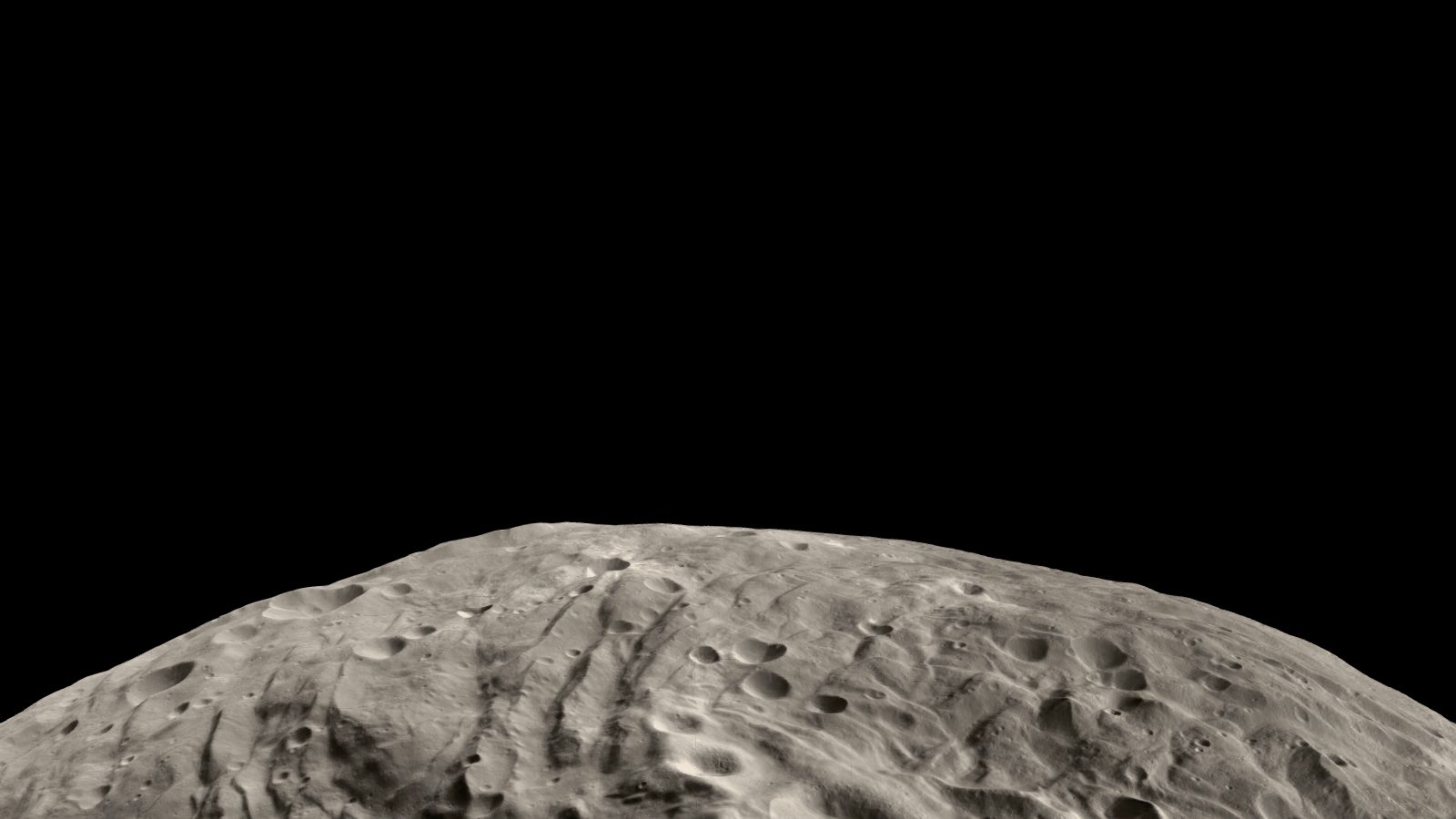
In its centre rises a peak about 22 kilometres high, one of the tallest mountains known in the solar system, made of material that rebounded upward after the impact.
Dawn found that Rheasilvia partly overlaps an older basin, Veneneia, about 400 kilometres wide. Counting the craters on their floors suggests Rheasilvia formed about one billion years ago and Veneneia about two billion years ago.
The Rheasilvia impact alone blasted away about 1% of Vesta's volume. That debris created the Vesta family of small asteroids, and some of it eventually found its way to Earth.
The great troughs
Wrapped around Vesta's equator is a set of huge parallel troughs, the largest of which, Divalia Fossae, stretch for hundreds of kilometres. The biggest single trough is about 465 kilometres long and up to about 20 kilometres wide, larger than the Grand Canyon.
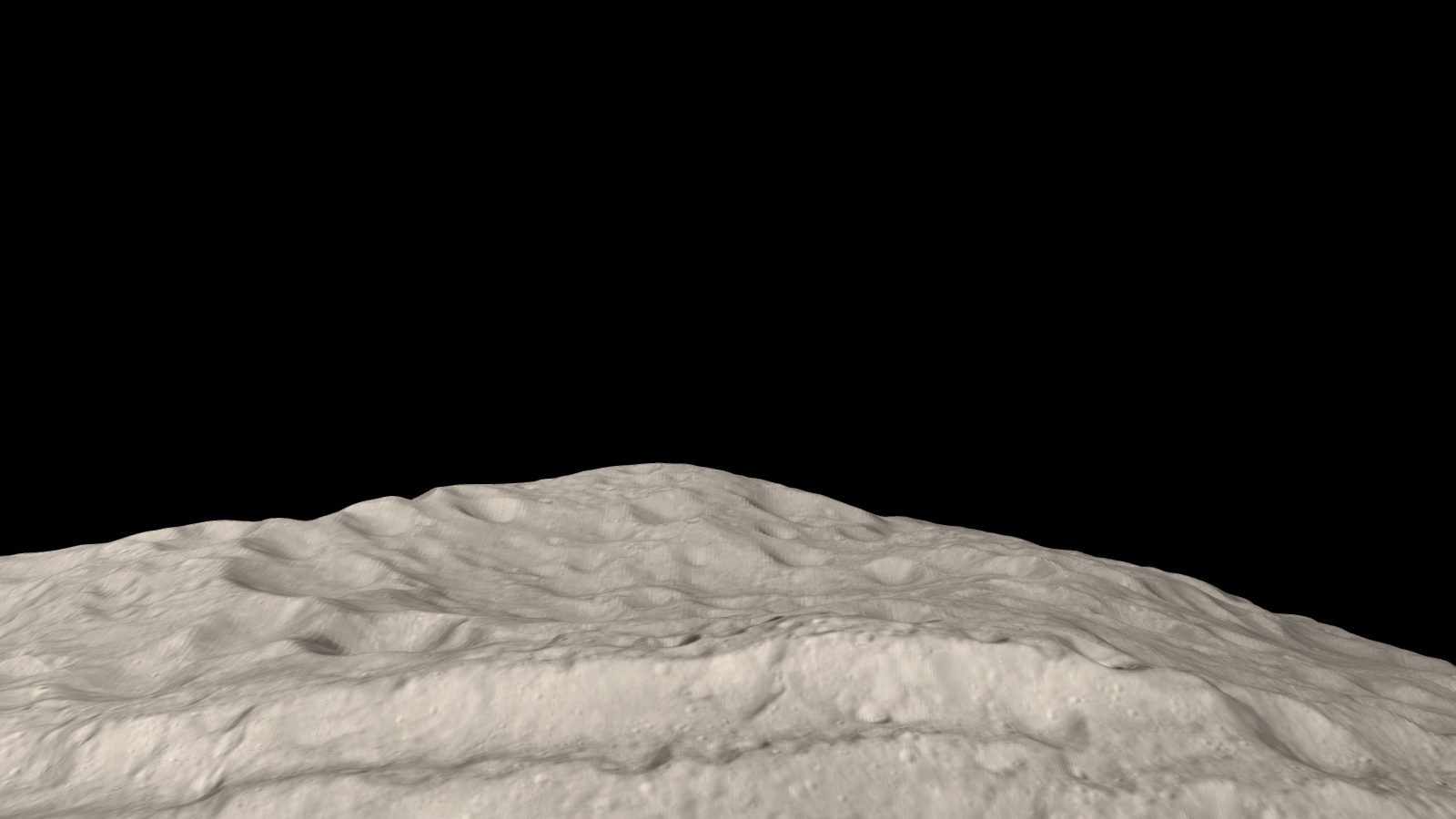
They are lined up with the centre of Rheasilvia, which tells scientists they are cracks formed by the shock of the giant impact as it rang through the whole of Vesta. A second set of troughs in the north lines up with the older Veneneia basin.
The Snowman and other craters
In the northern hemisphere, three craters in a row form a shape nicknamed The Snowman. The largest, Marcia, is about 60 kilometres across, with Calpurnia and Minucia above it. Marcia is one of the youngest large craters on Vesta.
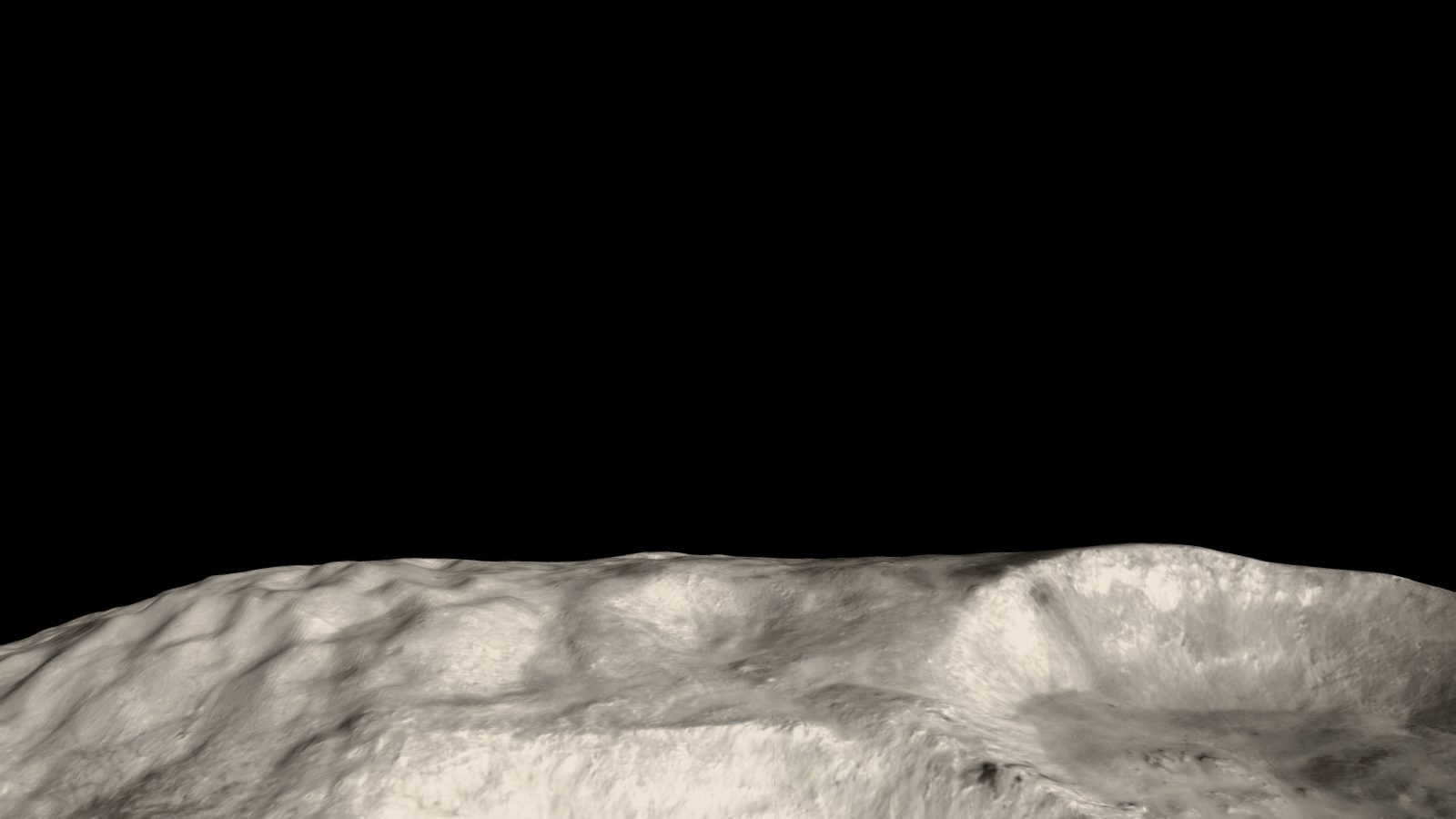
Vesta's craters are named after the Vestal Virgins, the priestesses of the goddess Vesta in ancient Rome, and after famous Roman women.
Dawn saw that some areas are bright and some very dark. The bright material is Vesta's own crust; the dark material appears to have been delivered by impacts of carbon rich asteroids. Dawn also found pitted terrain inside some craters, suggesting gases escaped from heated rock, perhaps from small amounts of water bearing minerals.
Pieces of Vesta on Earth
A group of meteorites called the HEDs, short for howardites, eucrites and diogenites, has long been linked to Vesta because their light matches the light reflected by its surface. They are volcanic and mantle rocks that formed in a melted, layered body.
Dawn confirmed the link: the minerals it measured on Vesta's surface, and the depth of the Rheasilvia impact, matched these meteorites. That makes Vesta one of a very small number of worlds for which we have samples in the laboratory, alongside the Moon and Mars.
These meteorites have been dated with precise radioactive clocks, so they show exactly how early Vesta formed and cooled, within the first few million years of the solar system.
Discovery and naming
Vesta was discovered on 29 March 1807 by the German astronomer Heinrich Olbers. It was the fourth asteroid found, after Ceres, Pallas and Juno.
The mathematician Carl Friedrich Gauss, who had worked out how to calculate the orbits of these new bodies, chose the name, after the Roman goddess of the hearth and home.
For decades these first asteroids were counted among the planets, until so many more were found that astronomers created a separate category for them in the mid nineteenth century.
Seeing it from Earth
Vesta is the brightest asteroid in our sky. Around its best appearances it can reach magnitude 5 to 6, making it the only asteroid that is sometimes visible to the naked eye from a very dark site.
With binoculars it is much easier: it looks like a star, but if you note its position against the background stars over a few nights, you can see it move.
Its brightness depends on how close it comes to Earth, which varies from one opposition to the next, roughly every 17 months.
Open questions
How did Vesta survive intact when most other protoplanets were destroyed or swept up into the planets?
Where exactly did the dark, carbon rich material on its surface come from, and how much water was ever on Vesta?
No new mission to Vesta is currently planned, so further work will rely on Dawn's data, meteorites and telescopes.
Missions
Vesta has been visited by one spacecraft.
- 2011Dawn NASA
Orbited Vesta from July 2011 to September 2012, mapping the whole world and measuring its gravity and composition. It was the first spacecraft to orbit an object in the main asteroid belt, then used its ion engines to travel on to Ceres. Fly to Rheasilvia
Fly there yourself
Every place on this page is real terrain in Starfall's 3D explorer. Pick one and the camera flies you there, with narration when you arrive.
Rheasilvia · central peakA basin 500 km wide with a 22 km central peak.The Snowman · Marcia craterThree craters stacked like a snowman.Divalia FossaeGiant troughs cracked open by the Rheasilvia impact.All places on Vesta
Sources
- NASA Science: 4 Vesta
- NASA: Dawn mission
- JPL Small Body Database: 4 Vesta
- Russell et al. 2012, Dawn at Vesta: testing the protoplanetary paradigm (Science)
- Schenk et al. 2012, The geologically recent giant impact basins at Vesta's south pole (Science)
- McSween et al. 2013, Dawn, the Vesta HED connection, and the geologic context for eucrites, diogenites and howardites (Meteoritics and Planetary Science)
Facts were checked against these sources by a separate review before publishing. Spotted something out of date? Space moves fast, and this page is updated as missions report back.