Quick facts
- Diameter
- about 940 km7% of Earth, a little narrower than France
- Mass
- 9.38 × 10²⁰ kgabout a quarter to a third of the whole asteroid belt
- Surface gravity
- 0.28 m/s²about 3% of Earth
- Average distance from the Sun
- 414 million km2.77 times Earth's distance
- Year
- 4.6 Earth yearsabout 4 years 7 months
- Day
- 9 hours 4 minutesa little over a third of an Earth day
- Axial tilt
- about 4°so some polar craters never see the Sun
- Surface temperature
- below about −40 °C even at noonfar colder in the polar shadows
- Density
- about 2,160 kg/m³a mix of rock and ice
- Discovered
- 1 January 1801the first asteroid ever found
- Official status
- dwarf planet since 2006the only one closer to the Sun than Neptune
- Moons
- 0Earth has 1
At a glance
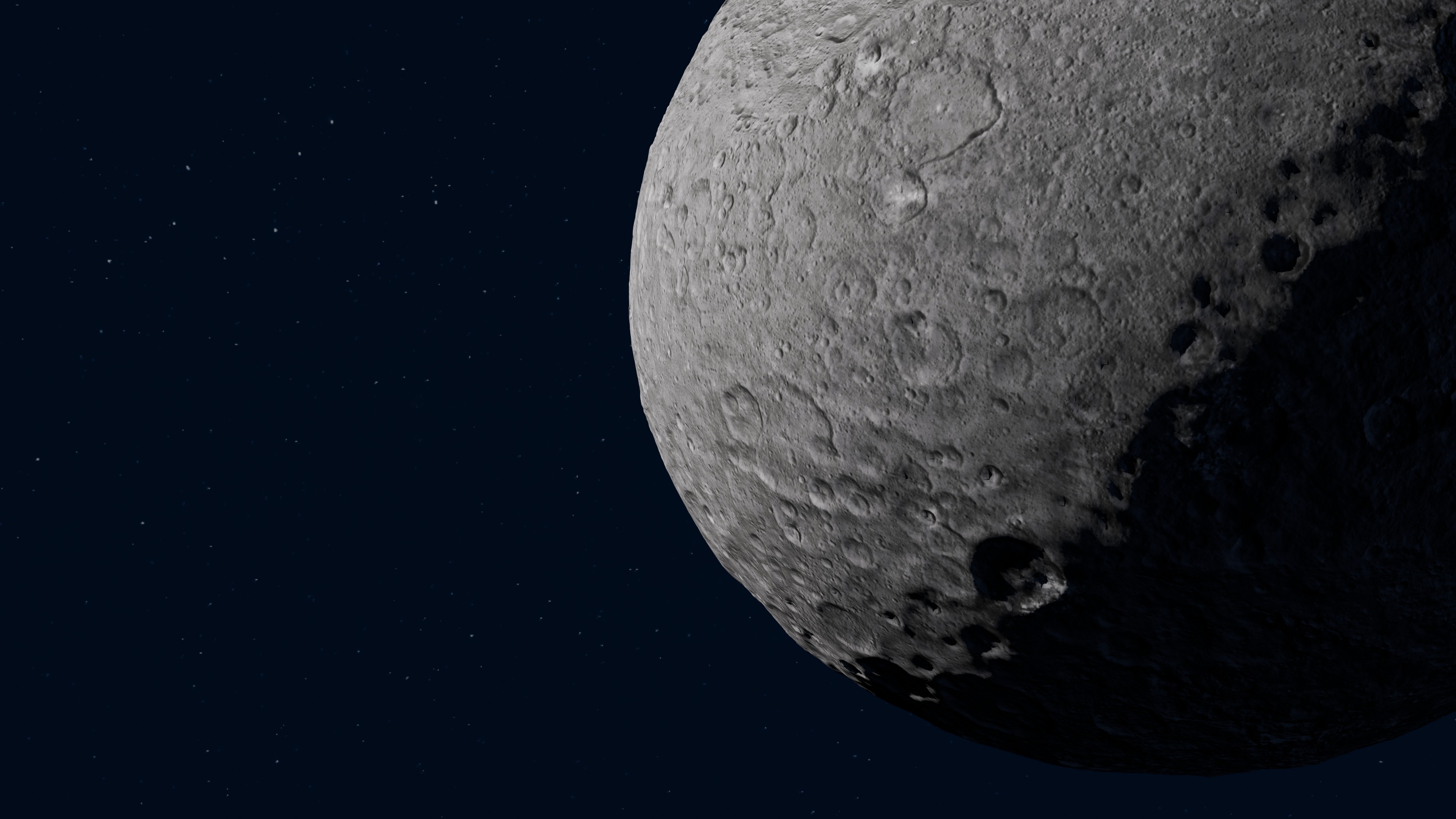
Ceres orbits in the asteroid belt between Mars and Jupiter. At about 940 kilometres across, it is by far the largest object there, and big enough for its own gravity to have pulled it into a nearly round shape. That is why it is classed as a dwarf planet, like Pluto.
It is very different from its rocky neighbour Vesta. Ceres is made of a mix of rock and ice, and its dark surface is covered in clays and salts that formed in water.
When NASA's Dawn spacecraft arrived in 2015, it saw bright spots shining in the dark like headlights. They turned out to be deposits of salt left behind by salty water that rose from inside Ceres, in some places quite recently.
That makes Ceres one of the more interesting places in the solar system for scientists who study where water, and possibly the ingredients for life, can be found.
Orbit, day and seasons
Ceres takes 4.6 years to go round the Sun, at an average distance of about 414 million kilometres, 2.8 times as far as Earth.
It turns once every 9 hours and 4 minutes. Its axis is tilted by only about 4 degrees, so it has almost no seasons, and the floors of some craters near its poles stay in permanent shadow. Dawn found bright ice in some of these cold traps.
It has no known moons, and no spacecraft has ever landed on it.
Inside: rock, ice and brine
Dawn's measurements of Ceres's gravity show it is partly layered. It probably has a dense interior of rock mixed with water rich minerals, under a crust about 40 kilometres thick made of a mixture of ice, salts and hydrated rock.
Ceres once had a global ocean, which has mostly frozen. But the evidence suggests that pockets of salty water, called brine, may still survive deep below the surface, kept from freezing by the salts dissolved in them.
The surface is rich in clay minerals containing ammonia. Ammonia ices are normally found farther from the Sun, so some scientists think Ceres may have formed in the outer solar system and moved inward, or collected material that did.
Occator and the bright spots
The brightest spots on Ceres lie in Occator, a crater about 92 kilometres wide and 4 kilometres deep. Its central bright area, Cerealia Facula, sits in a pit with a small dome in the middle; a scattering of smaller spots to the east is called Vinalia Faculae.
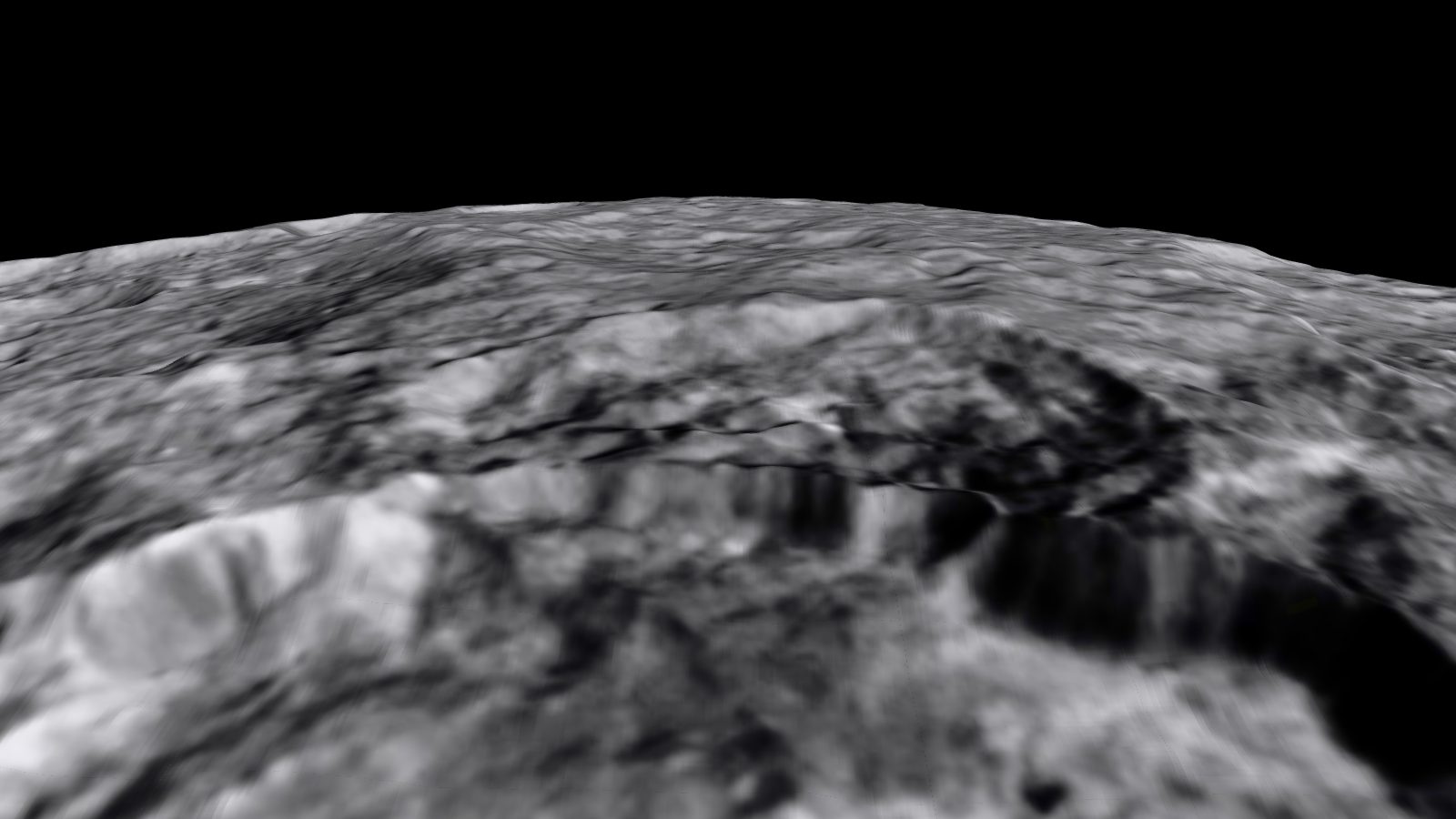
The bright material is mostly sodium carbonate, a salt that on Earth is found around hot springs and dry salt lakes. It was left behind when salty water reached the surface and the water evaporated or froze and escaped to space.
When Dawn flew as low as 35 kilometres above Occator in 2018, it also detected hydrated sodium chloride, a salt that loses its water quickly when exposed. Its presence means brine reached the surface within roughly the last few million years, and perhaps still does today. The source appears to be a reservoir of brine about 40 kilometres down.
Ahuna Mons, an ice volcano
Ahuna Mons is a lonely mountain about 4 kilometres high and 17 kilometres wide, with steep, streaked sides. There is nothing else quite like it on Ceres.
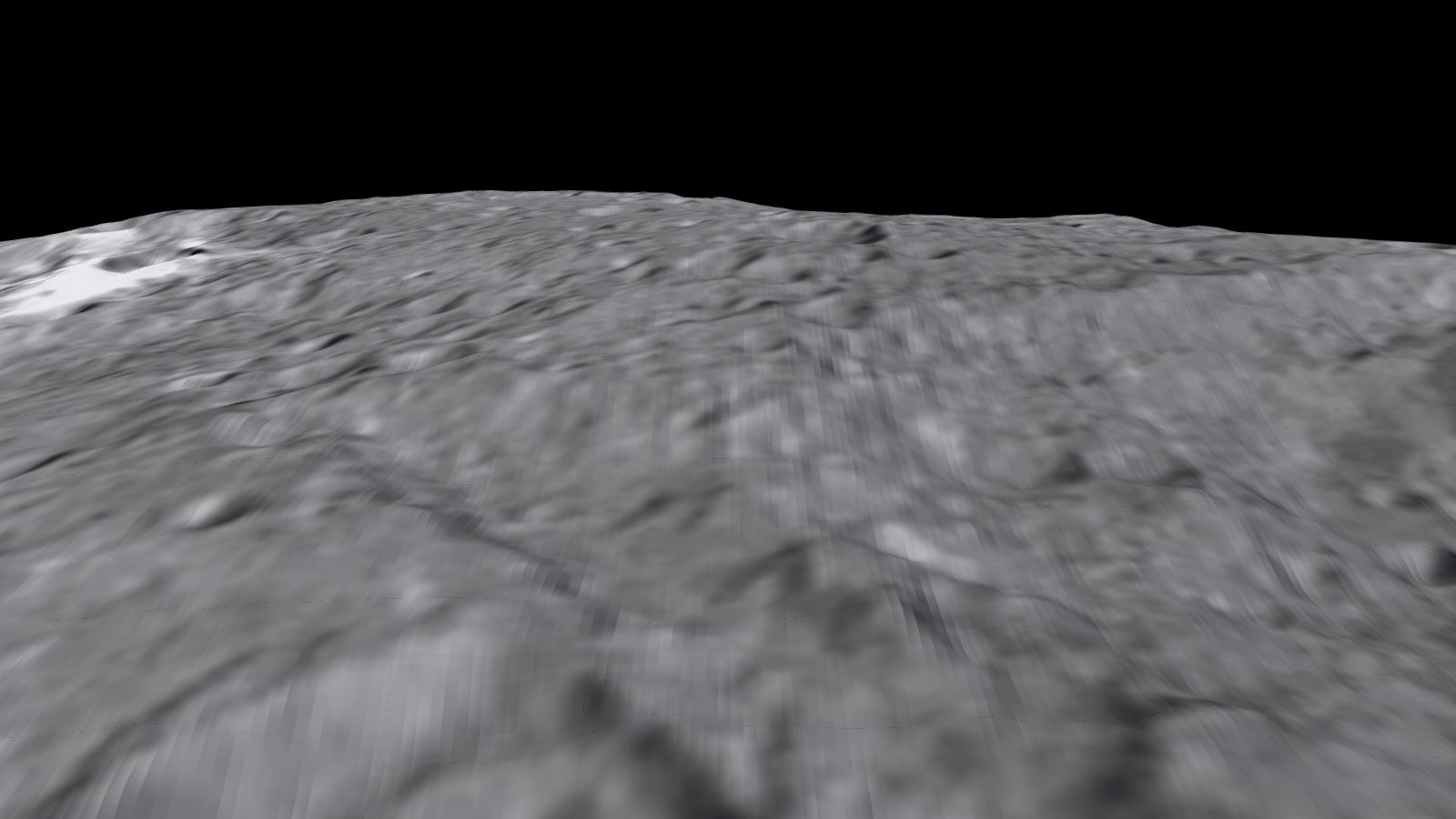
Scientists think it is a cryovolcano, built by a slow eruption of salty mud and ice rather than molten rock. It looks young, with few craters, probably no more than about 200 million years old, and perhaps much younger.
Because ice slowly flows over long times, older cryovolcanoes on Ceres may have slumped flat and disappeared, which could explain why Ahuna Mons stands alone.
Kerwan, Urvara and other craters
The largest crater on Ceres is Kerwan, about 280 kilometres across. It is shallow and softened, as if the ground had relaxed over time, a sign that the crust contains a lot of ice.
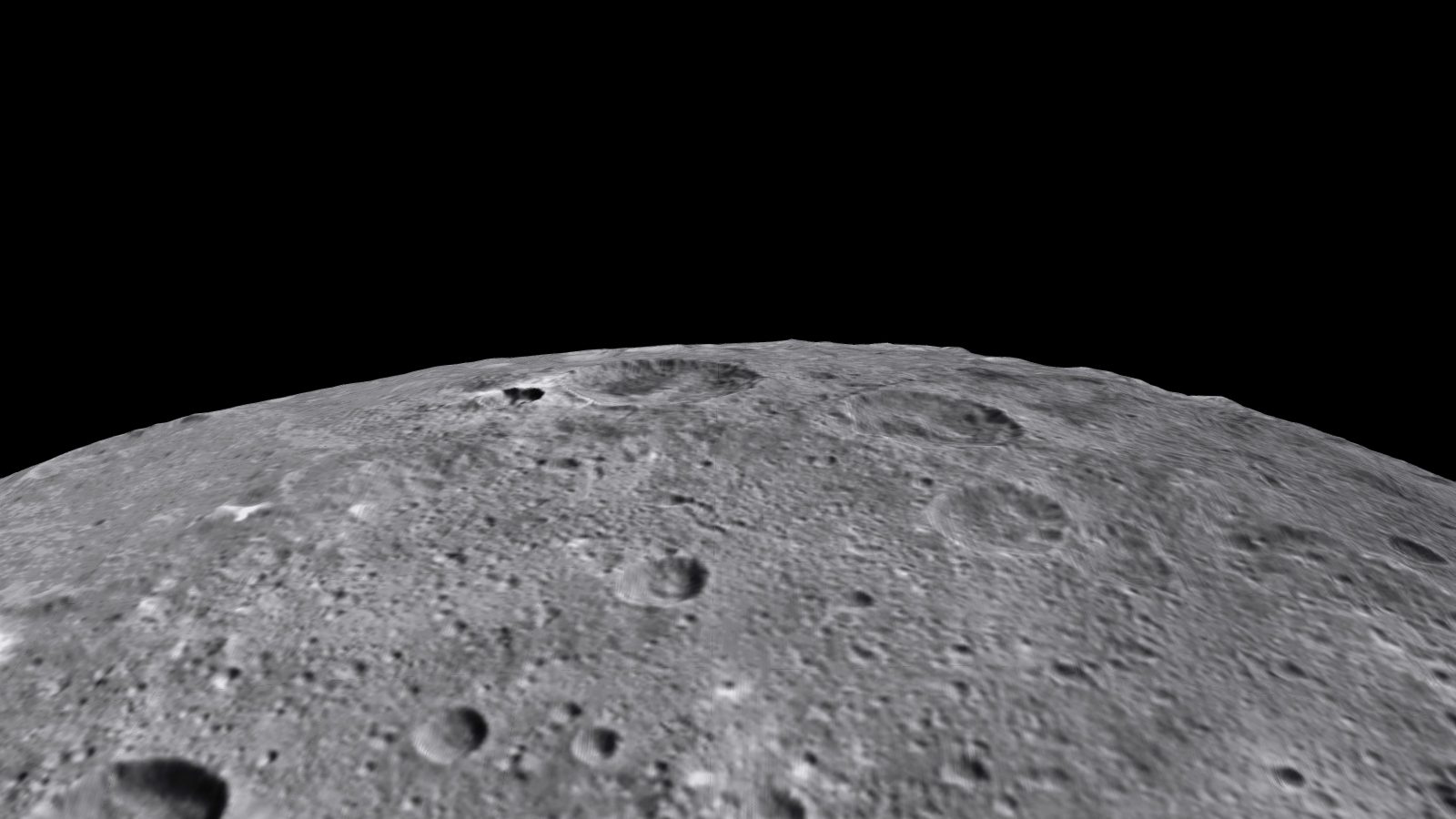
Urvara, about 170 kilometres across, has a sharp central peak and is younger. Nearby craters show landslides and flows that suggest ice mixed in the ground.
Ceres's craters and features are named after gods and goddesses of agriculture and vegetation from cultures around the world, and after agricultural festivals. Kerwan is a Hopi spirit of sprouting maize; Occator was a Roman god of harrowing.
Organic molecules
In 2017 Dawn's scientists reported organic material, complex carbon compounds, near the crater Ernutet. Organic molecules are not life, but they are among the ingredients life needs.
With water, salts, energy from inside and organics, Ceres is considered a possible ocean world, one of several places in the solar system where conditions might once have been suitable for life. There is no evidence that life exists there.
Discovery and naming
Ceres was discovered on 1 January 1801 by the Italian astronomer Giuseppe Piazzi at Palermo in Sicily. It was the first asteroid ever found, and for about half a century it was considered a planet.
Piazzi lost it behind the Sun's glare after a few weeks. The young mathematician Carl Friedrich Gauss developed a new method to calculate its orbit from Piazzi's few observations, and Ceres was found again at the end of 1801 almost exactly where Gauss predicted.
Piazzi named it after Ceres, the Roman goddess of agriculture and patron of Sicily. The word cereal comes from the same name. In 2006 the International Astronomical Union reclassified it as a dwarf planet.
Seeing it from Earth
Ceres is too faint for the naked eye, but at its best it reaches about magnitude 7, so it is an easy target with binoculars when you know where to look.
It looks exactly like a star. Mark its position against the surrounding stars and check again a night or two later to see it move.
Its best appearances, at opposition, come about every 15 months.
Open questions
How much liquid water still exists inside Ceres, and is any of it reaching the surface today?
Did Ceres form in the asteroid belt or farther out in the solar system?
Could its brine ever have been habitable? Scientists have proposed missions to land on Ceres and return samples from Occator, but none is currently funded.
Missions
Ceres has been visited by one spacecraft.
- 2015Dawn NASA
After leaving Vesta, Dawn entered orbit around Ceres in March 2015, becoming the first spacecraft to orbit two different worlds beyond Earth and the Moon. It mapped Ceres until it ran out of fuel in late 2018, and remains in a stable orbit there. Fly to the bright spots
Fly there yourself
Every place on this page is real terrain in Starfall's 3D explorer. Pick one and the camera flies you there, with narration when you arrive.
Occator · bright spotsSalt deposits left by brine from deep below.Ahuna MonsA lonely mountain that may be an ice volcano.Kerwan craterThe largest crater, softened by ice in the ground.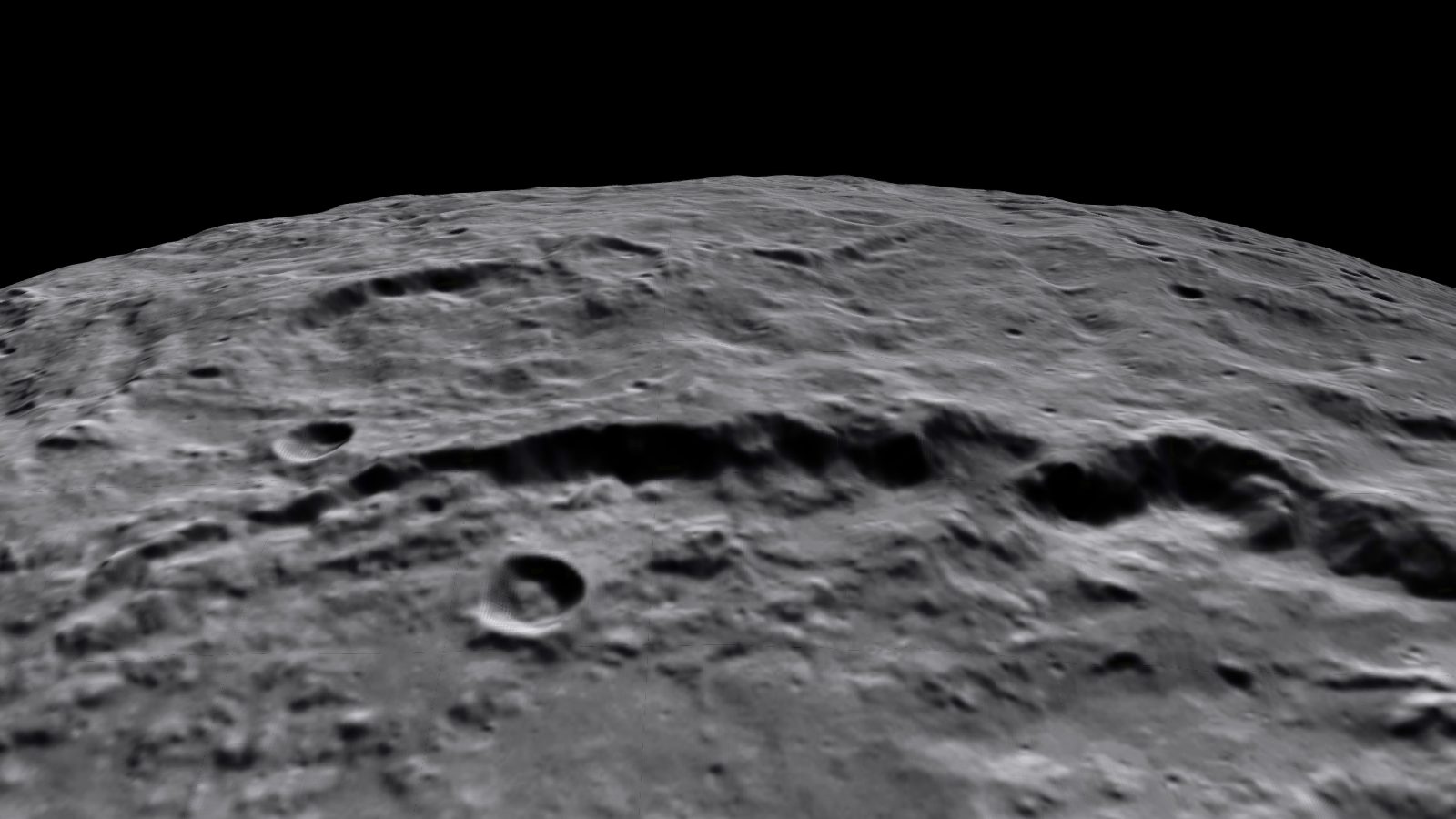 Urvara craterA younger crater with a sharp central peak.
All places on Ceres
Sources
- NASA Science: Ceres
- NASA: Dawn mission
- JPL Small Body Database: 1 Ceres
- De Sanctis et al. 2016, Bright carbonate deposits as evidence of aqueous alteration on Ceres (Nature)
- Ruesch et al. 2016, Cryovolcanism on Ceres (Science)
- De Sanctis et al. 2020, Fresh emplacement of hydrated sodium chloride on Ceres from ascending salty fluids (Nature Astronomy)
- De Sanctis et al. 2017, Localized aliphatic organic material on the surface of Ceres (Science)
Facts were checked against these sources by a separate review before publishing. Spotted something out of date? Space moves fast, and this page is updated as missions report back.