Quick facts
- Width
- 6,779 kmabout half of Earth
- Surface gravity
- 3.73 m/s²38% of Earth
- Length of a day (a sol)
- 24 h 39 min40 minutes longer
- Length of a year
- 687 Earth days1.88 Earth years
- Distance from the Sun
- 207 to 249 million kmabout 1.5 times farther
- Distance from Earth
- 55 to 401 million km3 to 22 light minutes
- Axial tilt
- 25.2°Earth: 23.4°
- Average temperature
- about −60 °CEarth: about 15 °C
- Air pressure at the surface
- about 6 millibarsless than 1% of Earth
- Air
- 95% carbon dioxideEarth: 0.04%
- Moons
- 2, Phobos and DeimosEarth: 1
- Escape velocity
- 5.0 km/s45% of Earth
Mars at a glance
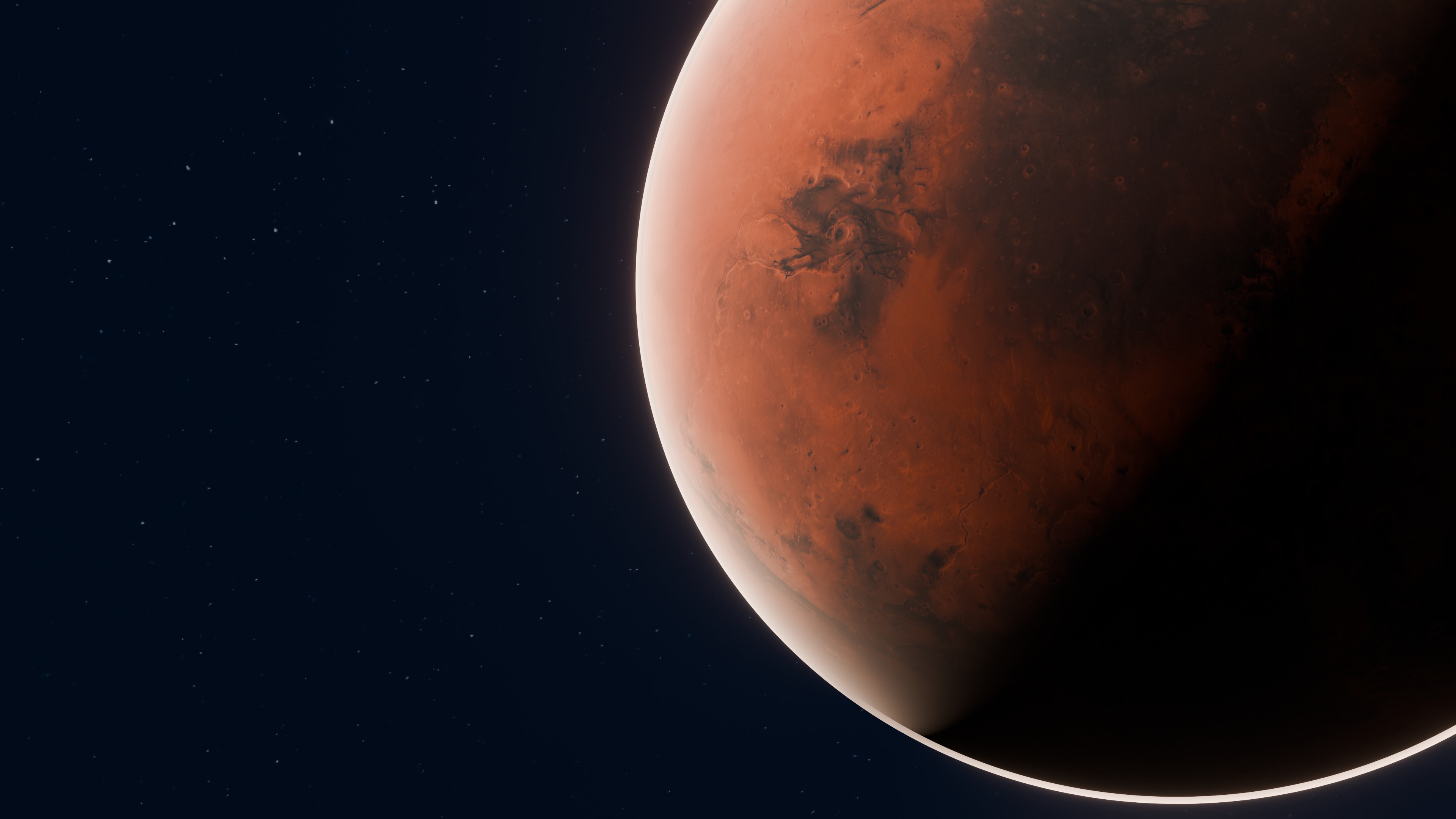
Mars is the fourth planet from the Sun and the outermost of the four rocky worlds. It is about half as wide as Earth and has about a tenth of its mass, so if you stood on it you would weigh a little over a third of what you weigh at home.
Its red colour comes from iron oxide, the same chemistry as rust, in a fine dust that coats almost everything and hangs in the air. Under that dust is a world of dark volcanic rock, bright polar ice and some of the largest landforms known anywhere.
The Romans named it after their god of war, probably because of that blood red glow in the night sky. Its two small moons, Phobos and Deimos, are named after the Greek words for fear and dread.
Days, years and seasons
A day on Mars, called a sol, lasts 24 hours and 39 minutes, so a person living there would only need to shift their clock by about forty minutes. Mission teams on Earth do exactly that, and the drift is why rover operators sometimes end up working through the night.
A Martian year lasts 687 Earth days, or about 669 sols. Mars is tilted on its axis by about 25 degrees, close to Earth's 23.4, so it has real seasons, each roughly twice as long as ours.
Its orbit is also noticeably stretched. At its closest, Mars is about 207 million kilometres from the Sun, and at its farthest about 249 million. That difference makes southern summers shorter and hotter than northern ones, and it is one reason the great dust storms tend to start in southern spring and summer.
Inside Mars
Like Earth, Mars has a crust, a rocky mantle and an iron rich core. What we know about the inside comes mostly from NASA's InSight lander, which set a seismometer on the ground in 2018 and listened to the planet for four years. It recorded more than 1,300 marsquakes, including one of magnitude 4.7 in May 2022, the largest ever measured on another planet.
The way quake waves bent and bounced showed that the core is mostly liquid and surprisingly large, roughly half the width of the planet. Later studies suggested a layer of molten rock wraps around it, which would make the metal core a little smaller than first thought, and a 2025 study found signs of a solid inner core at the very centre, with a radius of about 600 kilometres.
Mars has no global magnetic field today. Orbiters found strips of strongly magnetised rock in the ancient southern crust, a fossil of a field that switched off around four billion years ago. Without that shield, the solar wind has been able to strip the upper atmosphere away, a process NASA's MAVEN orbiter was sent to measure.
The surface
Mars is lopsided. Most of the northern hemisphere is smooth, low plains, while the south is high, ancient and covered in craters. Scientists still argue over why, with a giant early impact and differences in how the interior moved both on the table.
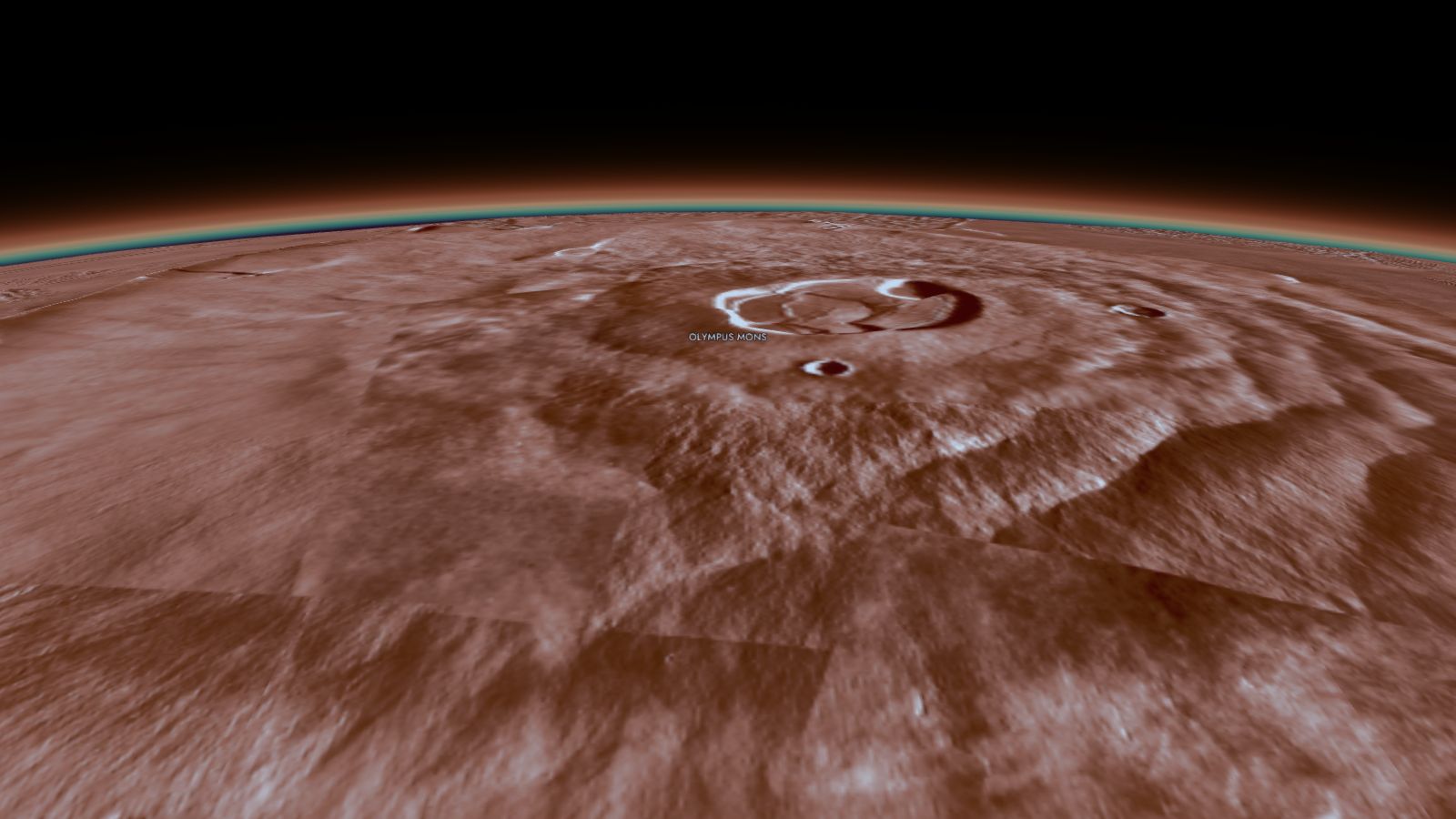
Straddling the boundary is the Tharsis bulge, a volcanic plateau thousands of kilometres across. On its edge stands Olympus Mons, the tallest volcano in the solar system, rising about 22 kilometres above the average surface level and spreading about 600 kilometres wide. Its slopes are so gentle that if you stood on them, most of it would be hidden beyond the horizon. Gravity is weak and there are no moving tectonic plates on Mars, so lava kept piling up over the same hot spot for a very long time.
East of Tharsis, Valles Marineris cuts across the planet for more than 4,000 kilometres, about the width of the United States, and reaches up to 7 kilometres deep. It is not a river canyon. The crust cracked apart as Tharsis swelled, and landslides and erosion widened the cracks afterwards.
In the south lies Hellas, an impact basin about 2,300 kilometres across and more than 7 kilometres deep. Its floor is the lowest ground on Mars, where the air is thick enough that liquid water could briefly exist before boiling or freezing.
At each pole sits a cap of ice, the northern one roughly a thousand kilometres across. Both caps are mostly water ice. Every winter so much carbon dioxide freezes out of the air onto the dark pole that the planet's air pressure drops noticeably, and in spring it turns back into gas.
Air and weather
The Martian air is about 95% carbon dioxide, with a little nitrogen and argon. It is very thin: the pressure at the surface averages around 6 millibars, less than 1% of Earth's. An unprotected person would lose consciousness within seconds, and water left in an open cup would quickly boil away or freeze.
Because the air is so thin, it holds very little heat. At the Viking 1 landing site temperatures swung from about −89 °C before dawn to about −31 °C in the afternoon. A summer afternoon near the equator can climb a little above freezing at ground level while the air at head height stays well below it.
Dust is the main weather. Dust devils, some several kilometres tall, wander across the plains and leave dark tracks. Regional storms are common, and every few Mars years a storm can grow to wrap the whole planet. One in 2018 blocked so much sunlight that the solar powered Opportunity rover never woke up again.
There are clouds of water ice and even of carbon dioxide ice, morning fog in canyons, and frost. In 2008 the Phoenix lander watched snow falling from clouds at night, though it turned back into vapour before reaching the ground.
Sunsets on Mars are blue. The fine dust scatters blue light forward, close to the direction of the Sun, so the sky around the setting Sun glows blue while the rest of the sky stays a dusty butterscotch.
Water, then and now
Mars today is a frozen desert, but the ground remembers water. Orbiters have mapped branching river valleys, dried lake beds, fan shaped deltas and minerals such as clays that only form in water. Most of that activity dates back more than three billion years.
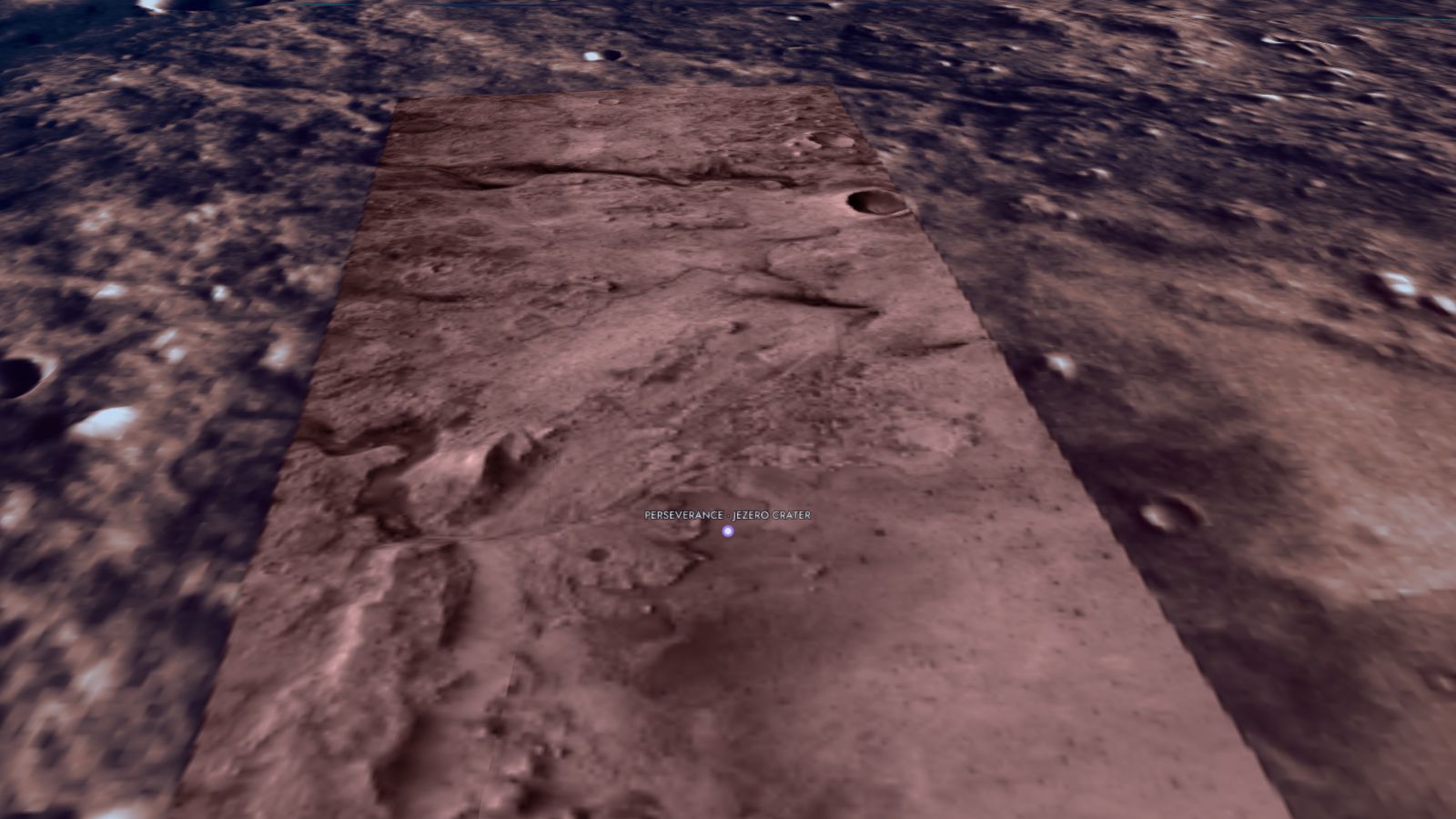
Rovers have walked through that history. Curiosity found that Gale crater once held a long lasting lake with water calm enough and chemistry gentle enough that microbes, had any existed, could have lived in it. Perseverance landed in Jezero crater beside an ancient river delta, chosen because deltas on Earth are good at burying and preserving signs of life.
Plenty of water is still there, locked up as ice. Both polar caps hold large amounts, and ice lies just under the surface across much of the mid and high latitudes. Phoenix scraped into it in 2008 and watched the exposed ice slowly vanish into the air over a few days.
Whether any liquid water remains is less certain. Radar from ESA's Mars Express hinted at salty water under the south polar ice, and a 2024 study of InSight's quake data suggested water may soak rock deep in the crust, roughly 10 to 20 kilometres down. Both ideas are still debated.
As for where most of the ancient water went, part of it is frozen, part is bound into minerals, and part escaped to space as the young planet lost its magnetic field and much of its air.
The search for life
No one has found life on Mars. What missions have found is that Mars once had the ingredients: liquid water, energy sources and the chemical building blocks used by life, including organic molecules preserved in rocks at Gale crater.
The first direct test came in 1976, when the two Viking landers ran experiments on soil samples. One of them gave a result that looked like life at first, but most scientists concluded that unusual soil chemistry explained it. Curiosity later measured traces of methane that rise and fall with the seasons, a gas that on Earth is largely made by living things, though geology can also produce it. Orbiters looking from above have not been able to confirm it, and the puzzle is still open.
In 2024 Perseverance found a rock nicknamed Cheyava Falls in an old river valley at Jezero, speckled with small light spots ringed by dark material. In 2025 NASA described the sample it drilled there as a potential biosignature: a pattern that living things can create, but which can also form without life. Settling it needs laboratories on Earth.
That is why Perseverance has been sealing rock cores in tubes and leaving some on the ground. Bringing them home proved so expensive and difficult that NASA's Mars Sample Return program was left without funding in 2026, and for now there is no firm plan to fetch the tubes.
Phobos and Deimos
Mars has two small, dark, potato shaped moons, both discovered by the American astronomer Asaph Hall in 1877. They may be captured asteroids, or they may have formed from debris thrown up by a giant impact on Mars. Japan's MMX mission, due to launch in October 2026, is designed to collect a sample from Phobos and bring it back to Earth around 2031, which should help settle the question.
Phobos, the larger one, is about 26 kilometres long and orbits only about 6,000 kilometres above the surface, closer than any other known moon to its planet. It goes around in 7 hours and 39 minutes, faster than Mars turns, so from the ground it rises in the west and sets in the east, two or three times a day. Mars's gravity is slowly pulling it inward, and in some tens of millions of years it will either crash or break into a ring.
Deimos is smaller, about 15 kilometres long, and orbits much farther out, taking about 30 hours to circle the planet. From the surface it would look like a bright star rather than a moon.
Seeing Mars from Earth
Earth catches up with Mars and passes it about every 26 months. Around that time, called opposition, Mars is opposite the Sun in our sky, rises at sunset, is up all night and shines brighter than almost any star. Launch windows come around every 26 months too, a few months before opposition, when the trip takes the least fuel.
Because Mars's orbit is stretched, some oppositions are much closer than others. In August 2003 Mars came within about 56 million kilometres, its closest approach in nearly 60,000 years. Through a small telescope at opposition you can see the polar caps and the darker regions on the surface.
Even at its closest, a radio signal takes about three minutes to cross the gap, and up to twenty two minutes at its farthest. That delay is why rovers cannot be driven with a joystick from Earth. Teams plan each day's moves in advance and the rover carries them out on its own.
Open questions
Did life ever begin on Mars, and if it did, does any of it survive deep underground where it is warmer and wetter?
How warm and wet was early Mars really? The rocks clearly show rivers and lakes, but climate models struggle to keep the young planet warm enough with a faint early Sun.
Why are the northern and southern halves so different, and is any liquid water still hidden under the ice or deep in the crust?
And for people: can astronauts live there safely, with thin air, cold, dust and radiation, and the ice under the surface as their water supply?
Missions
The milestones of Mars exploration, by the year each spacecraft arrived. Many more have tried, and roughly half of all attempts to reach Mars have failed.
- 1965Mariner 4 NASA
First successful flyby. Its photos showed a cratered, Moon like surface and ended hopes of canals and vegetation.
- 1971Mariner 9 NASA
First spacecraft to orbit another planet. It waited out a global dust storm, then mapped Olympus Mons and the canyon later named Valles Marineris after it.
- 1971Mars 3 Soviet Union
First soft landing on Mars. It fell silent after about twenty seconds.
- 1976Viking 1 and 2 NASA
Two orbiters and two landers. The landers sent back the first long running pictures and weather reports from the surface and tested the soil for life. Fly to the landing site
- 1997Mars Pathfinder and Sojourner NASA
Bounced down on airbags and released Sojourner, the first rover on another planet. Fly to the landing site
- 1997Mars Global Surveyor NASA
Measured the height of the whole planet with a laser and discovered the fossil magnetic stripes in the crust.
- 2001Mars Odyssey NASA
Detected hydrogen just under the surface across large areas, a sign of buried ice, and relayed signals for later rovers.
- 2003Mars Express ESA
Europe's first Mars orbiter, mapping the surface in 3D colour and probing under the ice with radar.
- 2004Spirit and Opportunity NASA
Twin rovers built for 90 sols. Spirit worked for six years, and Opportunity for nearly fifteen, driving about 45 kilometres and finding clear evidence of ancient water. Fly to the landing site
- 2006Mars Reconnaissance Orbiter NASA
Its HiRISE camera can see objects about the size of a desk from orbit, and it has photographed nearly every landing site.
- 2008Phoenix NASA
Landed in the far north, dug down to water ice and watched snow fall from the clouds. Fly to the landing site
- 2012Curiosity NASA
A car sized rover lowered by a rocket powered sky crane into Gale crater. It showed the crater once held a habitable lake and is still climbing Mount Sharp. Fly to the landing site
- 2014MAVEN and Mangalyaan NASA and ISRO
MAVEN studied how Mars loses its air to space. India's Mars Orbiter Mission made India the first country to reach Mars orbit on its first attempt.
- 2016ExoMars Trace Gas Orbiter ESA and Roscosmos
Sniffing the atmosphere for methane and other trace gases. Its companion lander, Schiaparelli, crashed.
- 2018InSight NASA
A geophysics lander that recorded marsquakes for four years and measured the core. Fly to the landing site
- 2021Perseverance and Ingenuity NASA
Perseverance is collecting rock samples in Jezero crater. Ingenuity made the first powered, controlled flight on another planet and went on to make 72 flights. Fly to the landing site
- 2021Hope United Arab Emirates
An orbiter that watches Martian weather across the whole planet through the day.
- 2021Tianwen-1 and Zhurong China
China's first independent Mars mission put an orbiter, a lander and the Zhurong rover in place on a single launch. Fly to the landing site
Fly there yourself
Every place on this page is real terrain in Starfall's 3D explorer. Pick one and the camera flies you there, with narration when you arrive.
Olympus MonsThe tallest volcano in the solar system.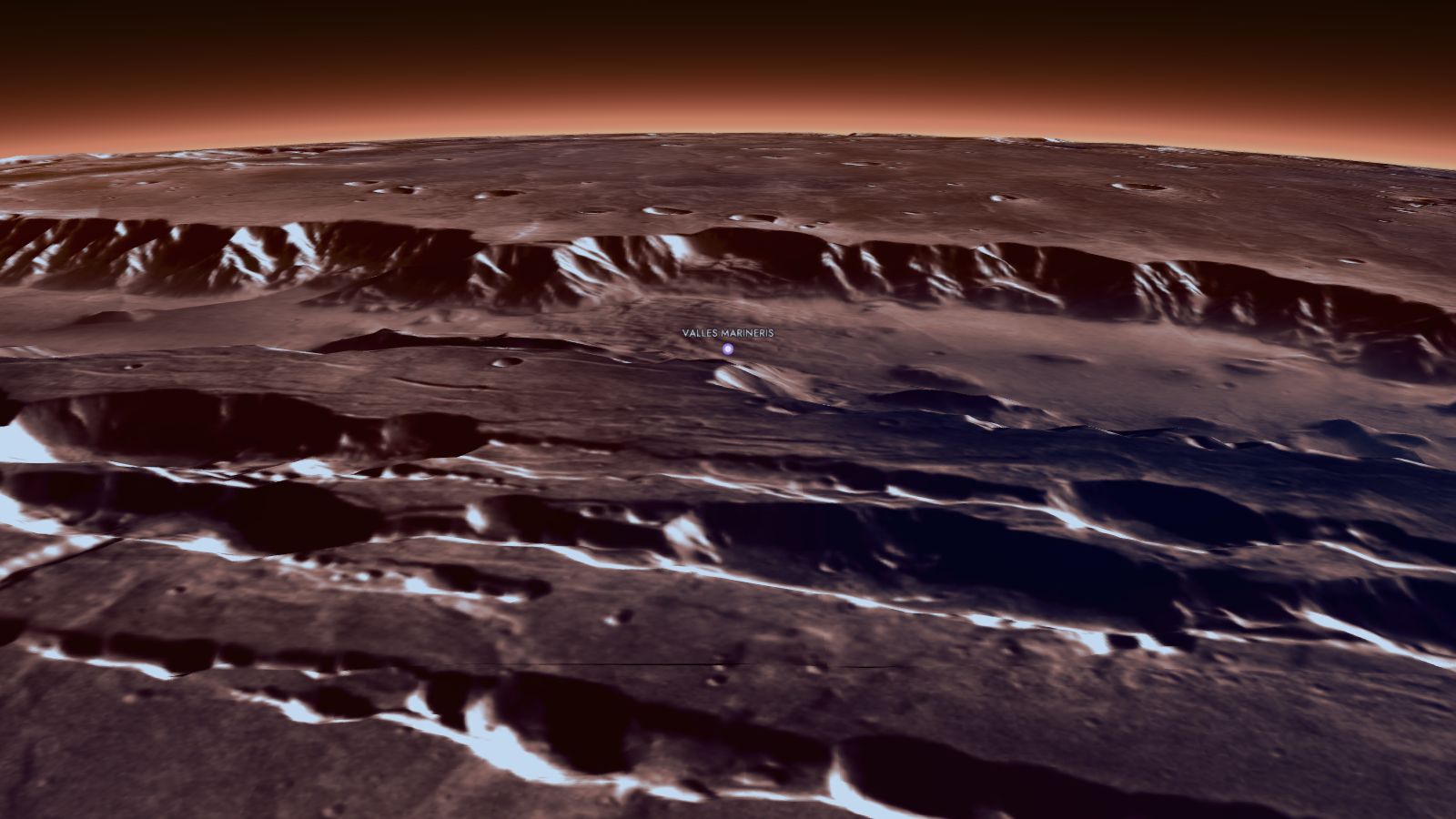 Valles MarinerisA canyon system as long as the United States is wide.Perseverance · Jezero craterAn ancient lake and river delta, home of Perseverance.
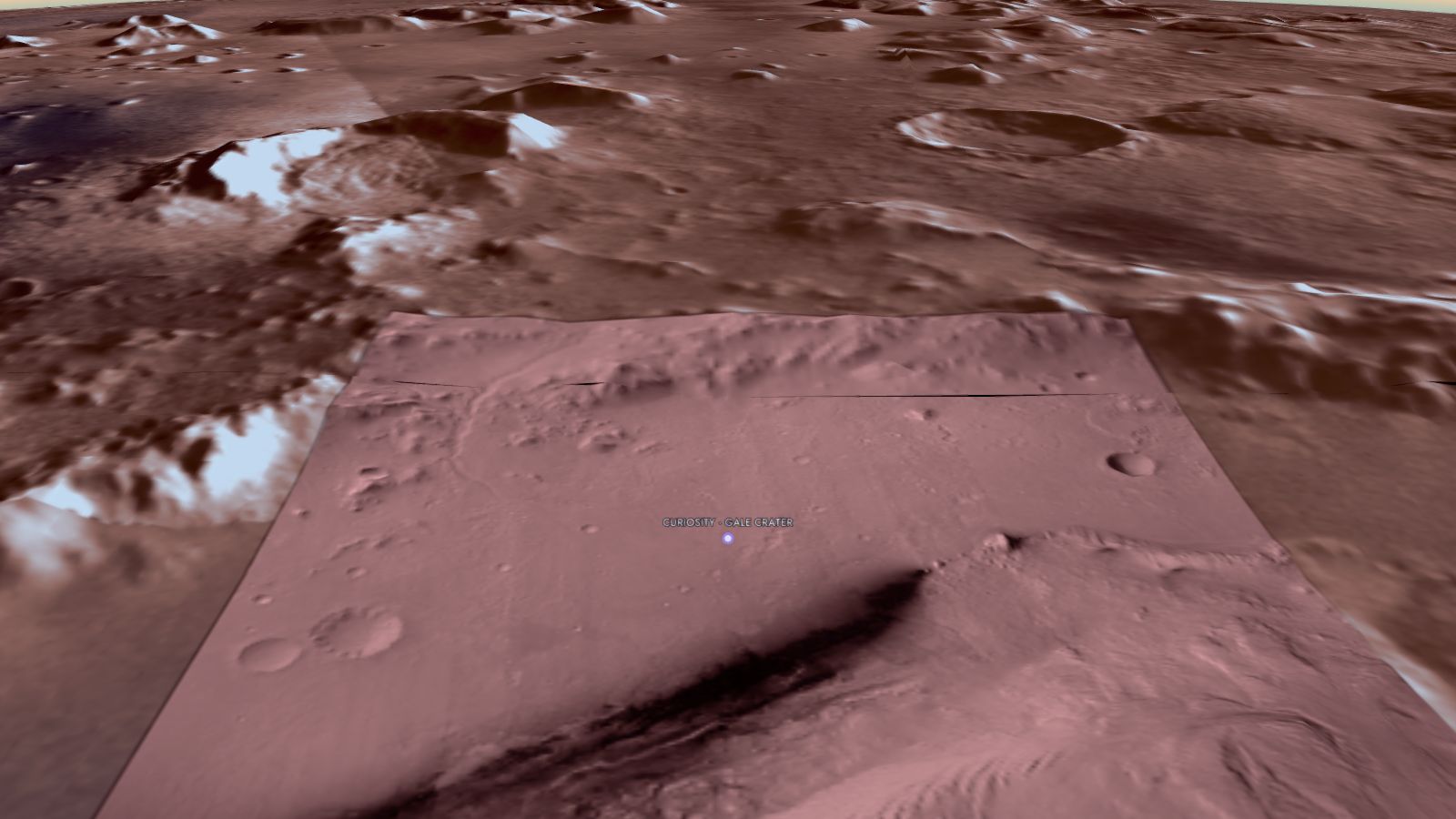 Curiosity · Gale craterCuriosity's crater and the layered Mount Sharp.
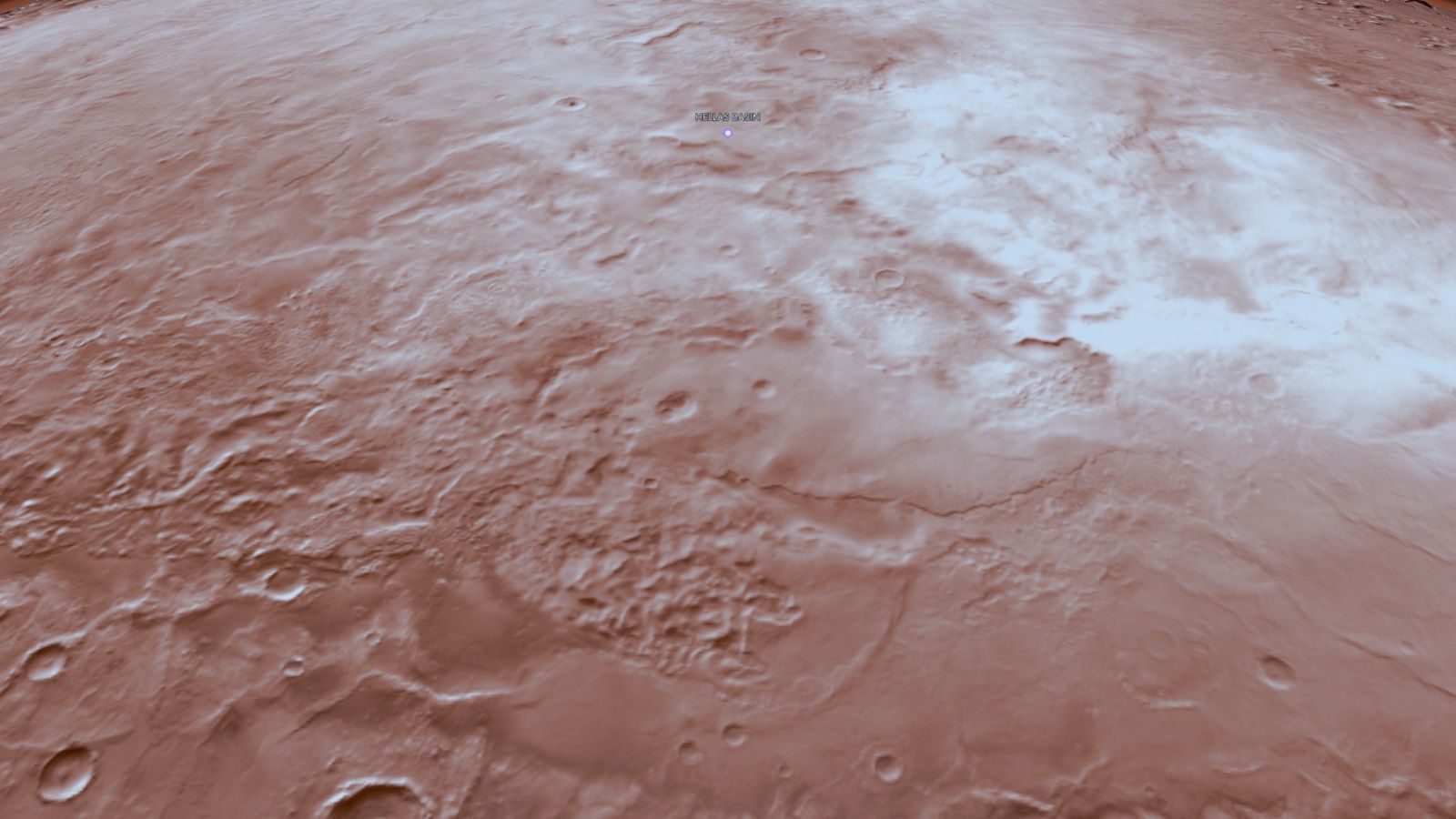 Hellas basinThe deepest and largest well preserved impact basin on Mars.
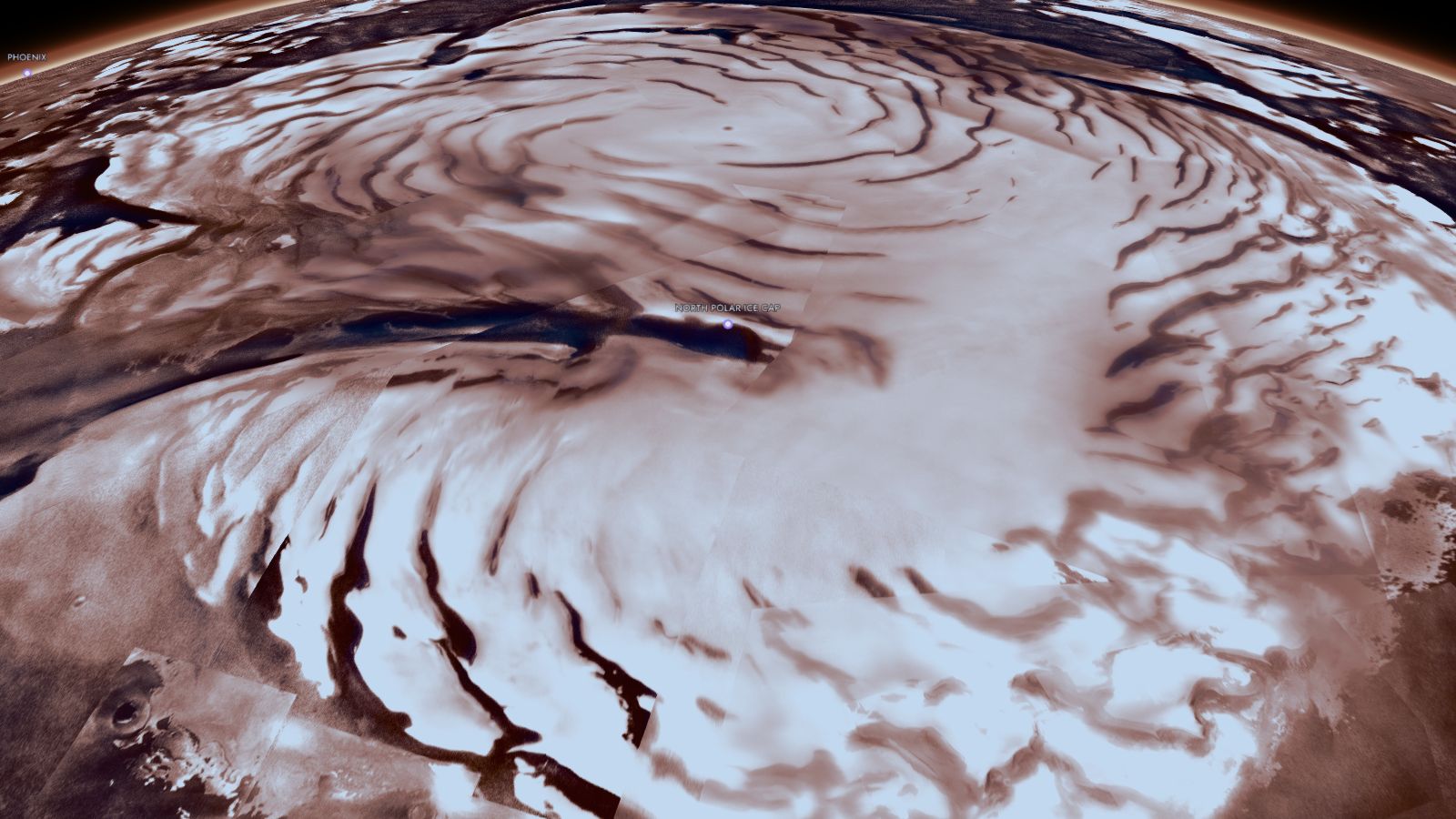 North polar ice capLayers of water ice built up over millions of years.
All places on Mars
Sources
- NASA Mars Fact Sheet (NSSDC)
- NASA Science: Mars
- NASA Science: Mars missions
- NASA: InSight mission
- NASA: Perseverance and the Cheyava Falls sample
- ESA: Mars Express
- JAXA: Martian Moons eXploration (MMX)
Facts were checked against these sources by a separate review before publishing. Spotted something out of date? Space moves fast, and this page is updated as missions report back.