Quick facts
- Diameter
- 4,879 km38% of Earth, a little wider than our Moon
- Mass
- 3.30 × 10²³ kg5.5% of Earth
- Surface gravity
- 3.7 m/s²38% of Earth, about the same as Mars
- Average distance from the Sun
- 57.9 million km0.39 times Earth's distance
- Year
- 88 Earth daysabout four Mercury years to one of ours
- Spin (one turn)
- 58.6 Earth daysthree turns for every two orbits
- Sunrise to sunrise
- 176 Earth daysone solar day lasts two Mercury years
- Surface temperature
- −180 °C to 430 °Cthe widest swing of any planet
- Density
- 5,429 kg/m³second only to Earth
- Axial tilt
- 0.03°Earth's is 23.4°, so Mercury has no seasons from tilt
- Magnetic field
- about 1% of Earth'sweak, but generated inside like ours
- Moons
- 0Earth has 1
At a glance
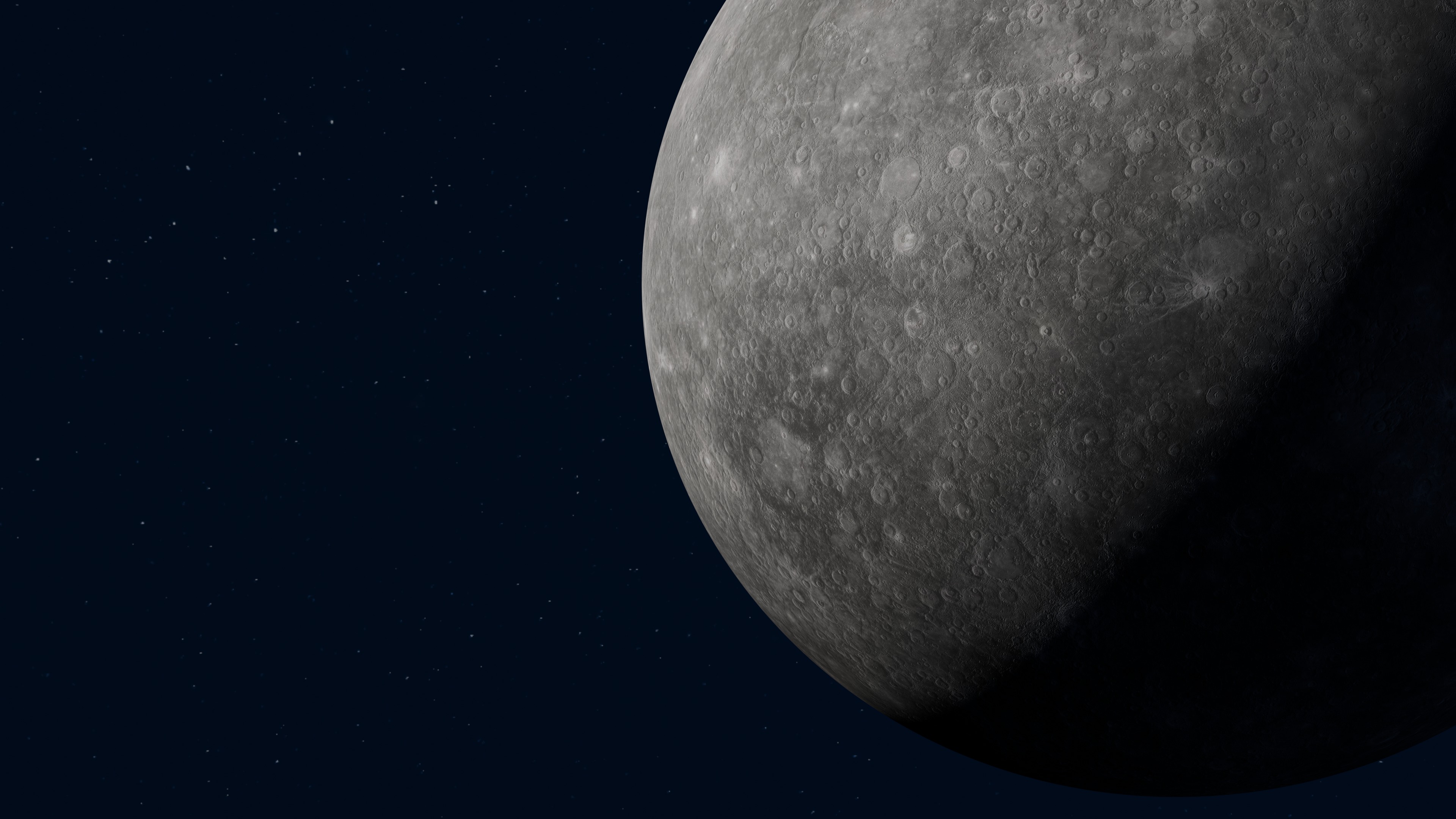
Mercury is the innermost planet and the smallest of the eight. It is only a little wider than our Moon, and two of the solar system's moons, Ganymede at Jupiter and Titan at Saturn, are larger. If you stood on it you would weigh about the same as on Mars, a little over a third of your weight at home.
From a distance it looks like the Moon: grey, airless and covered in craters. Underneath, it is very different. Mercury is mostly metal. Its iron core takes up about 85% of its radius, a far larger share than in any other rocky planet, which makes this small world almost as dense as Earth.
Because there is no real atmosphere to hold heat or carry it around, the ground swings from about 430 °C in sunlight to about −180 °C at night. Yet in the floors of craters near the poles, where sunlight never reaches, there is water ice that has survived for millions of years.
Mercury is also a planet that has shrunk. As its core slowly cooled, the whole world contracted by up to about 7 kilometres in radius, and the crust cracked into long cliffs that run for hundreds of kilometres across the surface.
Orbit, day and the strange sunrise
Mercury races around the Sun once every 88 days, faster than any other planet, at an average of about 47 kilometres per second. Its orbit is the most stretched of all the planets: it comes as close as 46 million kilometres to the Sun and swings out to nearly 70 million kilometres.
It spins slowly, once every 58.6 days, which is exactly two thirds of its year. Astronomers call this a 3 to 2 resonance: three turns on its axis for every two trips around the Sun. The Sun's pull locked it into this rhythm long ago.
Put the spin and the orbit together and one full day, from one sunrise to the next, lasts 176 Earth days, twice as long as the year. At some places on Mercury the Sun would rise, stop, go briefly backwards and then carry on, because near its closest point to the Sun the planet's orbital speed briefly outpaces its spin.
Mercury has almost no axial tilt, so it has no seasons in the way Earth does. What changes over its year is distance: from the surface the Sun looks about two and a half times wider than it does from Earth, and noticeably larger still at its closest.
The slow drift of Mercury's orbit also gave physics a famous test. Its closest point to the Sun shifts a little each orbit, by slightly more than Newton's gravity predicts. In 1915 Einstein's general relativity explained the extra 43 arcseconds per century exactly, one of the first signs that his theory was right.
Inside: a planet that is mostly core
Mercury's iron core is about 2,000 kilometres in radius, inside a planet only about 2,440 kilometres in radius. Above it there is a thin rocky mantle and crust, together only about 400 kilometres thick.
Measurements of the way Mercury wobbles as it spins, made by NASA's MESSENGER spacecraft and radar from Earth, show that at least the outer part of the core is still liquid. Data published in 2019 suggest it also has a solid inner core, about 2,000 kilometres across, roughly half the width of the whole core.
Why so much metal? Nobody is sure. One idea is that a giant impact early in the solar system's history blasted away much of Mercury's original rocky outer layer. Another is that the material Mercury formed from, so close to the young Sun, was already rich in iron. MESSENGER found the surface surprisingly rich in sulphur and potassium, elements that boil off easily, which is awkward for theories in which Mercury was once extremely hot.
That liquid metal also makes Mercury's magnetic field. It is weak, around 1% as strong as Earth's at the surface, and oddly lopsided, centred hundreds of kilometres north of the planet's middle. It is still strong enough to hold off the solar wind for much of the time and to create a small magnetosphere.
Craters, basins and cliffs
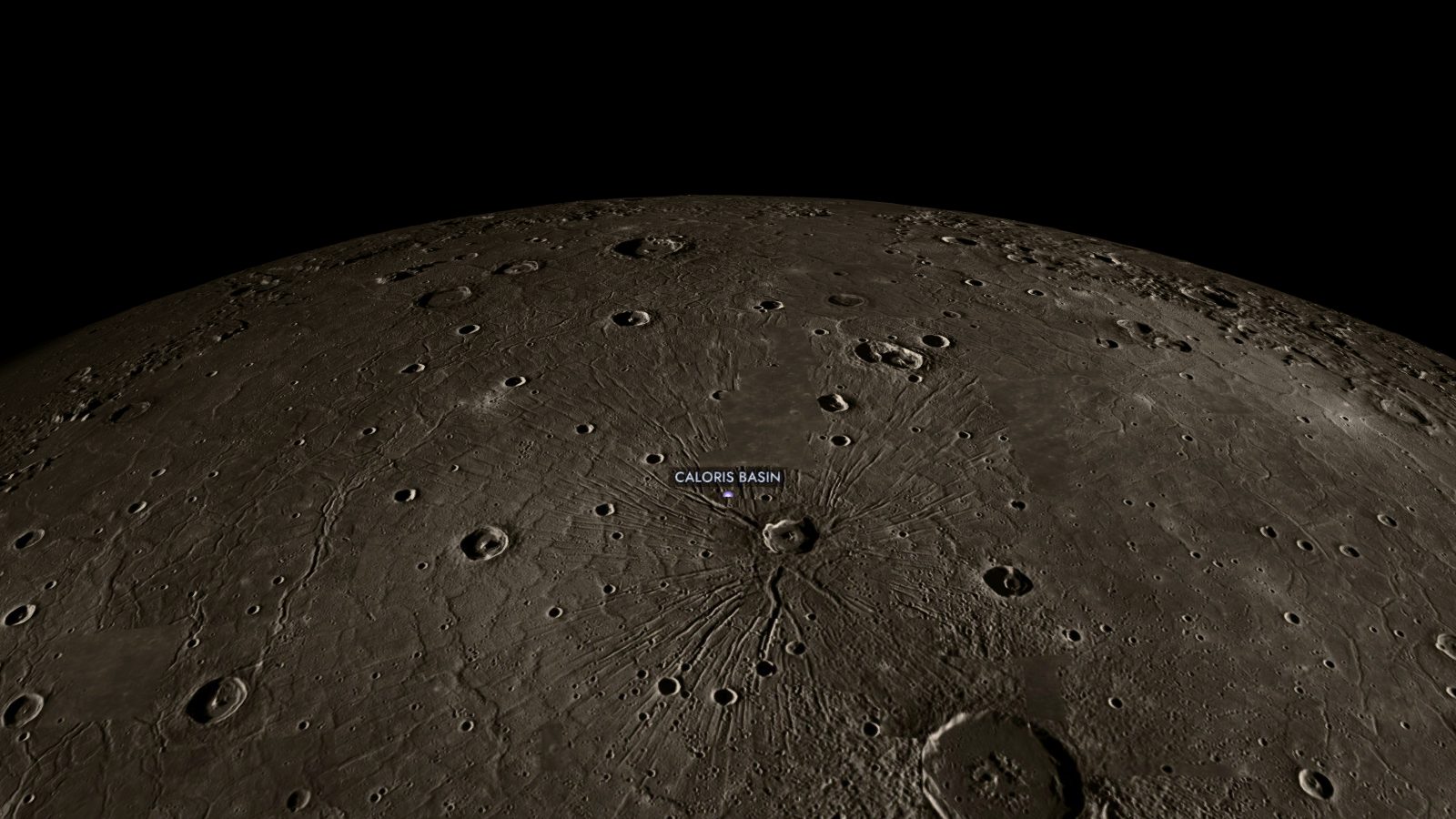
The largest well preserved impact feature on Mercury is the Caloris Basin, about 1,550 kilometres across. It formed about 3.8 to 3.9 billion years ago, and lava later flooded its floor. On the exact opposite side of the planet lies a patch of jumbled, hilly ground that scientists think was shaken apart by shock waves from the impact focusing there.
Younger features stand out more clearly. Rachmaninoff is a double ringed basin about 290 kilometres wide whose floor holds some of the youngest volcanic plains on the planet. Hokusai is a crater about 95 kilometres across with bright rays of ejected material that stretch for thousands of kilometres, a sign that it is recent by Mercury's standards.
Long cliffs called lobate scarps are Mercury's signature. Discovery Rupes runs for about 600 kilometres and rises more than a kilometre and a half high in places. Scarps like this form where the crust has been pushed together and one block has ridden up over another as the planet shrank.
Craters are named after artists, writers and composers. Kuiper is the exception: it honours the planetary scientist Gerard Kuiper, who worked on the Mariner 10 mission and died before it reached Mercury.
MESSENGER also found something new: hollows. These are shallow, bright, irregular pits, often in crater floors, that look fresh. They seem to form when volatile material in the rock is lost to space, which would mean Mercury's surface is still changing today.
Ice on the hottest planet's poles
In 1991 radar signals bounced off Mercury from Earth came back unusually bright from craters near the poles, the kind of reflection that ice gives. MESSENGER confirmed it in 2012: the floors of these craters are permanently shadowed, never lit by the Sun, and stay colder than about −170 °C.
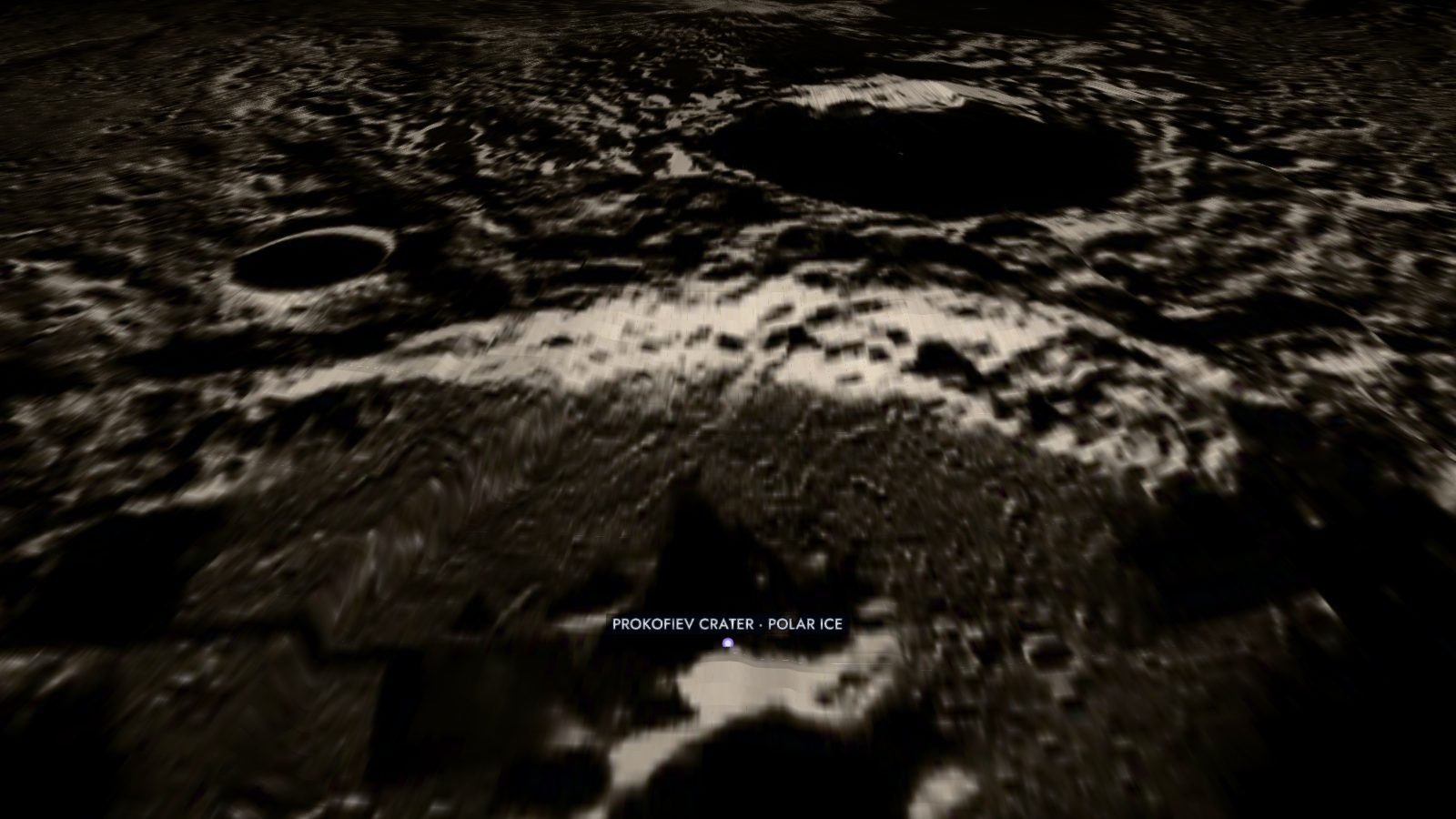
Prokofiev, a crater near the north pole about 110 kilometres wide, is one of the largest of these cold traps. In some craters the ice lies exposed at the surface; in others it is covered by a thin dark layer, possibly organic material, that insulates it.
The total amount is estimated at between about 100 billion and 1 trillion tonnes. It probably arrived with comets and water rich asteroids, and with the planet's almost zero tilt, these crater floors have stayed in shadow for a very long time.
A thin exosphere and a comet like tail
Mercury has no real atmosphere, only an extremely thin exosphere: atoms of hydrogen, helium, oxygen, sodium, potassium and calcium knocked off the surface by sunlight, the solar wind and tiny meteorite impacts. The atoms are so spread out that they rarely collide with each other.
Sunlight pushes sodium atoms away from the planet, forming a faint tail that stretches millions of kilometres behind Mercury. It glows in the yellow light of sodium and can be photographed from Earth with special filters.
Without an atmosphere to spread heat, the night side cools rapidly and the day side bakes. This is why Venus, although nearly twice as far from the Sun, is hotter: its thick atmosphere traps heat, while Mercury lets it all escape.
Discovery and naming
Mercury is visible to the naked eye and has been known since ancient times. Babylonian astronomers recorded it, and early Greek observers at first thought the morning and evening appearances were two different objects.
The Romans named it after Mercury, the swift messenger of the gods, a good match for the fastest moving planet in the sky. Its astronomical symbol is a stylised version of Mercury's winged staff.
For a long time astronomers believed Mercury always kept one face to the Sun, with a day as long as its year. In 1965 radar measurements from the Arecibo Observatory showed that it actually turns once every 59 days, which led to the discovery of its 3 to 2 resonance.
Seeing it from Earth
Mercury never strays far from the Sun in our sky, at most about 28 degrees. You can see it only low in the twilight, in the west soon after sunset or in the east shortly before sunrise, for a few weeks at a time several times a year.
It is bright enough to see without a telescope when you know where to look, but it is easily lost in the glow near the horizon. Never search for it with binoculars or a telescope while the Sun is above the horizon.
Sometimes Mercury passes directly across the face of the Sun as seen from Earth, a transit. There are about 13 or 14 each century. The most recent was on 11 November 2019, and the next will be on 13 November 2032. Watching one needs proper solar filters.
Open questions
Why does Mercury have such an enormous core? Was its rock stripped away by a collision, or did it form that way?
How does such a small planet keep a magnetic field going, and why is it so far off centre?
What makes the hollows, and how fast are they forming today? How much ice is in the polar craters, and where did it come from?
BepiColombo, the joint European and Japanese mission, is due to begin answering these from orbit. Its two orbiters will map the surface, the interior and the magnetic field in more detail than ever before.
Missions
Only three spacecraft have been sent to Mercury, because getting there means losing a huge amount of speed while falling towards the Sun.
- 1974Mariner 10 NASA
The first spacecraft to visit Mercury, with three flybys in 1974 and 1975. It photographed a little under half of the surface and discovered the magnetic field.
- 2008MESSENGER flybys NASA
Three flybys in 2008 and 2009 that revealed most of the hemisphere Mariner 10 never saw.
- 2011MESSENGER orbiter NASA
The first spacecraft to orbit Mercury, from March 2011 to April 2015. It mapped the whole planet, confirmed the polar ice and discovered the hollows, then crashed into the surface when its fuel ran out. Fly to the polar ice
- 2018BepiColombo ESA and JAXA
Launched in October 2018, it made six Mercury flybys between 2021 and 2025. It is due to be captured into orbit on 21 November 2026, then split into two orbiters, Europe's MPO and Japan's Mio, with science operations planned from early 2027.
Fly there yourself
Every place on this page is real terrain in Starfall's 3D explorer. Pick one and the camera flies you there, with narration when you arrive.
Caloris BasinThe largest well preserved basin, about 1,550 km wide.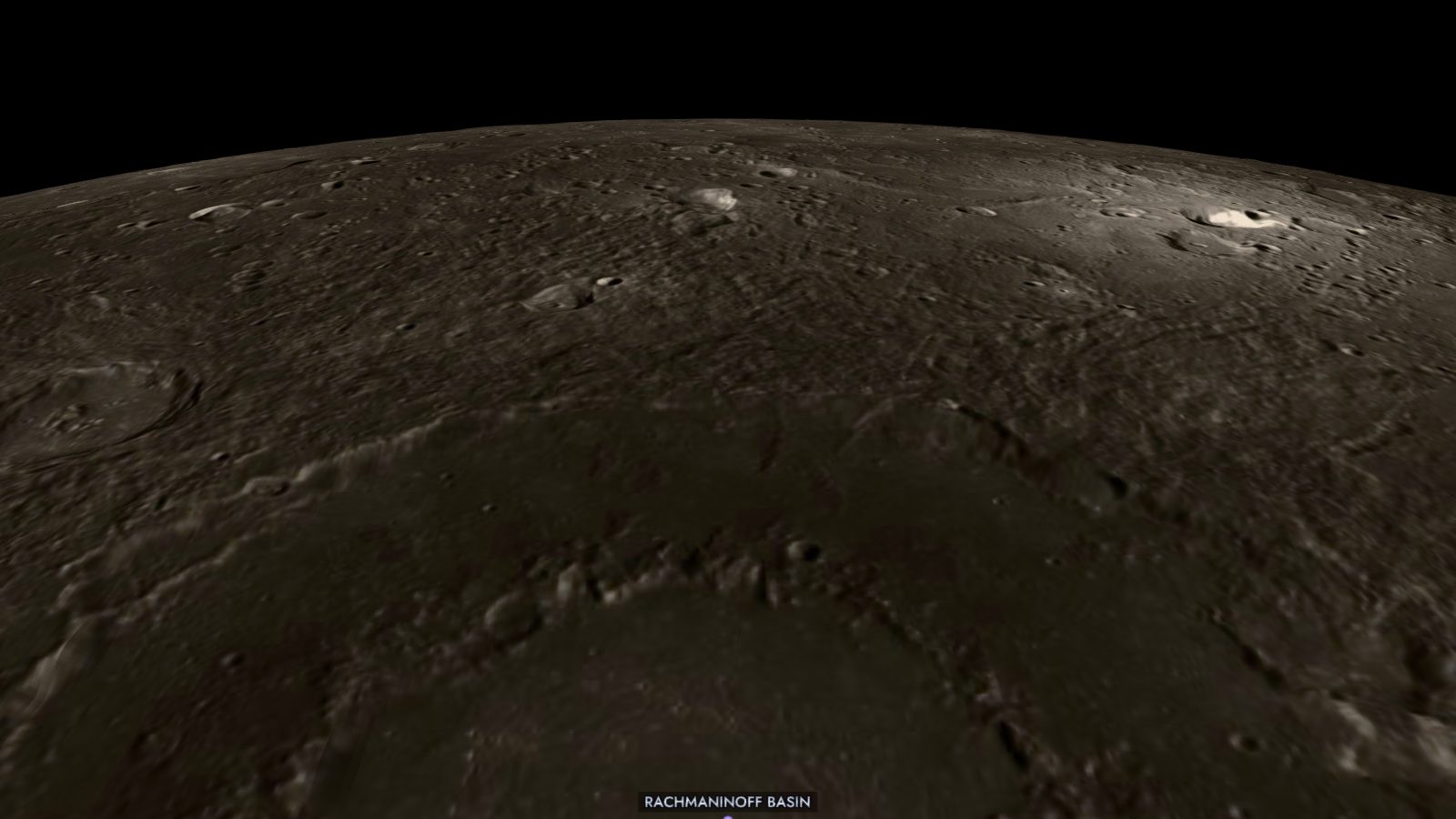 Rachmaninoff basinA double ringed basin with young volcanic plains.
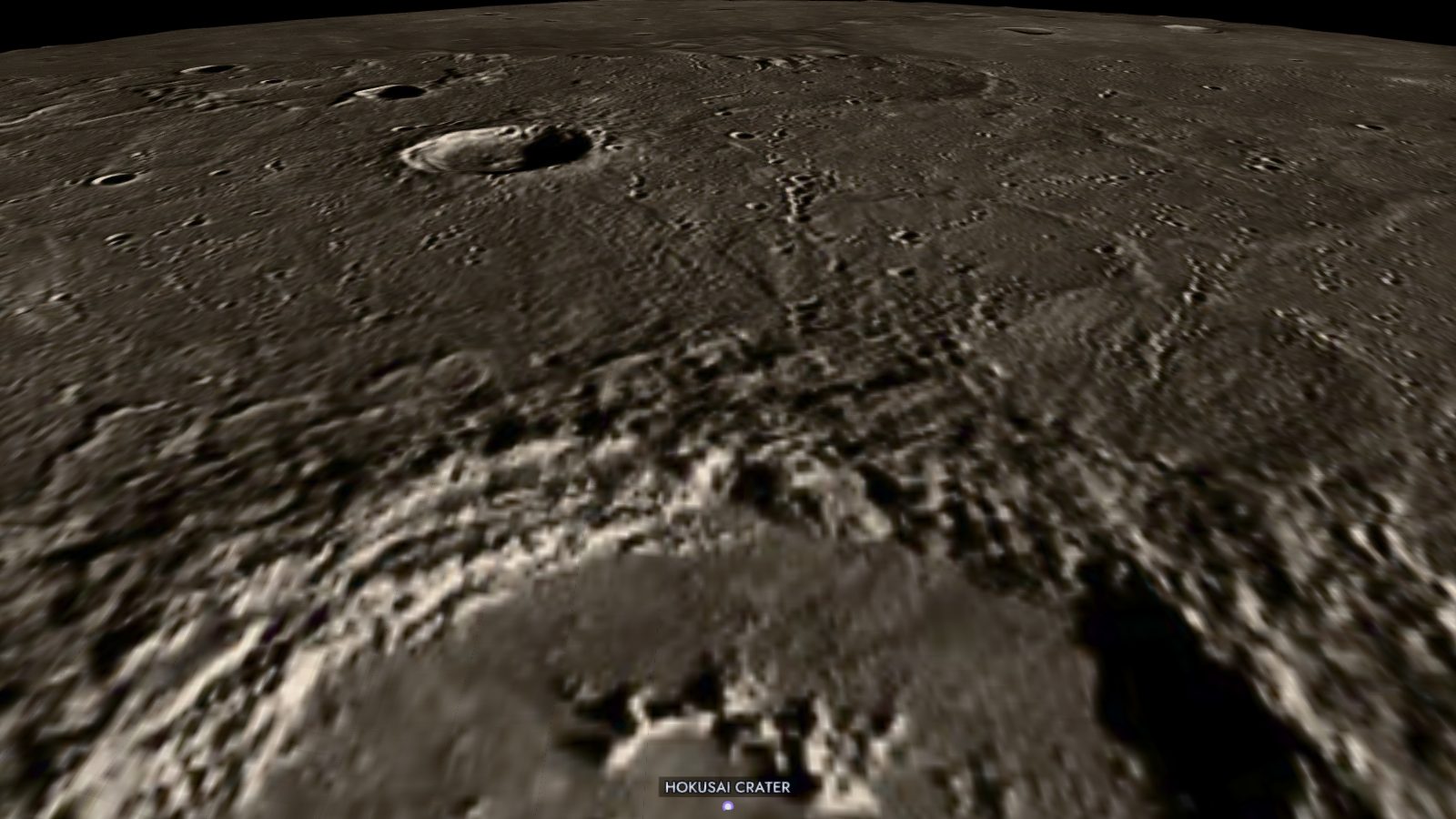 Hokusai craterA bright young crater whose rays cross the planet.
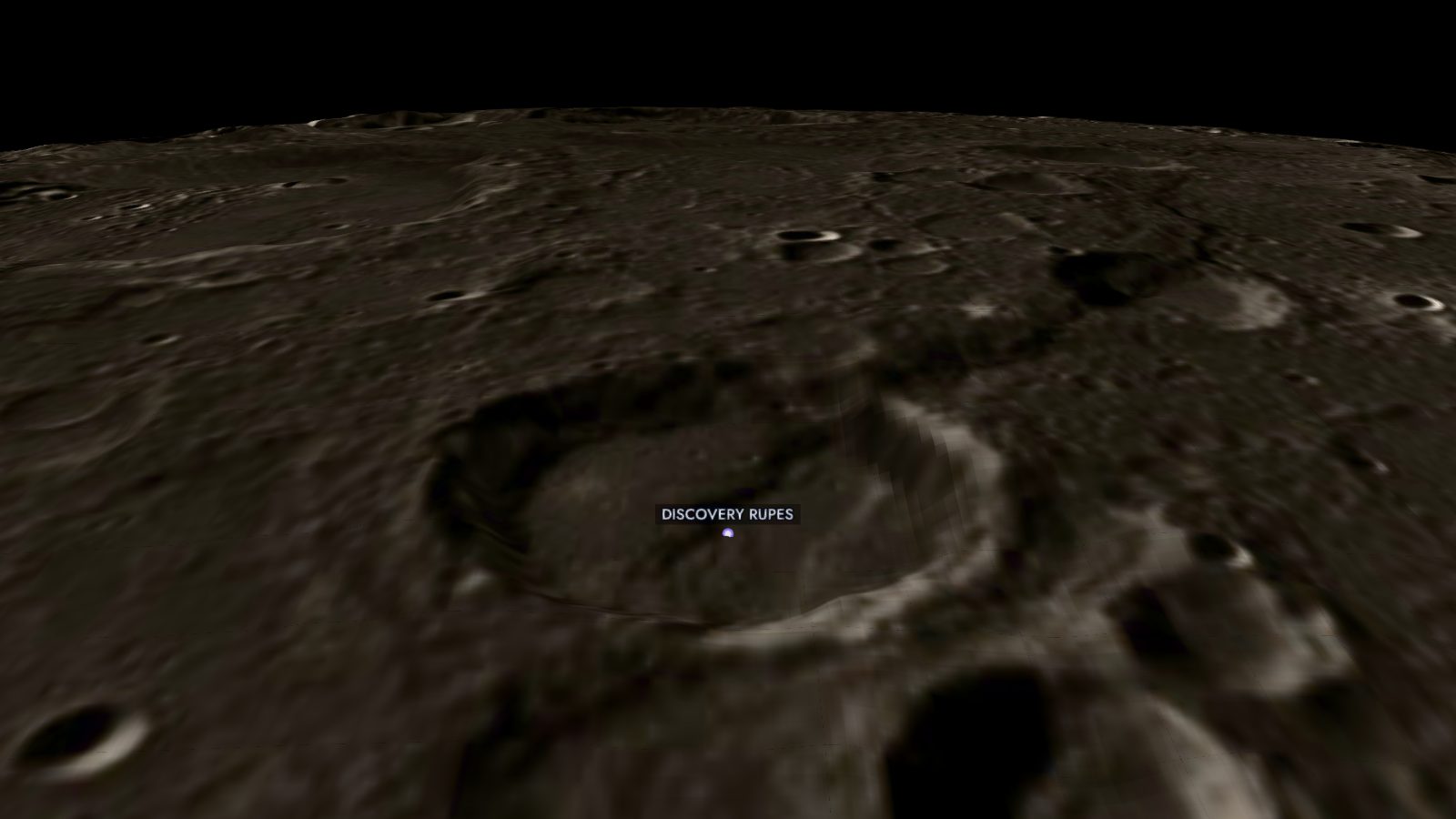 Discovery RupesA cliff about 600 km long, made as Mercury shrank.
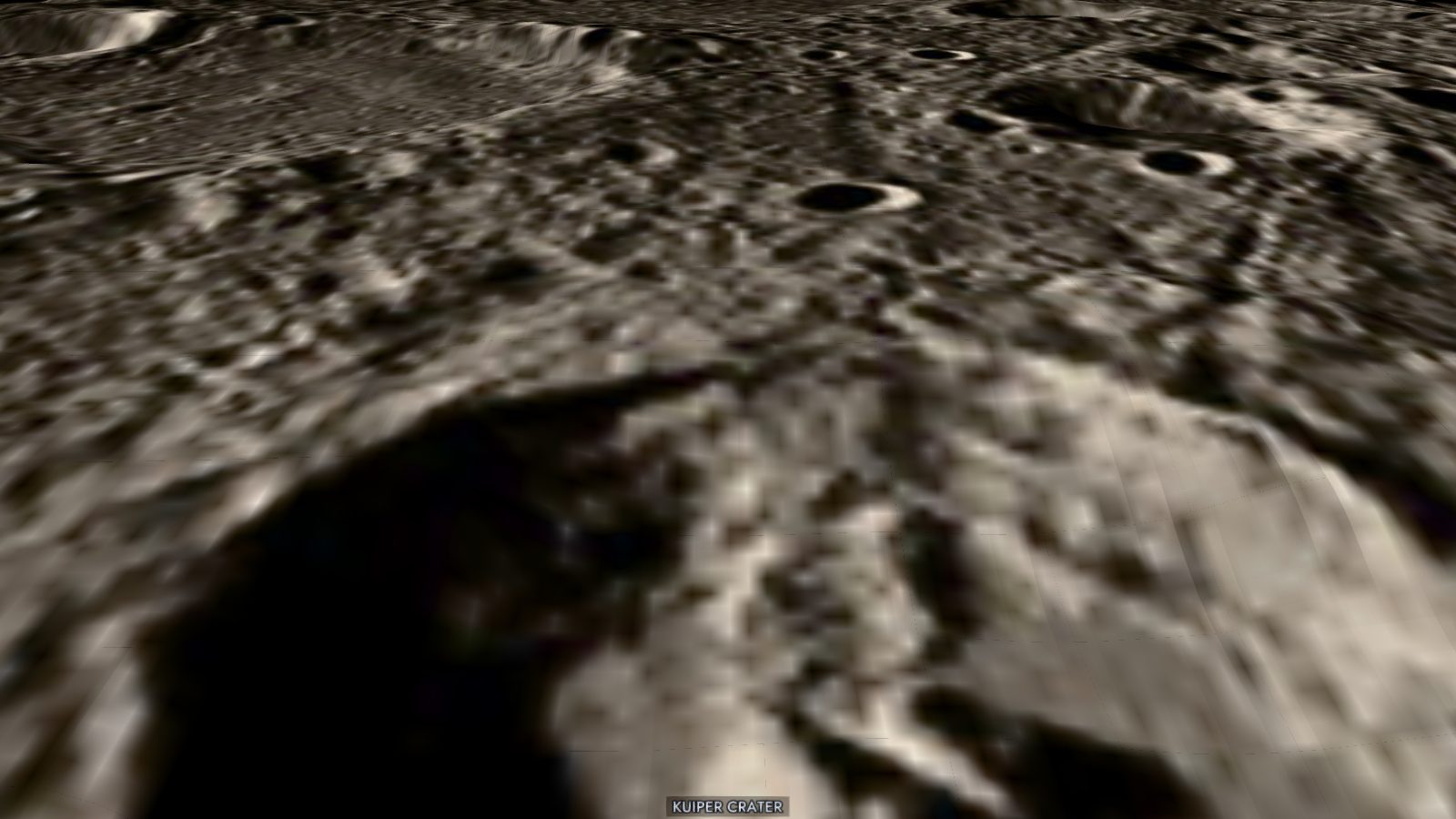 Kuiper craterNamed after a scientist from the Mariner 10 team.Prokofiev crater · polar iceA polar crater where water ice hides in shadow.
All places on Mercury
Sources
- NASA Mercury Fact Sheet (NSSDC)
- NASA Science: Mercury
- MESSENGER mission (Johns Hopkins APL)
- ESA: BepiColombo
- Genova et al. 2019, Geodetic evidence that Mercury has a solid inner core (Geophysical Research Letters)
- Byrne et al. 2014, Mercury's global contraction much greater than earlier estimates (Nature Geoscience)
- NASA: Transits of Mercury
Facts were checked against these sources by a separate review before publishing. Spotted something out of date? Space moves fast, and this page is updated as missions report back.