Quick facts
- Diameter
- 2,377 kmabout 19% of Earth, two thirds the width of our Moon
- Mass
- 1.30 × 10²² kg0.2% of Earth
- Surface gravity
- 0.62 m/s²about 6% of Earth
- Average distance from the Sun
- 5.9 billion km39.5 times Earth's distance, varying from 30 to 49
- Year
- 248 Earth yearsit has not completed an orbit since its discovery
- Day
- 6.4 Earth daysthe same as Charon's orbit, so they face each other
- Axial tilt
- about 120°it spins on its side, backwards
- Surface temperature
- about −240 °C to −220 °Cabout 33 to 55 degrees above absolute zero
- Atmosphere
- nitrogen with methane and carbon monoxidesurface pressure about one hundred thousandth of Earth's
- Moons
- 5Charon is half Pluto's width
- Discovered
- 18 February 1930by Clyde Tombaugh at Lowell Observatory
- Official status
- dwarf planet since 2006the largest known object in the Kuiper Belt
At a glance
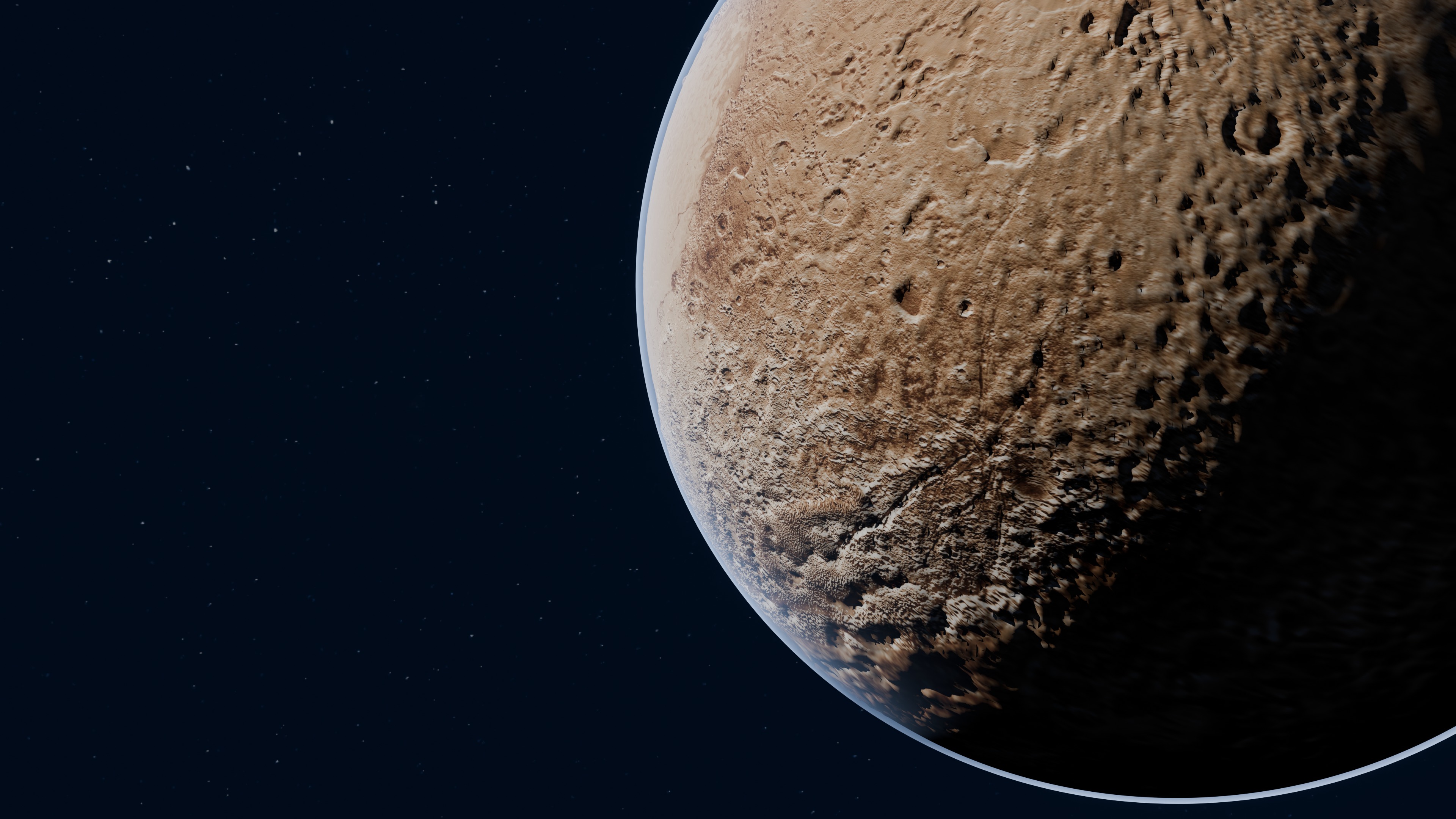
Pluto is a small, cold world in the Kuiper Belt, a vast region of icy bodies beyond the orbit of Neptune. For 76 years it was counted as the ninth planet; since 2006 it has been classed as a dwarf planet.
It is smaller than our Moon, about 2,377 kilometres across, and made of roughly two parts rock to one part ice. On its surface, ices that are gases on Earth, nitrogen, methane and carbon monoxide, lie frozen solid, while water ice is so cold and hard that it behaves like rock and forms mountains.
Before 2015 the best pictures of Pluto, from the Hubble Space Telescope, were only a few blurry pixels across. Then NASA's New Horizons spacecraft flew past and revealed a world with glaciers, mountains, possible ice volcanoes, a hazy blue atmosphere and, probably, an ocean hidden deep below.
Its large moon Charon is so big in comparison that the two are sometimes described as a double world.
A long, tilted orbit
Pluto's orbit is stretched and tilted by 17 degrees to the plane of the planets. It takes 248 years to go round the Sun, so it has not yet completed one orbit since its discovery in 1930.
At its closest it comes about 4.4 billion kilometres from the Sun, nearer than Neptune ever gets; at its farthest it is about 7.4 billion kilometres away. It was last closest to the Sun in 1989 and will be farthest away in 2114.
It never collides with Neptune, because it is locked in a resonance with it: Pluto completes two orbits for every three of Neptune's, so whenever Pluto crosses Neptune's path, Neptune is somewhere else.
Pluto spins on its side and backwards, once every 6.4 days. Charon orbits in exactly the same time, so each always shows the same face to the other. From one side of Pluto, Charon hangs motionless in the sky; from the other side it is never seen.
The heart: a glacier of nitrogen ice
The most famous feature on Pluto is the bright region shaped like a heart, named Tombaugh Regio after Pluto's discoverer. Its western lobe is Sputnik Planitia, a basin about 1,000 kilometres across filled with frozen nitrogen, several kilometres deep.
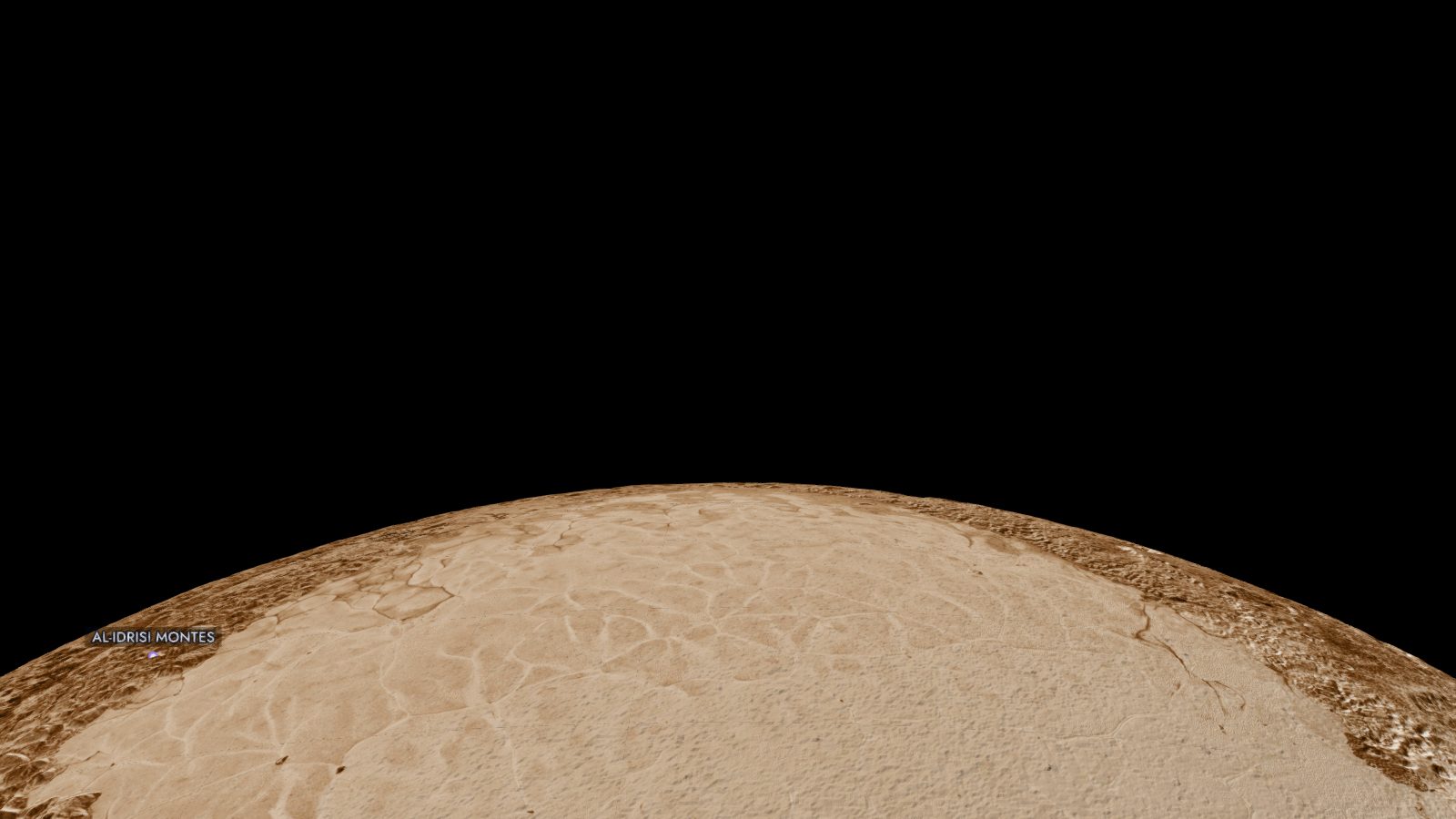
There are no impact craters at all on Sputnik Planitia, which means its surface is extremely young, less than about 10 million years old. The ice is divided into cells tens of kilometres wide, each slowly overturning as warmer nitrogen ice from below rises in the middle and sinks at the edges, like a very slow lava lamp.
The basin was probably made by a large impact long ago. Its position on Pluto, almost exactly opposite Charon, suggests it is unusually heavy, and one way to explain that is a dense ocean of liquid water lying beneath it. The weight of the nitrogen ice may even have helped roll Pluto round until the basin settled where it is now.
Around the edges, glaciers of nitrogen ice flow down from the surrounding highlands into the basin, much as glaciers flow on Earth.
Mountains of water ice
At Pluto's temperatures, water ice is as hard as rock, and it forms the planet's bedrock. Along the edge of Sputnik Planitia it rises into mountain ranges.
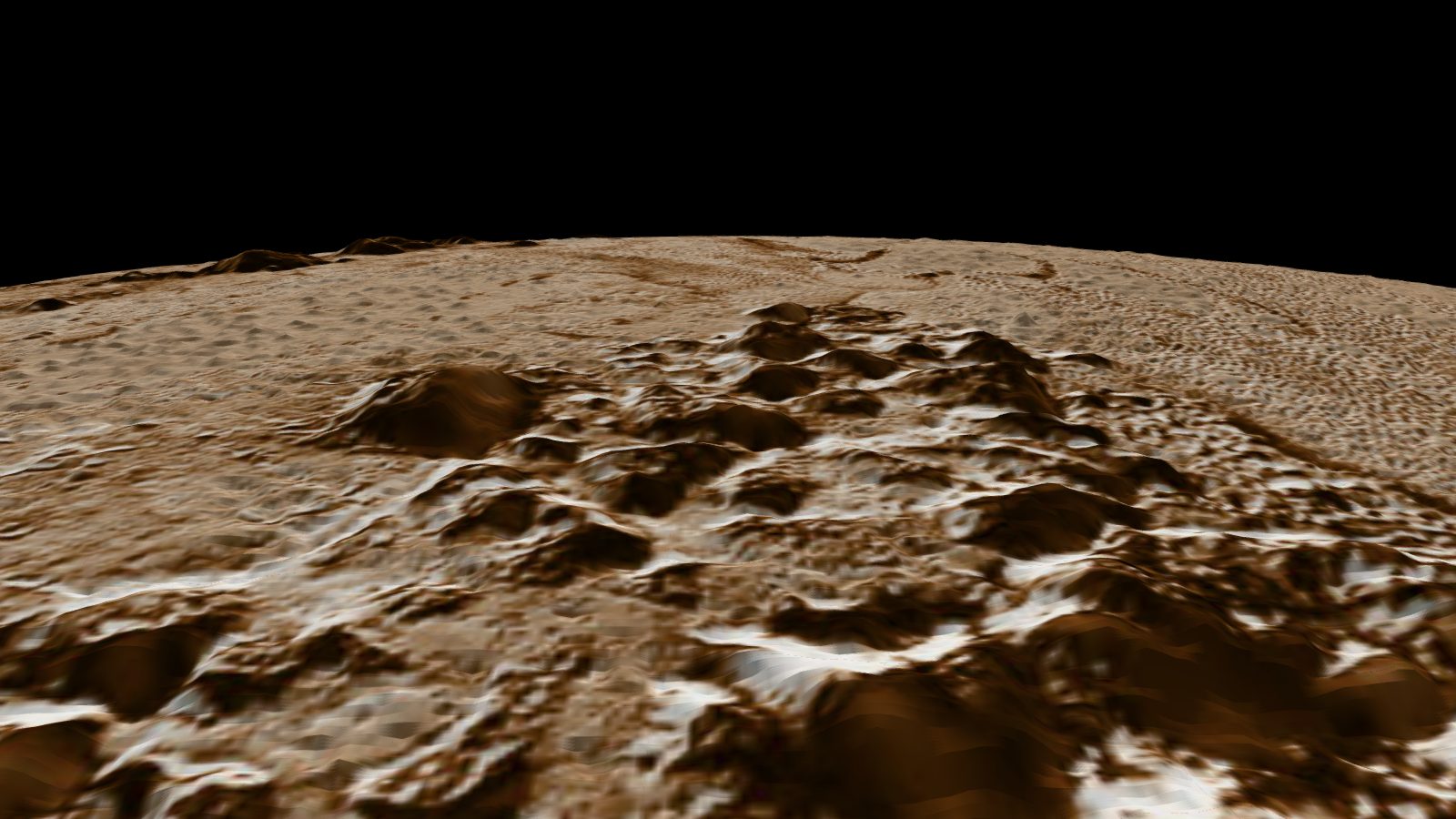
Tenzing Montes are the tallest, with peaks rising about 6 kilometres above their surroundings. To the north, the al-Idrisi Montes are a jumble of enormous blocks of water ice, perhaps broken pieces of crust floating like icebergs in the denser nitrogen ice around them.
Pluto's mountains are named after explorers and travellers, among them Tenzing Norgay, who with Edmund Hillary made the first ascent of Everest, and the twelfth century geographer al-Idrisi.
Ice volcanoes?
South of the heart stand two broad mountains with large pits at their summits. Wright Mons is about 150 kilometres across and 4 kilometres high, with a central depression about 40 kilometres wide.
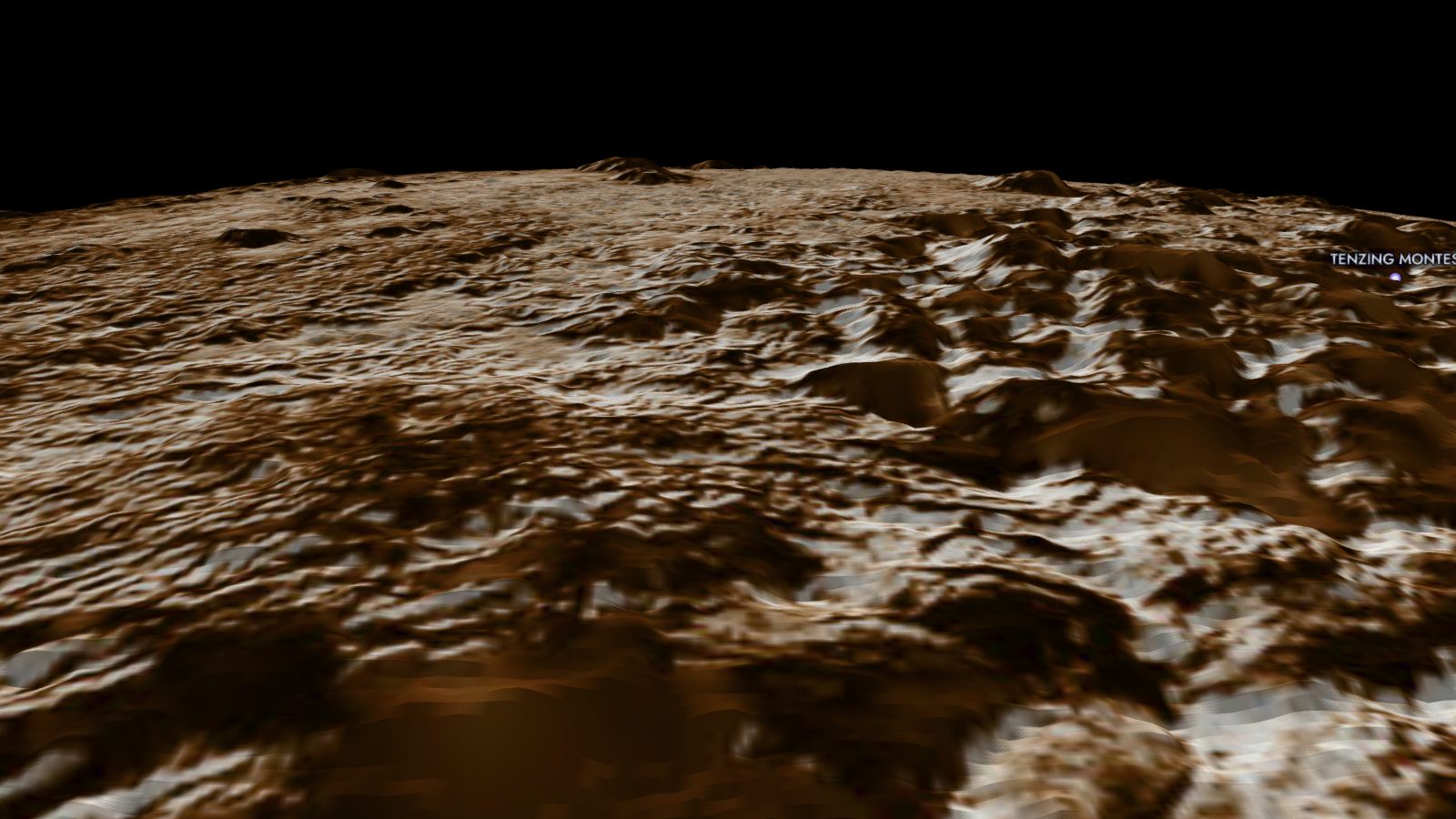
Many scientists think these are cryovolcanoes, built up from repeated eruptions of a slushy mix of ice and water rather than molten rock. There are very few craters on them, so they formed geologically recently, perhaps within the last one to two billion years.
If they are volcanoes, Pluto must have kept enough internal heat to melt or soften ice beneath its surface, which supports the idea of a hidden ocean.
Dark red lands and tholins
Not all of Pluto is bright. Along its equator stretches a long dark band, Belton Regio, informally called Cthulhu before it got its official name, about 3,000 kilometres long.
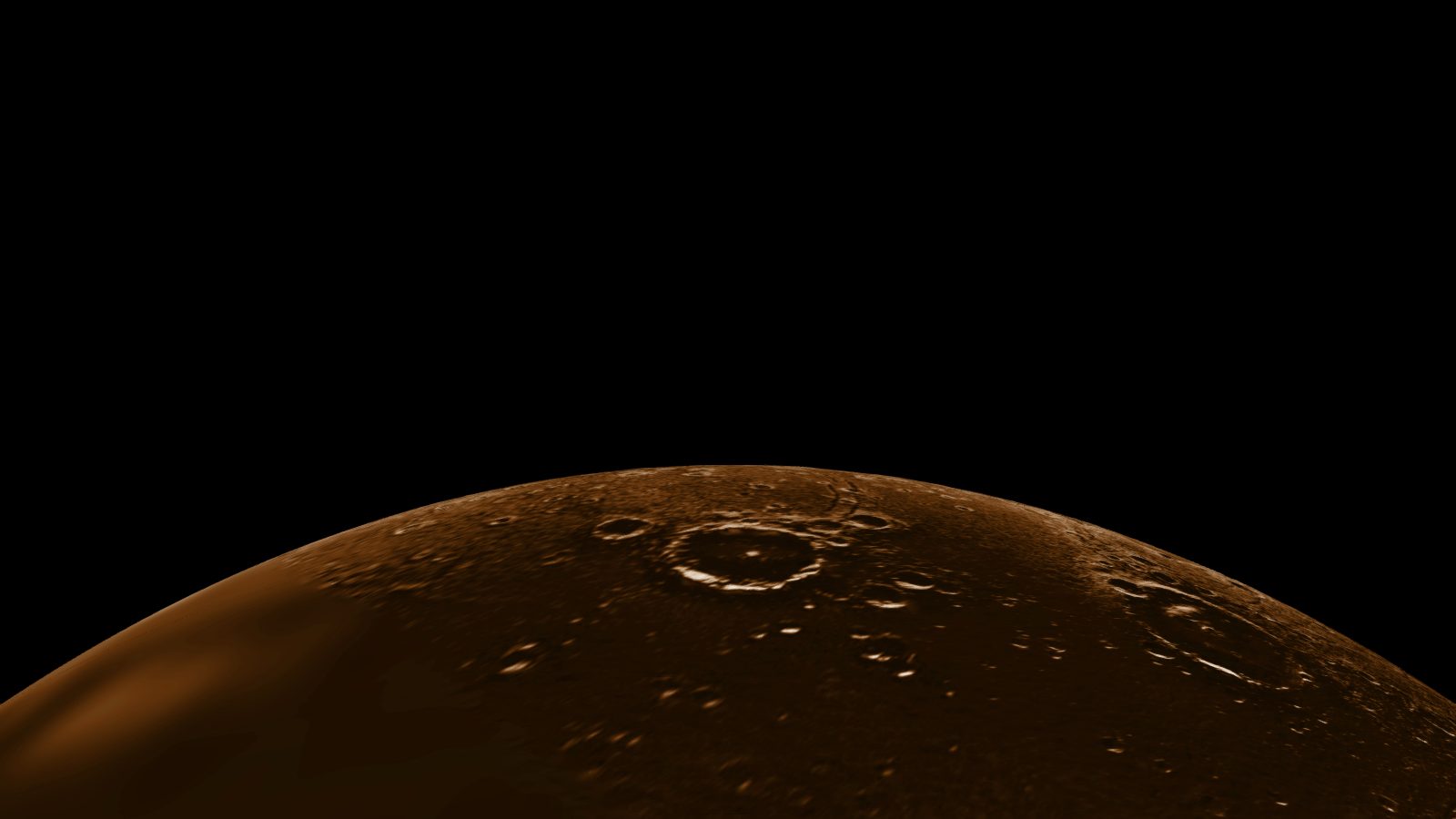
Its dark reddish colour comes from tholins, complex organic molecules made when ultraviolet light and particles from space break apart methane and nitrogen in the atmosphere. The pieces join into larger molecules that drift down and coat the surface.
Charon has a similar dark red patch at its north pole, informally called Mordor Macula. Scientists think it forms from methane that escapes Pluto's atmosphere, is captured by Charon and freezes in the long polar night.
A thin blue sky
Pluto has a very thin atmosphere, mainly nitrogen with traces of methane and carbon monoxide. The pressure at the surface is about one hundred thousandth of Earth's.
Looking back at Pluto after the flyby, New Horizons photographed sunlight shining through the atmosphere and saw about 20 layers of haze extending far above the surface. The haze particles scatter blue light, giving Pluto a blue sky.
The atmosphere changes with Pluto's long seasons and its changing distance from the Sun. Observations of stars passing behind Pluto showed its pressure roughly tripled between 1988 and 2015. As Pluto moves farther from the Sun, much of the atmosphere is expected eventually to freeze back onto the surface, and recent measurements suggest it may have begun to thin.
Charon and the small moons
Pluto has five known moons. Charon, discovered in 1978, is about 1,212 kilometres across, half the width of Pluto. The pair orbit a point in space between them, outside Pluto itself.
Charon's surface is grey water ice, with a vast system of canyons longer and deeper than the Grand Canyon, possibly cracked open when an ancient ocean inside it froze and expanded.
The four small moons, Nix, Hydra, Kerberos and Styx, are irregular chunks of ice only tens of kilometres across. They tumble chaotically as they orbit. All five probably formed from the debris of a giant collision between Pluto and another large body long ago, a similar story to how our Moon formed.
Discovery and the planet debate
Percival Lowell believed there was an undiscovered planet beyond Neptune and set up a search at his observatory in Flagstaff, Arizona. After his death the search continued, and on 18 February 1930 a young astronomer named Clyde Tombaugh found Pluto by comparing photographs of the sky taken days apart.
The name was suggested by Venetia Burney, an 11 year old girl in Oxford, after the Roman god of the underworld. Its first two letters are also the initials of Percival Lowell.
From 1992 astronomers began finding many other icy bodies in the same region, and in 2005 they found Eris, which is almost exactly the same size as Pluto and more massive. That forced a decision. On 24 August 2006 the International Astronomical Union defined a planet as a body that orbits the Sun, is round, and has cleared its orbital neighbourhood. Pluto passes the first two tests but not the third, so it was classed as a dwarf planet, along with Eris and Ceres.
The decision remains controversial among some scientists and the public. Whatever it is called, Pluto is now understood as the best known member of a huge population of icy worlds.
Seeing it from Earth
Pluto is very faint, around magnitude 14 to 15, thousands of times fainter than the faintest stars you can see with the naked eye. You need a telescope at least about 25 centimetres wide, a dark sky and a detailed chart, and even then it looks like a dim star.
Experienced observers confirm they have found it by sketching or photographing the field on two nights and seeing which point of light has moved.
It currently lies in the constellation Capricornus, low in the sky for observers in the north, and it is growing fainter as it moves away from the Sun.
Open questions
Is there really an ocean under Sputnik Planitia, and how has Pluto kept it from freezing for billions of years?
Are Wright Mons and its neighbour truly ice volcanoes, and could any still be active?
Will Pluto's atmosphere collapse as it moves away from the Sun, and how quickly? No new mission to Pluto is currently planned, so for now these questions will be studied with telescopes and New Horizons' data.
Missions
Pluto has been visited by one spacecraft so far.
- 2015New Horizons NASA
Launched in January 2006, it flew about 12,500 kilometres above Pluto on 14 July 2015 and mapped Pluto and Charon. It then flew past the Kuiper Belt object Arrokoth on 1 January 2019 and continues to study the outer solar system from more than 60 times Earth's distance from the Sun. Fly to the heart
Fly there yourself
Every place on this page is real terrain in Starfall's 3D explorer. Pick one and the camera flies you there, with narration when you arrive.
Sputnik Planitia · the heartA young glacier of nitrogen ice in Pluto's heart.Tenzing MontesWater ice peaks about 6 km high.Wright MonsA broad mountain that may be an ice volcano.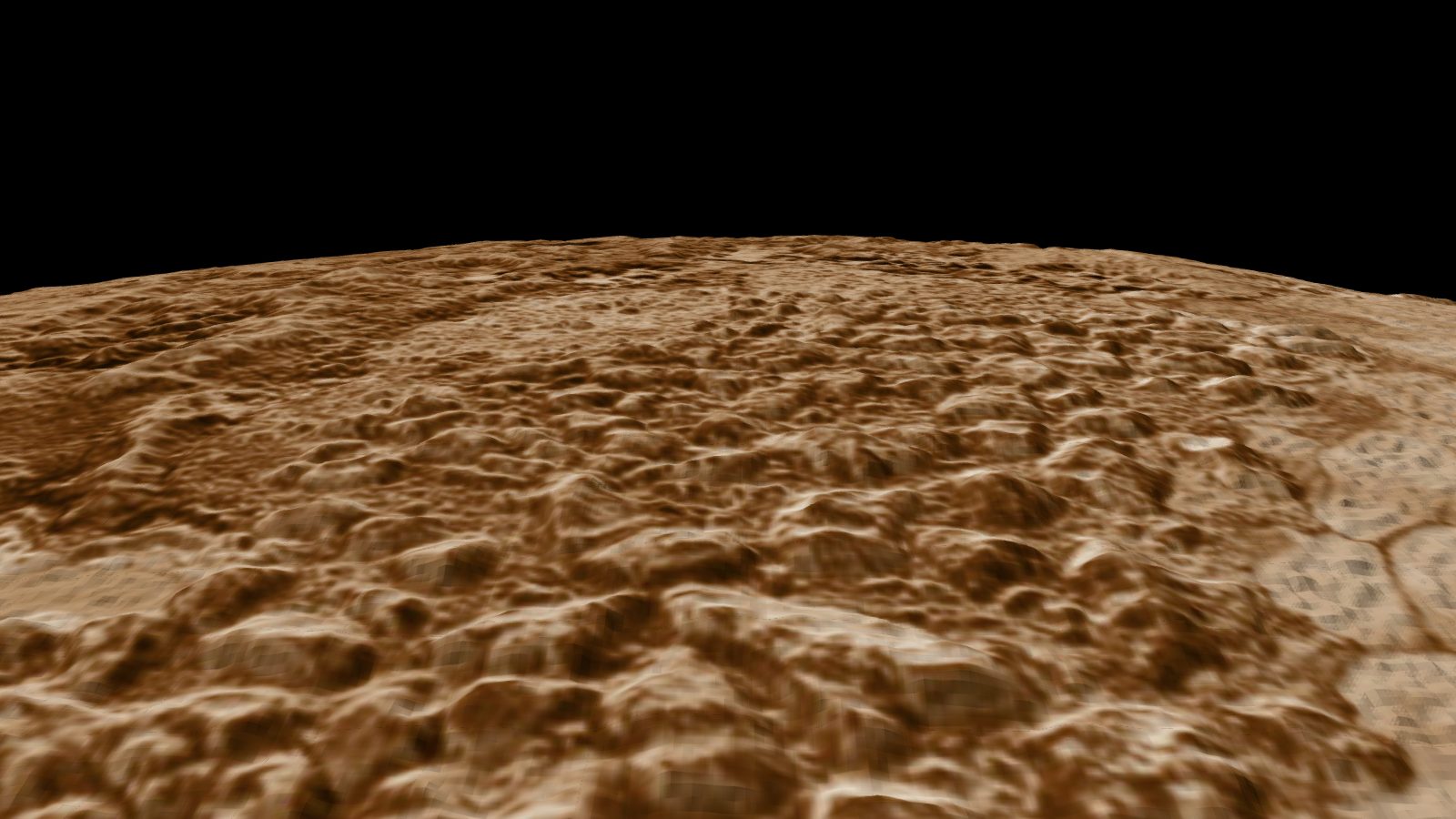 al-Idrisi MontesGiant blocks of ice jostling at the heart's edge.Belton Regio · CthulhuA long dark red land coated in tholins.
All places on Pluto
Sources
- NASA Pluto Fact Sheet (NSSDC)
- NASA Science: Pluto
- New Horizons mission (Johns Hopkins APL)
- Stern et al. 2015, The Pluto system: initial results from its exploration by New Horizons (Science)
- Nimmo et al. 2016, Reorientation of Sputnik Planitia implies a subsurface ocean on Pluto (Nature)
- Singer et al. 2022, Large scale cryovolcanic resurfacing on Pluto (Nature Communications)
- IAU 2006 press release: result of the planet definition vote
Facts were checked against these sources by a separate review before publishing. Spotted something out of date? Space moves fast, and this page is updated as missions report back.