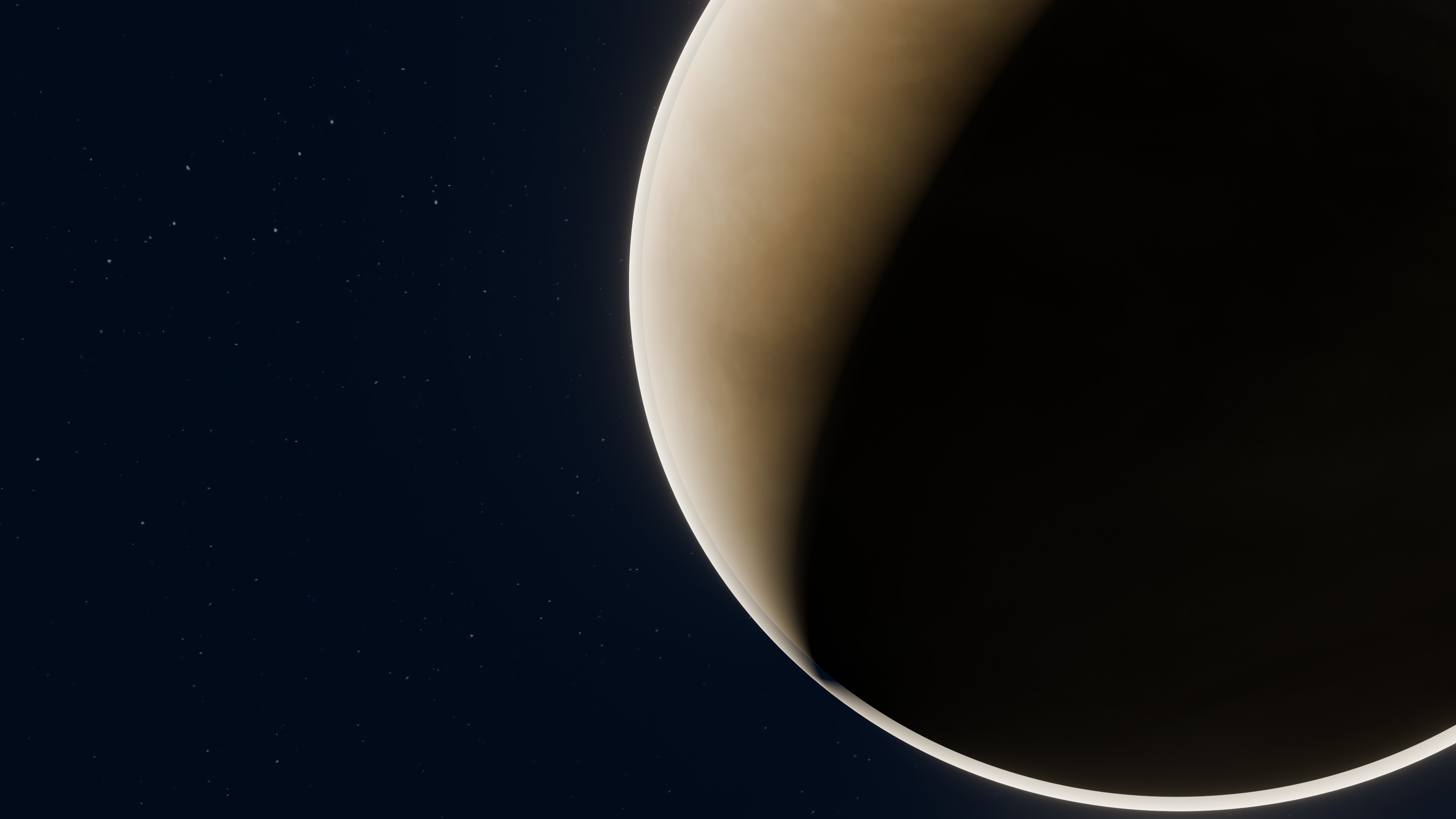
Quick facts
- Diameter
- 12,104 km95% of Earth
- Mass
- 4.87 × 10²⁴ kg82% of Earth
- Surface gravity
- 8.87 m/s²90% of Earth
- Average distance from the Sun
- 108.2 million km0.72 times Earth's distance
- Year
- 224.7 Earth daysabout 7.4 Earth months
- Spin (one turn)
- 243 Earth days, backwardsthe slowest spin of any planet
- Sunrise to sunrise
- about 117 Earth daysthe Sun rises in the west
- Surface temperature
- about 464 °Chotter than Mercury, day and night
- Surface pressure
- about 92 barlike being 900 metres under the sea
- Atmosphere
- 96.5% carbon dioxide, 3.5% nitrogenEarth's air is 0.04% carbon dioxide
- Magnetic field
- none of its ownEarth has a strong one
- Moons
- 0Earth has 1
At a glance
Venus is the second planet from the Sun and our closest planetary neighbour. In size, mass and make up it is the most Earth like planet we know, which is why it is often called Earth's twin.
The resemblance ends at the clouds. Venus is wrapped in an atmosphere of carbon dioxide so thick that the pressure at the surface is about 92 times Earth's. That blanket traps the Sun's heat so well that the ground sits at about 464 °C everywhere, on the day side and the night side, at the equator and at the poles.
Above it all are layers of cloud made of droplets of sulphuric acid, which reflect most of the sunlight that reaches them. That is why Venus shines so brightly in our sky, and why no telescope on Earth can see its surface in ordinary light.
Studying Venus is partly about understanding Earth. Two planets that started out so similar ended up completely different, and working out why helps scientists understand how climates change and what makes a planet habitable.
A backwards, slow spin
Venus has the most circular orbit of any planet, going round the Sun every 224.7 days at an average distance of 108 million kilometres.
It turns on its axis extremely slowly, once every 243 Earth days, so a Venus day measured against the stars is longer than its year. It also spins backwards compared with most planets. Its axial tilt is listed as 177°, which is the same as saying it is nearly upright but turning the wrong way.
Combine the slow backwards spin with the orbit and sunrise to sunrise takes about 117 Earth days. On Venus the Sun would rise in the west and set in the east, though you would never see it through the clouds.
Nobody knows for certain why Venus spins this way. It may have been hit by large bodies early on, or the tides raised in its heavy atmosphere by the Sun may have slowed and reversed its spin over billions of years.
The atmosphere and its runaway greenhouse
The atmosphere of Venus has roughly 90 times the mass of Earth's. It is almost all carbon dioxide, with some nitrogen and small amounts of sulphur dioxide and water vapour. Standing on the surface would feel like being nearly a kilometre deep in the ocean, in an oven.
Carbon dioxide lets sunlight in but stops heat radiating back out, which is the greenhouse effect. On Venus it has run away. Scientists think the young planet may once have had liquid water. As the Sun grew brighter, the water evaporated, water vapour trapped even more heat, and eventually the water was split apart by sunlight and its hydrogen lost to space. A clue is that the hydrogen left behind is unusually rich in its heavier form, deuterium, more than 100 times richer than on Earth, which is what you would expect if most of the water escaped.
On Earth, carbon dioxide is locked away in rocks such as limestone and dissolved in the oceans. Without oceans, Venus had nowhere to store it, so it stayed in the air.
The thick main cloud deck sits roughly 45 to 70 kilometres up. At about 50 to 55 kilometres altitude, the pressure and temperature are close to those at Earth's surface, which is why some scientists have proposed floating balloon probes, and why some have wondered about life in the clouds.
Weather: winds faster than the planet
Although the planet turns very slowly, its upper atmosphere races around it in about four Earth days, at speeds of around 360 kilometres per hour. This is called superrotation, and explaining exactly how it is maintained is still an active research problem.
At each pole there is a huge swirling vortex that changes shape from day to day. Down at the surface the air is so thick that winds are slow, only a few kilometres per hour, but they push with great force.
The sulphuric acid in the clouds falls as rain, but it evaporates in the heat long before it reaches the ground. Whether Venus has lightning is still debated: several spacecraft have recorded radio signals that might come from it, but the evidence is not conclusive.
The surface under the clouds
Radar can see through the clouds, and NASA's Magellan orbiter used it to map about 98% of the surface between 1990 and 1994. It revealed a world shaped by volcanoes: vast lava plains, more than a thousand volcanic centres, and strange round features called coronae and pancake domes that are found nowhere else.
There are two main highland regions, often compared to continents. Ishtar Terra in the north holds Maxwell Montes, the highest mountains on Venus, about 11 kilometres above the average surface. Aphrodite Terra stretches along the equator and is about the size of South America.
Venus has far fewer craters than the Moon or Mercury, and they are scattered fairly evenly. That suggests the whole surface is quite young, very roughly 300 to 700 million years old, and that something, perhaps widespread volcanism, resurfaced the planet. Small meteorites burn up in the thick air, so there are no tiny craters at all.
Is Venus still volcanically active? Looking again at old Magellan images, scientists reported in 2023 that a vent on Maat Mons changed shape over eight months in 1991, and in 2024 others reported signs of fresh lava flows. Together these are the strongest evidence so far that Venus has active volcanoes today.
Only the Soviet Venera and Vega landers have made controlled landings on the surface, although one of NASA's Pioneer Venus probes survived hitting the ground and kept sending data for about an hour. Their photographs show flat slabs of dark rock under an orange sky. The longest any of them survived was a little over two hours, before the heat and pressure overwhelmed them.
No magnetic field
Venus has an iron core like Earth's, but it does not generate a magnetic field of its own. One likely reason is its very slow spin together with the way heat leaves its interior; without the right kind of churning in the core, there is no dynamo.
Instead, the solar wind slams directly into the upper atmosphere. Electric currents in the charged upper layers create a weak induced magnetic field that diverts some of it, but the planet still loses atoms such as hydrogen and oxygen to space, carried away in a long tail behind it.
Discovery and naming
After the Sun and Moon, Venus is the brightest natural object in the sky and has been known since prehistory. Ancient cultures often saw it as two objects, the morning star and the evening star. Babylonian tablets recorded its movements in detail.
It is named after the Roman goddess of love and beauty. Almost all features on its surface are named after real and mythical women, the exceptions being Maxwell Montes, named after the physicist James Clerk Maxwell, and two highland regions, Alpha Regio and Beta Regio.
In 1610 Galileo saw through his telescope that Venus shows phases, like the Moon. The full range of phases he saw only makes sense if Venus goes round the Sun, which became strong evidence against the old idea that everything circles the Earth.
During the transit of Venus in 1761, Mikhail Lomonosov noticed a halo of light around the planet's edge and concluded it had an atmosphere. In 1962 NASA's Mariner 2 flew past Venus, the first successful visit by any spacecraft to another planet, and measured how hot it really is.
Seeing it from Earth
Venus is impossible to miss when it is well placed. It shines brilliant white in the west after sunset or in the east before dawn, and it can be bright enough to cast faint shadows on a dark night. It never appears more than about 47 degrees from the Sun.
Through a small telescope or steady binoculars you can see its phases change. It looks largest as a thin crescent, when it is closest to us, and smallest when it is nearly full on the far side of the Sun.
Every so often Venus crosses the face of the Sun as seen from Earth. These transits come in pairs eight years apart, separated by more than a century. The last two were in 2004 and 2012, and the next will not be until December 2117.
Life in the clouds?
The surface is far too hot for life as we know it. The clouds are another matter: at around 50 kilometres up the temperature is mild, although the droplets are concentrated sulphuric acid, harsher than anything on Earth where life is found.
In 2020 a team reported detecting phosphine gas in the clouds, which on Earth is associated with living things. The claim caused great excitement but was quickly challenged; reanalyses found much weaker signals or none at all, and the result remains disputed. Most scientists treat it as unconfirmed.
Open questions
Did Venus ever have oceans, and for how long? If it did, it may once have been habitable.
How active are its volcanoes today, and did a single planet wide event resurface it or did change happen gradually?
What keeps its atmosphere superrotating, and what is the dark substance in the clouds that absorbs ultraviolet light?
Several new missions are planned to answer these, including NASA's DAVINCI probe and VERITAS orbiter, and Europe's EnVision orbiter, though their schedules depend on budgets.
Missions
Venus was the first planet visited by a spacecraft, and dozens of missions have flown past, orbited or landed on it.
- 1962Mariner 2 NASA
The first successful flyby of another planet. It found the surface was extremely hot.
- 1967Venera 4 Soviet Union
The first probe to send back measurements from inside another planet's atmosphere.
- 1970Venera 7 Soviet Union
The first spacecraft to transmit data from the surface of another planet.
- 1975Venera 9 and 10 Soviet Union
The first orbiters of Venus, and landers that returned the first pictures from the surface of another planet.
- 1978Pioneer Venus NASA
An orbiter that studied the clouds and mapped the surface with radar for 14 years, and four probes that plunged through the atmosphere.
- 1982Venera 13 and 14 Soviet Union
Landers that took the first colour pictures of the surface and analysed the soil. Venera 13 survived for about two hours.
- 1985Vega 1 and 2 Soviet Union with international partners
On the way to Halley's Comet, each dropped a lander and a balloon that floated in the clouds for about two days.
- 1990Magellan NASA
Mapped about 98% of the surface with radar until 1994, revealing a world shaped by volcanoes.
- 1990Flybys by passing spacecraft NASA, ESA and JAXA
Galileo, Cassini, MESSENGER, Parker Solar Probe, BepiColombo and Solar Orbiter all used Venus's gravity on the way to other targets, and several took measurements as they passed.
- 2006Venus Express ESA
Studied the atmosphere from orbit until 2014, including the polar vortices and signs of recent volcanism.
- 2015Akatsuki JAXA
After missing orbit in 2010, it entered orbit in 2015 and studied the weather of Venus. Contact was lost in 2024 and JAXA ended the mission in September 2025.
- 2030sDAVINCI, VERITAS and EnVision NASA and ESA
Planned missions: a probe to descend through the atmosphere, and two radar orbiters. As of 2026, DAVINCI is aiming for launch around the end of 2030; the others depend on budgets and partnership agreements.
Sources
- NASA Venus Fact Sheet (NSSDC)
- NASA Science: Venus
- ESA: Venus Express
- JAXA: Venus Climate Orbiter Akatsuki operation completed (2025)
- Herrick and Hensley 2023, Surface changes observed on a Venusian volcano (Science)
- ESA: EnVision
- Space.com: the outlook for NASA's Venus missions (March 2026)
Facts were checked against these sources by a separate review before publishing. Spotted something out of date? Space moves fast, and this page is updated as missions report back.