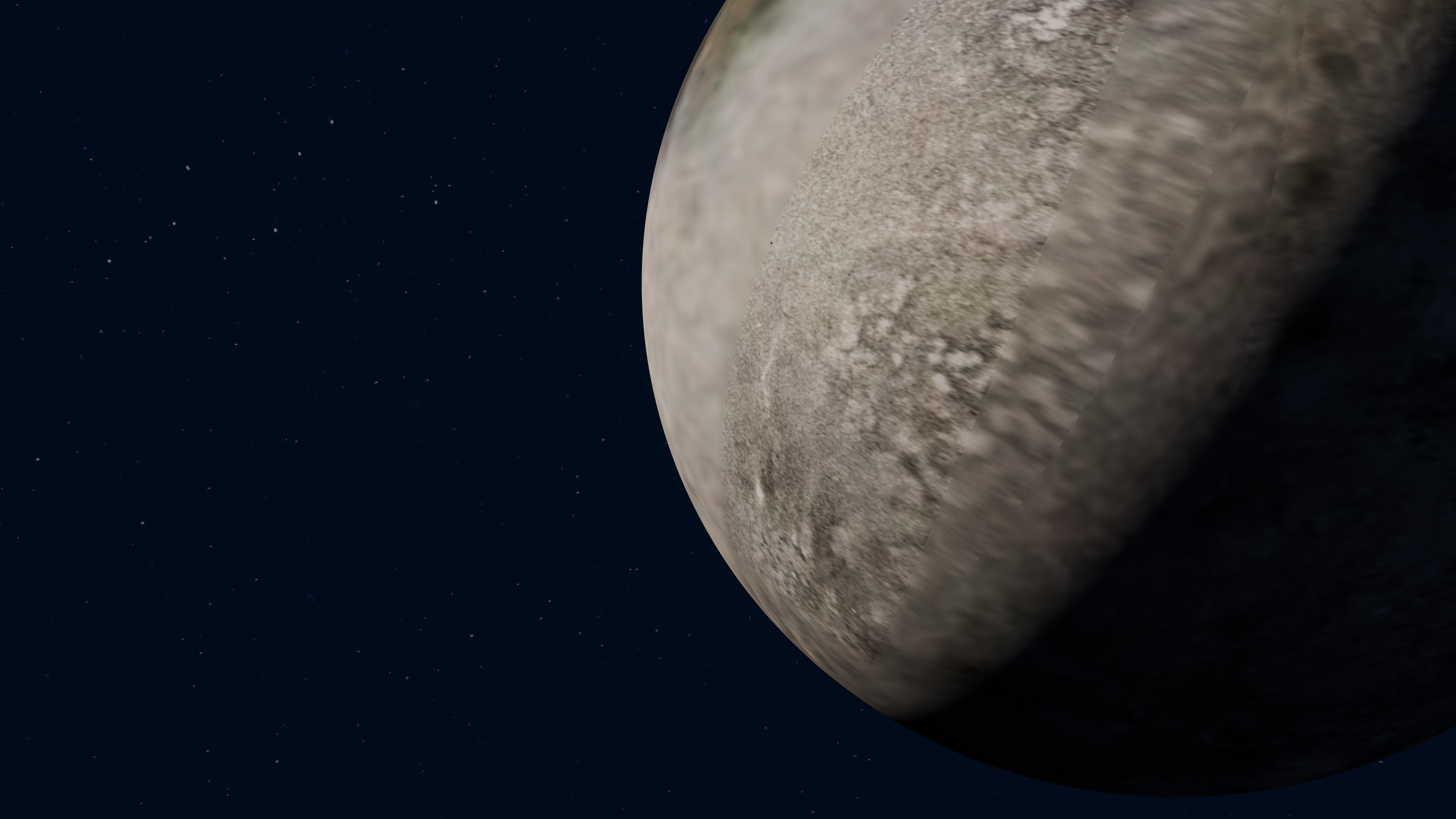
Quick facts
- Diameter
- 2,707 km21% of Earth, about three quarters of our Moon
- Mass
- 2.14 × 10²² kg0.36% of Earth
- Surface gravity
- 0.78 m/s²8% of Earth
- Distance from Neptune
- 354,800 kma little closer than our Moon is to Earth
- One orbit (and one day)
- 5.88 Earth days, backwardsit always shows Neptune the same face
- Surface temperature
- about −235 °Cone of the coldest surfaces measured
- Atmosphere
- very thin nitrogenabout 70,000 times lower than on Earth
- Density
- 2,061 kg/m³about two thirds rock, one third ice
- Plumes
- about 8 km highseen by Voyager 2 in 1989
- Year
- 164.8 Earth yearsit travels around the Sun with Neptune
- Discovered
- 10 October 1846by William Lassell, 17 days after Neptune
- Rank among moons
- seventh largestlarger than Pluto
At a glance
Triton is by far the largest of Neptune's 16 known moons, holding more than 99% of the mass of everything that orbits Neptune. At 2,707 kilometres across, it is a little smaller than our Moon and slightly larger than Pluto.
It is unusual in two ways. It orbits Neptune backwards, against the direction the planet spins, and its orbit is steeply tilted. No other large moon does this, and the best explanation is that Triton did not form around Neptune at all but was captured from the Kuiper Belt.
Its surface is one of the coldest known, about −235 °C, and is covered in frozen nitrogen, with water ice as bedrock. Even so, it is geologically young and has active plumes, which makes Triton a strong candidate for an ocean world.
Everything we know up close comes from a single flyby by Voyager 2 in August 1989, which photographed only about 40% of its surface in detail.
A backwards, captured orbit
Triton circles Neptune every 5.88 days at a distance of about 355,000 kilometres, a little closer than our Moon is to Earth. Like most large moons, it keeps the same face towards its planet.
But it goes the wrong way. Its orbit is retrograde, running against Neptune's spin, and tilted by about 157 degrees to Neptune's equator. Moons that form from the disc around a young planet orbit in the same direction as the planet spins, so Triton almost certainly came from somewhere else.
The leading idea is that Triton was once one half of a pair of objects orbiting each other in the Kuiper Belt, like Pluto and Charon. When the pair passed close to Neptune, the planet's gravity captured Triton and flung its partner away. The capture would have left Triton on a very stretched orbit, and the tides that gradually made it circular would have heated and possibly melted its interior.
Triton's arrival would also have scattered or destroyed many of Neptune's original moons, which may explain why Neptune's other moons are so small, apart from the oddly stretched orbit of Nereid.
Because its orbit runs backwards, tides are slowly drawing Triton closer to Neptune. In a few billion years it should come close enough to be torn apart by Neptune's gravity, perhaps forming a ring system.
A young, frozen surface
Voyager 2 saw relatively few impact craters on Triton, which means its surface has been renewed recently in geological terms, probably within the last 100 million years or so.
Much of the western hemisphere that Voyager saw is covered in cantaloupe terrain, a strange landscape of dimples and ridges that looks like the skin of a melon. It may form as blobs of less dense ice rise slowly through the crust.
Other regions hold smooth plains and terraced basins, such as Ruach and Tuonela Planitiae, that look like frozen lakes. They are thought to have been flooded by cryovolcanic eruptions of icy slush, perhaps a mix of water and ammonia, that froze in place.
The surface reflects most of the sunlight that hits it, making Triton one of the brightest objects in the solar system. Combined with its great distance from the Sun, this keeps it extremely cold.
Plumes and the polar cap
Voyager 2 photographed a large polar cap over the southern hemisphere, which was then in its long summer. The cap is made mostly of nitrogen ice and has a faint pinkish tint, probably from organic material formed by radiation.
Across the cap, Voyager saw dozens of dark streaks, and at least two active plumes rising about 8 kilometres into the sky before being carried sideways by wind for up to about 150 kilometres.
The plumes may be driven by sunlight. Even at Triton's distance, weak sunlight passing through clear nitrogen ice could warm dark material underneath, building up gas pressure until it bursts through like a geyser. Others have suggested the energy comes from inside Triton. Either way, Triton was only the third world, after Earth and Io, where active eruptions had been seen.
A thin nitrogen atmosphere
Triton has a very thin atmosphere, mostly nitrogen with traces of methane and carbon monoxide. The pressure at the surface is around 14 millionths of a bar, about 70,000 times lower than on Earth.
It exists because some of the nitrogen ice on the surface turns to gas in sunlight, much as on Pluto. Voyager saw thin hazes and clouds in it, and winds strong enough to carry the plume material sideways.
Observations of stars passing behind Triton showed that its atmosphere grew denser in the years after Voyager's visit, as its southern summer continued. Triton's seasons are complicated by its tilted orbit and Neptune's 165 year path around the Sun.
Inside: a hidden ocean?
Triton's density suggests it is made of roughly two thirds rock and metal and one third water ice. It probably separated into a rocky core and an icy mantle and crust.
The heat released as its orbit was tidied up after capture, together with heat from radioactive elements in its rock, may have been enough to keep a layer of liquid water beneath the ice to this day, especially if ammonia acts as an antifreeze.
Its young surface and active plumes support this idea, and Triton is often listed among the solar system's possible ocean worlds. Without a return mission, though, there is no direct evidence of an ocean.
Discovery and naming
The English astronomer William Lassell discovered Triton on 10 October 1846, just 17 days after Neptune itself was found. Lassell was a brewer who had made his fortune in beer and built his own large telescopes.
For decades it was simply called the satellite of Neptune. The name Triton, after the son of the sea god Poseidon in Greek mythology, was suggested by the French astronomer Camille Flammarion in 1880, but it did not come into common use until the twentieth century.
Its backward orbit was recognised early, and its large size made it a natural target when Voyager 2 reached Neptune. Mission planners steered the spacecraft past Neptune's north pole partly so it could pass Triton afterwards.
Seeing it from Earth
Triton shines at about magnitude 13.5, so it can be seen with a telescope of about 20 centimetres or larger under dark skies, as a faint point close to Neptune's small blue disc.
Because it orbits so close to the bright planet, it helps to use high magnification and to look when Triton is at its greatest distance from Neptune, every few days.
Open questions
Does Triton hide a liquid ocean, and is it still being heated today?
What powers its plumes: sunlight on the polar cap, or heat from within?
What does the rest of the surface look like? Voyager 2 saw less than half of it in detail. Several missions to Triton have been proposed, including NASA's Trident concept, but none has been selected or scheduled.
Missions
Triton has been visited by one spacecraft.
- 1989Voyager 2 NASA
Passed about 40,000 km from Triton on 25 August 1989, a few hours after its closest approach to Neptune. It mapped the southern hemisphere, measured the atmosphere and discovered the plumes.
Sources
- NASA Neptunian Satellite Fact Sheet (NSSDC)
- NASA Science: Triton
- NASA Photojournal PIA18668: Map of Triton (Paul Schenk)
- Agnor and Hamilton 2006, Neptune's capture of its moon Triton in a binary planet gravitational encounter (Nature)
- Soderblom et al. 1990, Triton's geyser like plumes: discovery and basic characterization (Science)
- Smith et al. 1989, Voyager 2 at Neptune: imaging science results (Science)
Facts were checked against these sources by a separate review before publishing. Spotted something out of date? Space moves fast, and this page is updated as missions report back.