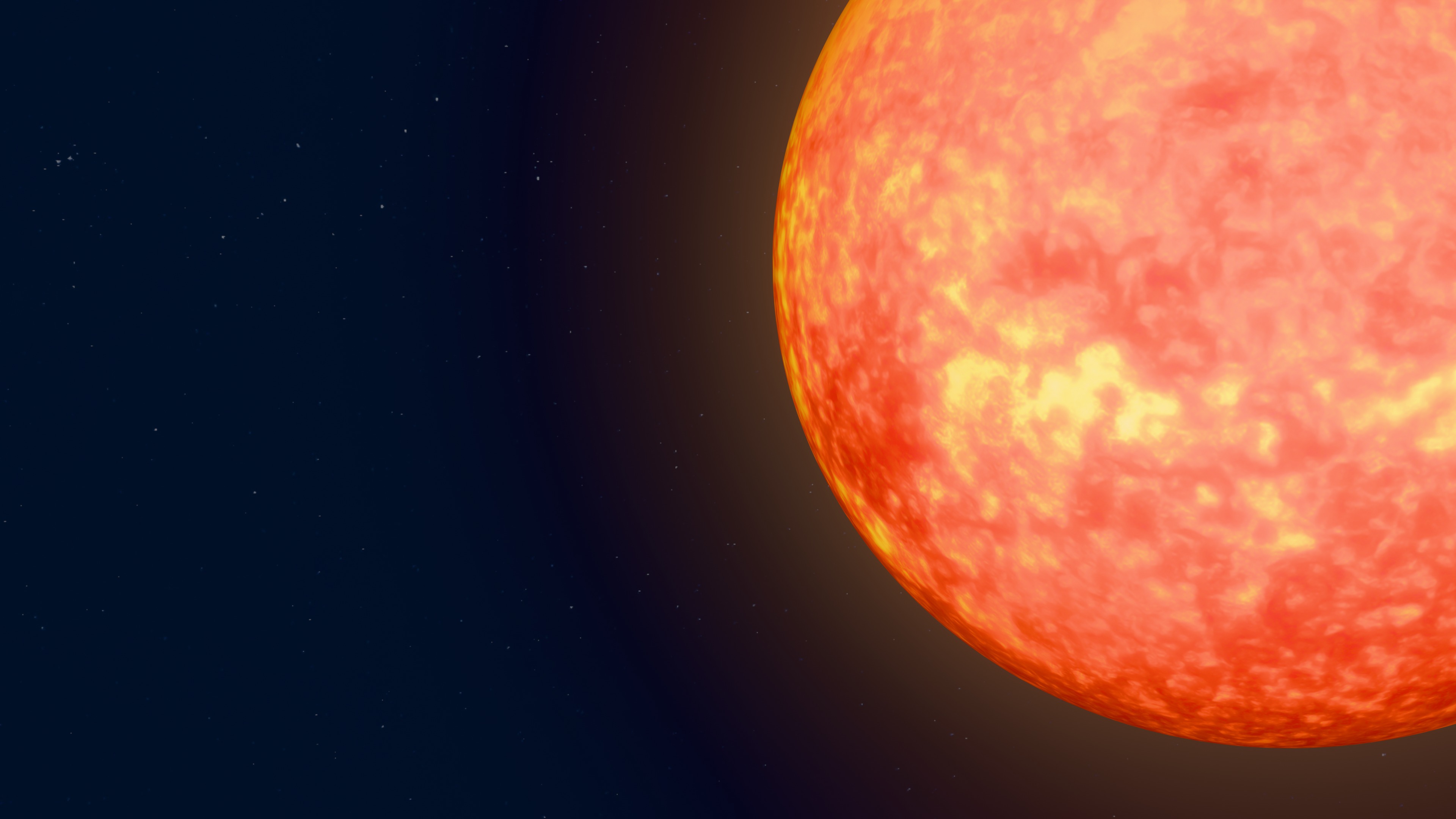
Quick facts
- Diameter
- 1,391,400 km109 Earths side by side
- Mass
- 1.989 × 10³⁰ kg333,000 times Earth, 99.8% of the solar system
- Surface gravity
- 274 m/s²28 times Earth
- Distance from Earth
- 149.6 million km on averagesunlight takes about 8 minutes 20 seconds to reach us
- Surface temperature
- about 5,500 °Cthe visible surface, called the photosphere
- Core temperature
- about 15 million °Cwhere hydrogen fuses into helium
- Corona temperature
- 1 to 3 million °Chundreds of times hotter than the surface below it
- Spin (one turn)
- about 25 days at the equator, 35 near the polesit is not solid, so different parts turn at different speeds
- Make up (by mass)
- about 73% hydrogen, 25% heliumplus small amounts of oxygen, carbon, iron and others
- Age
- about 4.6 billion yearsabout halfway through its life
- Type
- G2V yellow dwarfa common kind of star
- Orbit around the galaxy
- about 230 million yearsabout 26,000 light years from the centre of the Milky Way
At a glance
The Sun is a star, the only one close enough for us to see in detail. It is a vast ball of gas, mostly hydrogen and helium, held together by its own gravity and heated from within by nuclear fusion.
It is huge by our standards: 109 times wider than Earth, with a volume that could hold about 1.3 million Earths. It contains 99.8% of all the mass in the solar system; all the planets, moons, asteroids and comets together make up the rest.
Among stars, though, it is quite ordinary. Astronomers call it a yellow dwarf. Many stars in our galaxy are smaller and dimmer red dwarfs, while some are dozens of times more massive.
Without the Sun there would be no life on Earth. Its light drives photosynthesis, weather and the water cycle, and its gravity holds the planets in their orbits. Its activity also affects us directly, through auroras and the space weather that can disrupt satellites and power grids.
How the Sun shines
Deep in the core, the temperature is about 15 million °C and the pressure is enormous. There, hydrogen nuclei collide hard enough to fuse, in a chain of steps that ends with helium. Each time, a tiny amount of mass disappears and becomes energy, as Einstein's E = mc² describes.
The Sun converts about 600 million tonnes of hydrogen into helium every second, losing about four million tonnes of mass as energy in the process. Even at that rate it has enough fuel to keep shining steadily for billions of years.
Fusion also produces neutrinos, ghostly particles that pass straight out of the Sun and through Earth almost without stopping. Detectors deep underground catch a tiny fraction of them, giving us a direct view of what is happening in the core right now.
The light itself has a much slower journey. Energy from the core is absorbed and emitted again countless times on its way out, and estimates of how long this takes range from about ten thousand to over a hundred thousand years. Once it leaves the surface, it reaches Earth in just over eight minutes.
Inside the Sun
The Sun has layers, although none of them is solid. The core extends to about a quarter of the way out. Around it is the radiative zone, where energy creeps outward as light, and then the convection zone, the outer 30% or so, where hot gas rises, cools and sinks again like water boiling in a pan.
The tops of those convection cells give the visible surface, the photosphere, its grainy look. Each grain, or granule, is roughly the size of a country, around 1,000 kilometres across, and lasts only about ten minutes.
Scientists learn about the hidden interior by watching the surface ripple. Sound waves travel through the Sun and make it vibrate in millions of ways, and studying these vibrations, called helioseismology, reveals its inner structure, much as earthquakes reveal Earth's.
Because the Sun is gas, it does not turn as one piece. The equator goes round in about 25 days and the regions near the poles in about 35. This uneven spin twists the Sun's magnetic field and helps drive its activity.
The atmosphere: chromosphere and corona
Above the photosphere is a thin layer called the chromosphere, which glows red and pink and can be seen briefly at the edge of the Sun during a total eclipse.
Beyond that is the corona, the Sun's outer atmosphere, which extends millions of kilometres into space. During a total solar eclipse it appears as a pearly white halo around the Moon. Strangely, it is far hotter than the surface below, between one and several million degrees.
Why the corona is so hot is one of the oldest puzzles in solar physics. The leading ideas involve magnetic energy: tiny explosive reconnections of tangled magnetic field lines, and waves travelling up along them, both depositing heat high above the surface.
The corona does not stay put. It streams constantly outward as the solar wind, a flow of charged particles that blows past all the planets at a few hundred kilometres per second and creates a bubble around the solar system called the heliosphere.
Sunspots, flares and the solar cycle
Sunspots are darker patches where strong magnetic fields stop hot gas from rising to the surface. They are still extremely hot, around 3,500 to 4,000 °C, but look dark against the brighter surface around them. Large ones can be several times wider than Earth.
The number of sunspots rises and falls over a cycle of about 11 years. At the same time, the Sun's overall magnetic field flips, so that its north and south magnetic poles swap places every cycle.
Around sunspots, tangled magnetic fields can snap and release sudden bursts of energy called solar flares, sometimes accompanied by coronal mass ejections, huge clouds of magnetised gas thrown out into space. When one hits Earth it can trigger geomagnetic storms and bright auroras far from the poles.
The current cycle, number 25 since regular records began in 1755, reached its maximum around October 2024. In May of that year the strongest geomagnetic storm in more than two decades brought auroras to skies as far south as Mexico.
Space weather and Earth
Earth's magnetic field and atmosphere protect us at the surface from the Sun's most energetic particles, but solar storms can still cause trouble. They can disrupt radio communication, affect satellite navigation, damage satellites and, in extreme cases, overload power grids.
The largest storm on record, the Carrington Event of 1859, produced auroras near the tropics and sparks in telegraph lines. A storm of that size today could cause serious damage, which is why agencies around the world now watch the Sun constantly and issue space weather forecasts.
Astronauts are also at risk from solar particle events, especially outside Earth's magnetic shield on the way to the Moon or Mars.
Birth and future
The Sun formed about 4.6 billion years ago from a collapsing cloud of gas and dust. Most of the material fell to the centre and ignited; the leftovers formed a spinning disc from which the planets grew.
It is slowly getting brighter, by about 10% every billion years. In roughly a billion years that will be enough to make Earth too hot for liquid water oceans.
In about five billion years, when the hydrogen in its core runs out, the Sun will swell into a red giant, probably engulfing Mercury and Venus and possibly Earth. It will then shed its outer layers into a glowing shell of gas and leave behind a white dwarf, a hot, dense core about the size of Earth that will slowly cool for billions of years.
The Sun is not massive enough to explode as a supernova or to become a black hole.
Understanding the Sun
People have watched the Sun for as long as there have been people, and many cultures worshipped it. Ancient astronomers tracked its yearly path to build calendars and predict the seasons.
Around 1610 Galileo and others observed sunspots through early telescopes and saw them move across the disc, showing that the Sun rotates. In 1868, studying the light of the chromosphere during an eclipse, astronomers found a new element they named helium after the Greek word for the Sun; it was not found on Earth until 1895.
How the Sun actually shines remained a mystery until the twentieth century. In the 1920s and 1930s, Arthur Eddington, Hans Bethe and others worked out that nuclear fusion powers it. The detection of solar neutrinos from the 1960s onward confirmed it.
Seeing it safely
Never look directly at the Sun, and never point binoculars or a telescope at it without a proper certified solar filter fitted over the front. Even a brief glimpse through unfiltered optics can cause permanent eye damage.
Safe ways to watch it include eclipse glasses that meet the ISO 12312-2 standard, projecting its image onto a sheet of card with a pinhole or small telescope, and dedicated solar telescopes. With these you can follow sunspots as they move across the disc from day to day.
A total solar eclipse, when the Moon completely covers the Sun, is the only time the corona can be seen with the naked eye, and only during totality. The total eclipse of 12 August 2026 crossed Greenland, Iceland and Spain. The next, on 2 August 2027, crosses the southern tip of Spain, North Africa and the Middle East.
Open questions
Why is the corona so much hotter than the surface, and exactly how is the solar wind accelerated to such high speeds?
What sets the length and strength of each solar cycle, and can we predict large flares and coronal mass ejections early enough to give useful warnings?
What happens at the Sun's poles, which until recently had never been seen directly? Spacecraft such as Parker Solar Probe and Solar Orbiter are now getting closer, and higher above the poles, than ever before.
Missions
Dozens of spacecraft have studied the Sun; these are some of the most important.
- 1974Helios 1 and 2 West Germany and NASA
Flew closer to the Sun than any earlier spacecraft and measured the solar wind there.
- 1990Ulysses ESA and NASA
The first spacecraft to fly over the Sun's poles, using a swing past Jupiter to tilt its orbit. It worked until 2009.
- 1995SOHO ESA and NASA
Has watched the Sun almost continuously for three decades from a point 1.5 million kilometres towards the Sun, and has also discovered more than 5,000 comets.
- 2001Genesis NASA
Collected particles of the solar wind and returned them to Earth in 2004. Its capsule crashed on landing, but many samples were recovered.
- 2006Hinode and STEREO JAXA, NASA and partners
Hinode studies the Sun's magnetic fields in detail; the twin STEREO spacecraft gave the first views of the Sun from two sides at once.
- 2010Solar Dynamics Observatory NASA
Takes detailed images of the whole Sun in many wavelengths every few seconds, the source of many of the best known pictures.
- 2018Parker Solar Probe NASA
The closest spacecraft to the Sun. Since December 2024 it has passed about 6.1 million kilometres from the surface at around 690,000 km per hour, the fastest object ever built. Its mission has been extended into 2029.
- 2020Solar Orbiter ESA and NASA
Is gradually tilting its orbit to see the poles, and in 2025 took the first ever images of the Sun's south pole.
- 2023Aditya-L1 ISRO
India's first solar observatory, watching the Sun from the same vantage point as SOHO since early 2024.
- 2024Proba-3 ESA
Two spacecraft flying in precise formation, one casting a shadow on the other to create artificial total eclipses and study the corona.
- 2025PUNCH NASA
Four small satellites that image the corona as it turns into the solar wind.
Sources
- NASA Sun Fact Sheet (NSSDC)
- NASA Science: The Sun
- NASA: Parker Solar Probe completes its 29th close approach (September 2026)
- ESA: Solar Orbiter
- NASA and NOAA: The Sun has reached its solar maximum period (October 2024)
- STCE: Solar Cycle 25 reached its maximum in October 2024
- ISRO: Aditya-L1
Facts were checked against these sources by a separate review before publishing. Spotted something out of date? Space moves fast, and this page is updated as missions report back.