Quick facts
- Width
- 3,475 kmabout a quarter of Earth
- Surface gravity
- 1.62 m/s²about one sixth of Earth
- Distance from Earth
- 363,000 to 406,000 kmabout 1.3 light seconds
- One orbit
- 27.3 days29.5 days from full Moon to full Moon
- Sunrise to sunrise
- 29.5 Earth daysabout two weeks of daylight, then two of night
- Surface temperature
- −178 to 117 °Cat the equator, night to noon
- Mass
- 1.2% of Earthabout 81 Moons make one Earth
- Air
- almost nonea trace about as thin as the best vacuums made in labs
- Moving away from Earth
- 3.8 cm a yearabout as fast as fingernails grow
- Escape velocity
- 2.4 km/sabout a fifth of Earth
- Age
- about 4.5 billion yearsslightly younger than Earth
- People who have walked on it
- 12all between 1969 and 1972
The Moon at a glance
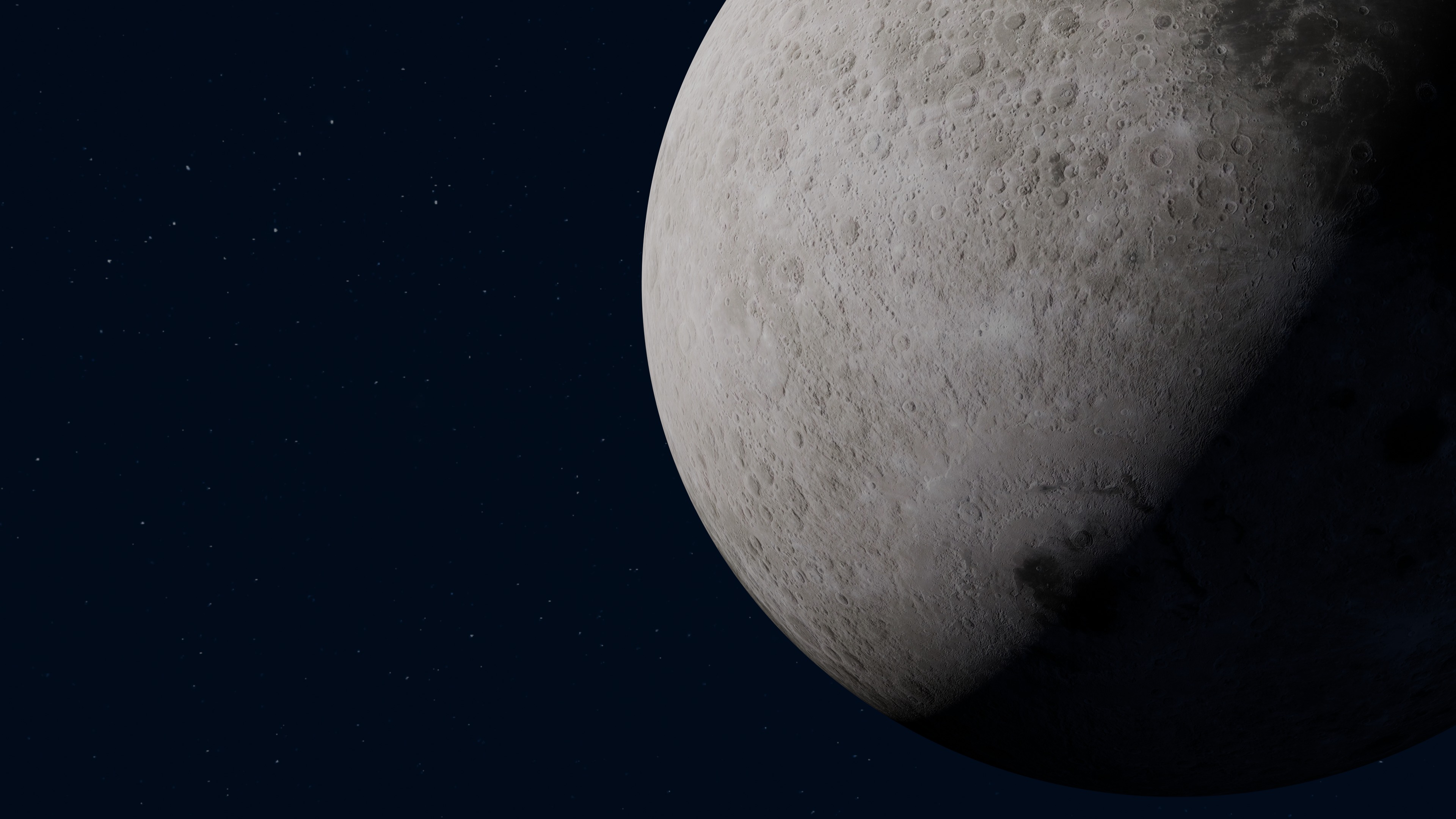
The Moon is Earth's only natural satellite, about 384,400 kilometres away on average. It is the fifth largest moon in the solar system, and of all the moons that circle planets it is the largest compared with the planet it orbits.
It has almost no air, no liquid water on its surface and no weather. With nothing to wear the ground down except the slow rain of meteorites, its surface is a museum. Footprints left by the Apollo astronauts are still there, and rocks they collected have barely changed in billions of years.
The Moon steadies the tilt of Earth's axis, which helps keep our seasons and climate stable over long periods. It also drives most of the ocean tides, and it has set the rhythm of calendars, festivals and farming for as long as people have kept records.
How the Moon was born
The leading idea is that the Moon formed from a collision. About 4.5 billion years ago, when Earth was still young, a body roughly the size of Mars, often called Theia, struck it a glancing blow. Molten rock and vapour were thrown into orbit, and within a short time much of that debris came together as the Moon.
The strongest clue comes from Apollo samples. Moon rocks have almost exactly the same mix of oxygen isotopes as rocks on Earth, which fits a shared origin. The Moon also has only a small iron core, which fits the idea that it was built mostly from rocky outer layers rather than metal.
Early on, so much heat was released that the Moon's outer layers melted into a global ocean of magma. Light minerals floated to the top and cooled into the pale crust of the highlands, the oldest ground you can see when you look up.
One face, phases and tides
The Moon turns on its axis in exactly the time it takes to go around Earth, so it always keeps the same face towards us. This is called tidal locking, and Earth's gravity slowed the Moon's spin to this point long ago. Because its orbit is slightly oval and tilted, it seems to rock a little, and over time we can see about 59% of its surface.
The side facing away is often called the dark side, but it gets just as much sunlight as the near side. It is only hidden from us. Phases happen because we see different amounts of the sunlit half as the Moon goes around Earth, from a thin crescent to full and back again over about 29.5 days.
The Moon's gravity pulls the oceans into two bulges, one facing the Moon and one on the far side, and Earth turns underneath them, which gives most coastlines two high tides a day. That same tidal pull is slowly braking Earth's spin, making our days longer by a tiny fraction of a second each century, and pushing the Moon about 3.8 centimetres farther away every year. Lasers bounced off mirrors left by Apollo astronauts measure that drift to within millimetres.
The surface
Two kinds of ground make up the Moon's face. The bright highlands are ancient crust, battered by craters. The dark patches, called maria or seas, are huge plains of basalt lava that flooded old impact basins, mostly more than three billion years ago, though Chang'e 5 brought back lava only about two billion years old. Early astronomers thought they were water, and the names stuck.
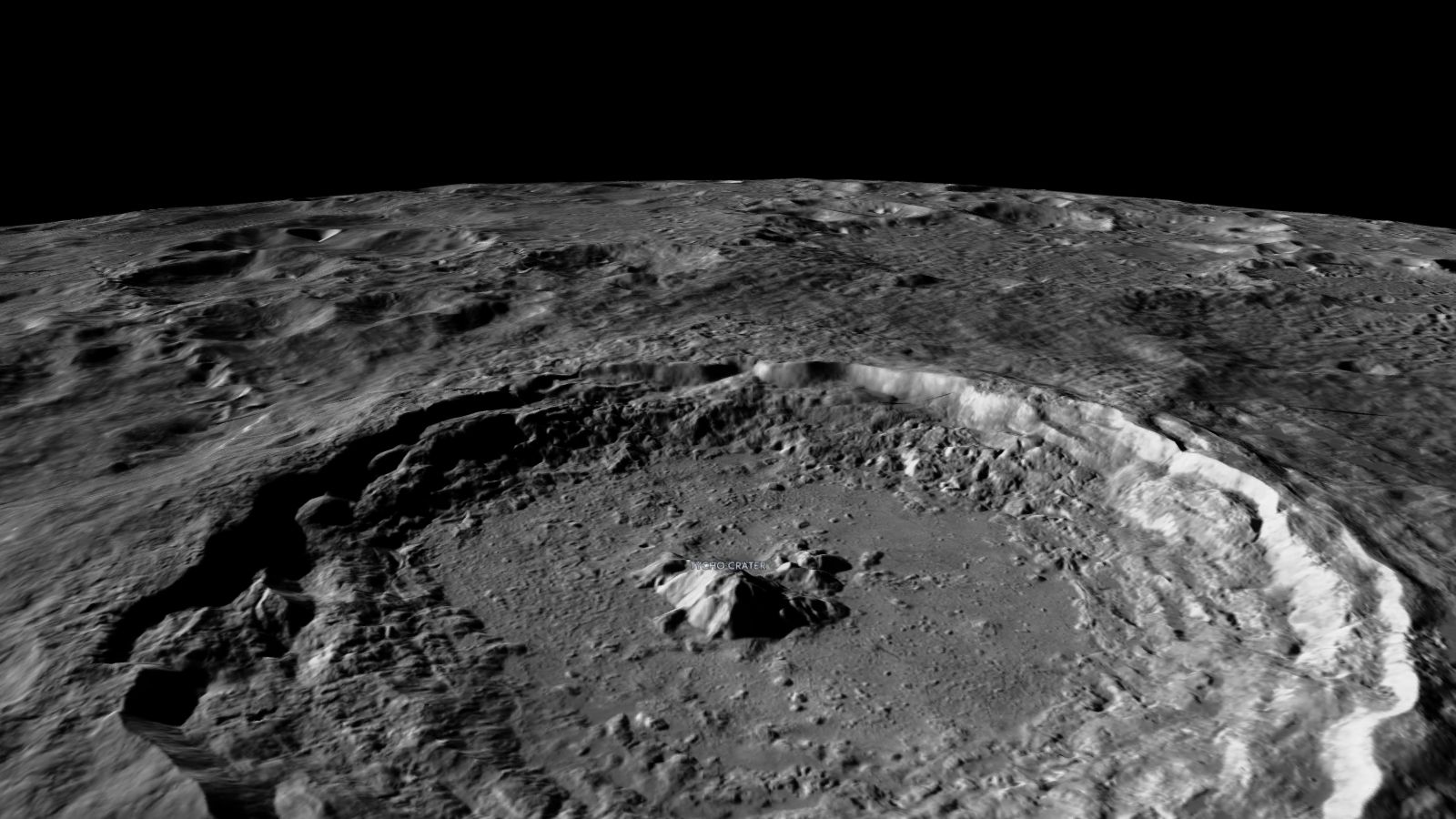
Craters come in every size. Tycho, about 85 kilometres wide and young by lunar standards at around 100 million years old, throws bright rays of debris across much of the near side. Copernicus has terraced walls and central peaks. Aristarchus is one of the brightest spots on the Moon, easy to find even without a telescope.
Some features look almost designed. Rupes Recta, the Straight Wall, is a fault about 110 kilometres long. Mare Orientale, on the western edge, is a bullseye of rings nearly 1,000 kilometres across, left by one of the last giant impacts.
The far side looks different again, with thicker crust and very few dark seas. It also holds the South Pole Aitken basin, about 2,500 kilometres across and one of the largest known impact craters in the solar system.
Everything is covered in regolith, a layer of crushed rock and glassy dust made by billions of years of impacts. It is fine, sharp and clings to everything. Apollo crews found it scratched visors, jammed seals and smelled like spent gunpowder once it came back into the cabin.
Inside the Moon
The Moon has a crust, a thick rocky mantle and a small core rich in iron. Seismometers left by Apollo crews recorded thousands of moonquakes until they were switched off in 1977. Some come from deep inside, triggered by Earth's tides, and some are shallow and surprisingly strong.
When a used Apollo lunar module was deliberately crashed into the surface in 1969, the instruments recorded the Moon vibrating for close to an hour. Dry, cold rock carries vibrations much further than the wet rock of Earth.
The Moon is also shrinking slightly as its interior cools. Images from NASA's Lunar Reconnaissance Orbiter show thousands of small cliffs where the crust has been squeezed, and some of the shallow moonquakes may come from these faults.
Ice at the poles
The Moon's axis is barely tilted, so near the poles the Sun always skims the horizon. The floors of some deep craters there have not seen sunlight for billions of years, and they are among the coldest places measured in the solar system, colder than −230 °C.
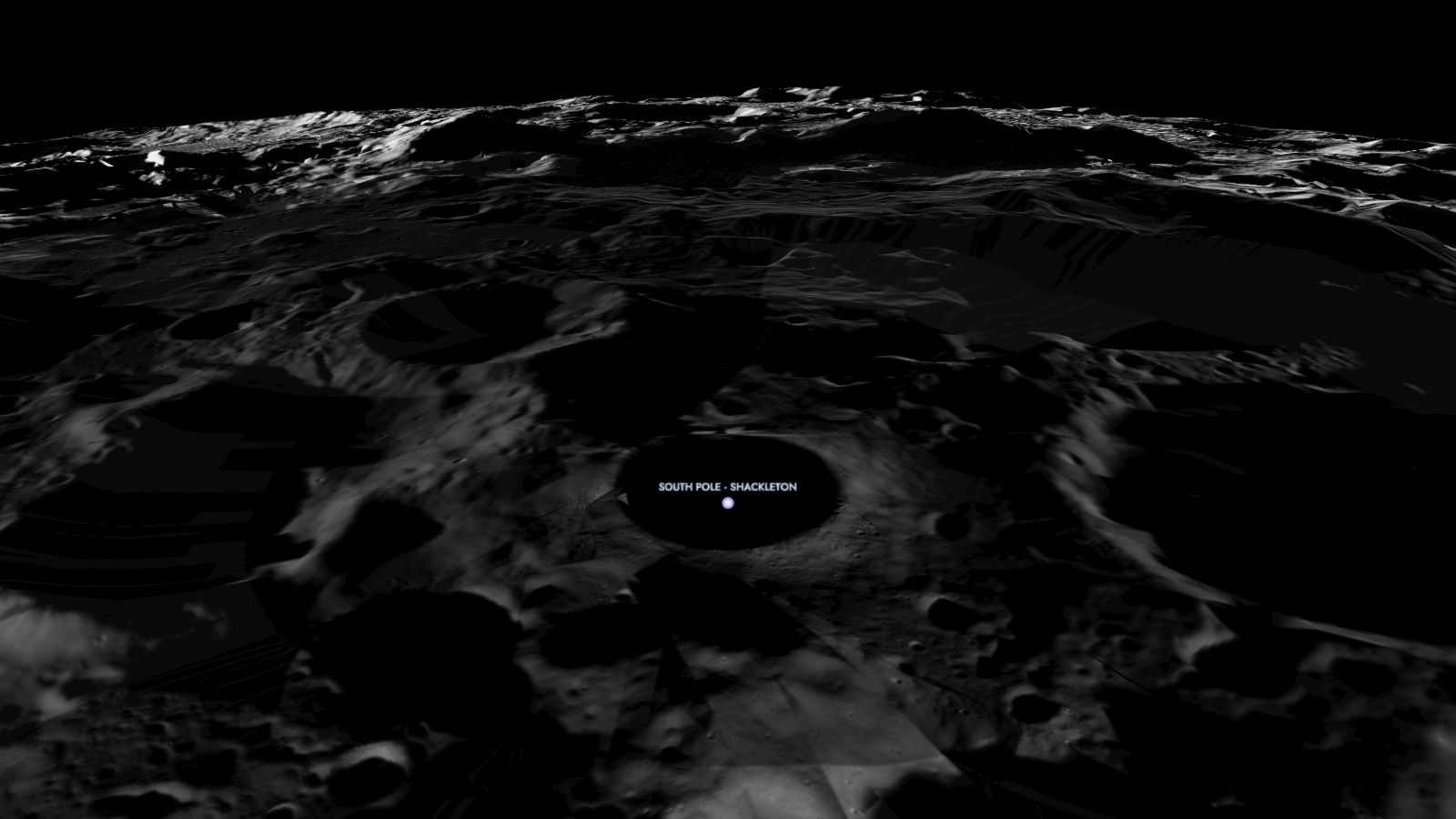
Those craters can trap water ice. In 2009 NASA crashed a spent rocket stage into one of them, and the plume of debris it threw up contained water. Later analysis of data from India's Chandrayaan-1 orbiter found clear signs of exposed ice in shadowed spots at both poles.
Ice matters because it can be turned into drinking water, oxygen and even rocket fuel. That is why the region around the south pole, near craters such as Shackleton, has become the target for the next wave of landers and for NASA's Artemis astronauts.
Apollo
Between 1969 and 1972, NASA's Apollo program landed six crews on the Moon. Twelve astronauts walked on its surface, and they brought back 382 kilograms of rock and soil that scientists are still studying today.
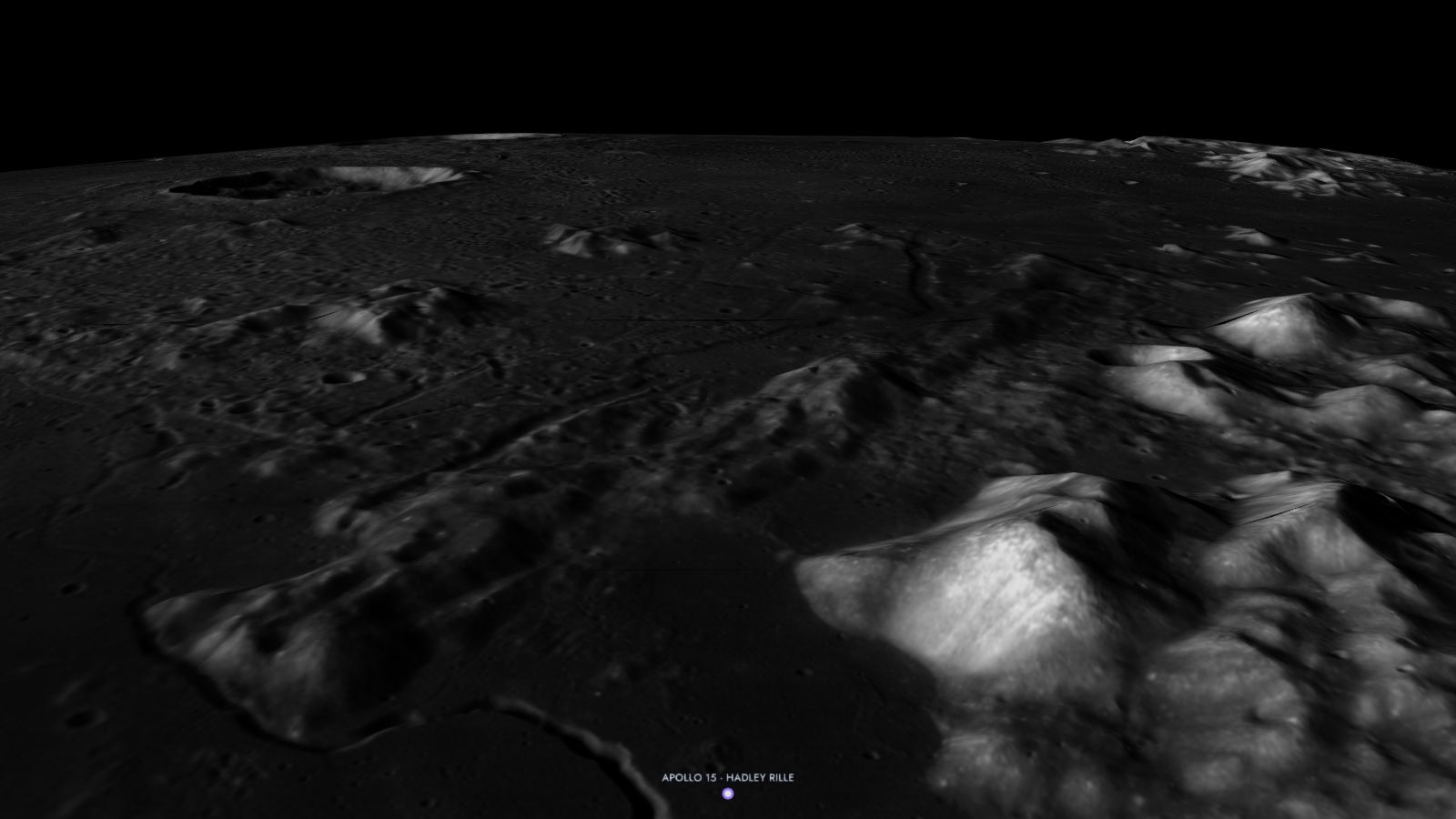
Apollo 11 landed on the Sea of Tranquility on 20 July 1969, and Neil Armstrong and Buzz Aldrin spent about two and a half hours outside. Each landing after that went somewhere harder and more interesting. Apollo 15 set down beside the winding Hadley Rille with the first crewed lunar rover, and Apollo 17 explored a valley in the Taurus Littrow region, with geologist Harrison Schmitt on the crew.
Apollo 13 never landed. An oxygen tank exploded on the way, and the crew looped around the Moon and made it home safely. Apollo 17 left the Moon in December 1972, and no one has been back since.
Robots, and the return of people
The Soviet Union reached the Moon first with robots. Luna 2 hit it in 1959, Luna 3 sent back the first photos of the far side that year, and Luna 9 made the first soft landing in 1966. In 1970 Luna 16 returned soil automatically, and Lunokhod 1 became the first rover on another world.
After a long pause, the Moon got busy again. China landed Chang'e 3 in 2013, then put Chang'e 4 down on the far side in 2019, a first. Chang'e 5 brought samples home in 2020, and Chang'e 6 returned the first samples from the far side in 2024. India's Chandrayaan 3 landed in the south polar region in 2023, farther south than any earlier lander, and Japan's SLIM landed about 55 metres from its target in 2024, well inside its 100 metre goal, though it ended up tipped on its nose.
Private companies have joined in. Intuitive Machines' Odysseus made the first commercial landing in 2024, though it tipped over, and Firefly's Blue Ghost landed upright and completed its mission in 2025.
NASA's Artemis program aims to put astronauts back on the surface near the south pole. Artemis III, planned for 2027, will test docking with the new landers in orbit around Earth, and Artemis IV is planned to land in 2028. Artemis I flew an uncrewed Orion capsule around the Moon in 2022. In April 2026, Artemis II carried four astronauts around the Moon and back: Reid Wiseman, Victor Glover, Christina Koch and Canadian Jeremy Hansen, the first person from outside the United States to fly to the Moon.
Seeing the Moon
The best time to look is not at full Moon. When the Moon is a crescent or half lit, the Sun shines across the surface at a low angle along the line between day and night, and craters and mountains throw long shadows. Even binoculars show a lot.
A few days after new Moon, you may see the dark part faintly glowing. That is earthshine: sunlight bounced off Earth onto the Moon and back to your eyes.
The Moon looks bigger near the horizon, but that is an illusion of the brain, not the sky. It does genuinely change size a little, because its orbit is oval. A so-called supermoon, at its closest, looks about 14% wider than a full Moon at its farthest.
When Earth passes exactly between the Sun and the Moon, we get a lunar eclipse, and the Moon turns coppery red from sunlight bent through Earth's atmosphere, the light of every sunrise and sunset on Earth at once.
Open questions
Exactly how did the giant impact happen, and why are Earth and Moon rocks so similar if much of the Moon should have come from the impactor?
How much ice is really hidden at the poles, where did it come from, and is it pure enough and easy enough to reach to support people?
Why are the near side and the far side so different, with lava seas on one face and almost none on the other?
And how will people live there: dust, radiation, two week nights and the challenge of building with what is already on the ground.
Missions
Firsts and milestones at the Moon, by year. Landing sites you can fly to are linked.
- 1959Luna 2 and Luna 3 Soviet Union
Luna 2 was the first spacecraft to reach another world, crashing into the Moon. Luna 3 sent back the first photos of the far side.
- 1966Luna 9 Soviet Union
First soft landing and first pictures from the surface. NASA's Surveyor 1 followed a few months later.
- 1968Apollo 8 NASA
First people to orbit the Moon, and the famous Earthrise photograph.
- 1969Apollo 11 NASA
Neil Armstrong and Buzz Aldrin become the first people to walk on the Moon. Fly to the landing site
- 1969Apollo 12 NASA
A pinpoint landing beside the Surveyor 3 probe, which the crew visited on foot. Fly to the landing site
- 1970Luna 16 and Lunokhod 1 Soviet Union
The first robotic sample return, and the first remote controlled rover on another world. Fly to the landing site
- 1971Apollo 14 NASA
Explored the hilly Fra Mauro region, the original target of Apollo 13. Fly to the landing site
- 1971Apollo 15 NASA
The first rover driven by astronauts, taken along the edge of Hadley Rille. Fly to the landing site
- 1972Apollo 16 NASA
The only landing in the central highlands. Fly to the landing site
- 1972Apollo 17 NASA
The last crewed landing so far, with the first scientist on the Moon. Fly to the landing site
- 2009LRO and LCROSS NASA
Lunar Reconnaissance Orbiter began mapping the whole Moon in fine detail. LCROSS crashed into a polar crater and found water.
- 2019Chang'e 4 China
First landing on the far side, with the Yutu 2 rover. Fly to the landing site
- 2020Chang'e 5 China
The first samples brought back from the Moon since 1976. Fly to the landing site
- 2022Artemis I NASA
An uncrewed Orion capsule flew around the Moon and back on the first Space Launch System rocket.
- 2023Chandrayaan 3 India
The first landing in the south polar region, making India the fourth country to land on the Moon. Fly to the landing site
- 2024SLIM, Odysseus and Chang'e 6 Japan, Intuitive Machines and China
Japan's pinpoint landing, the first commercial landing, and the first samples from the far side.
- 2025Blue Ghost Mission 1 Firefly Aerospace
The first commercial lander to touch down upright and complete its mission.
- 2026Artemis II NASA, with the Canadian Space Agency
In April, four astronauts, including Canada's Jeremy Hansen, flew around the Moon, the first crew to leave Earth orbit since 1972.
Fly there yourself
Every place on this page is real terrain in Starfall's 3D explorer. Pick one and the camera flies you there, with narration when you arrive.
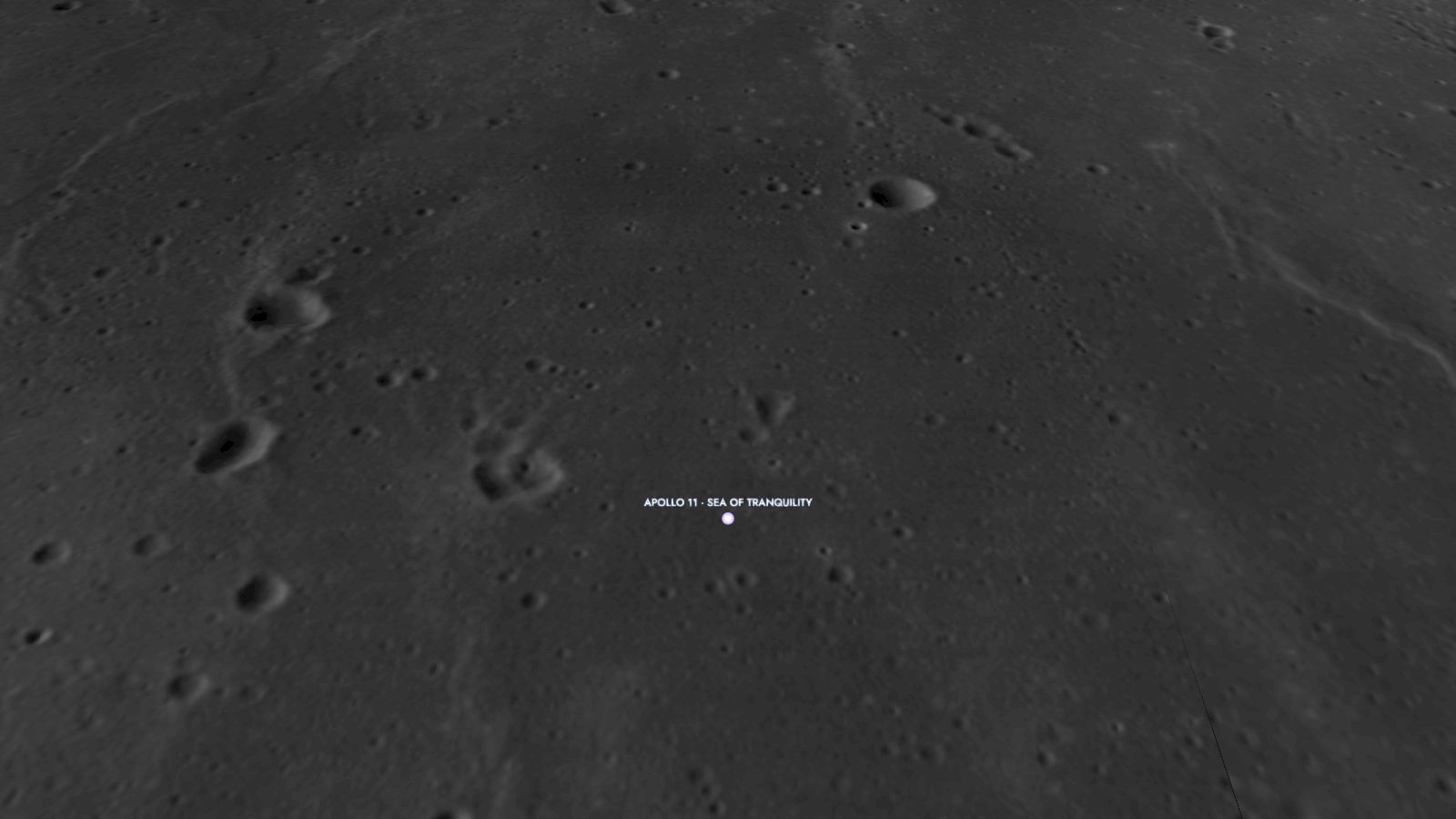 Apollo 11 · Sea of TranquilityWhere the first footprints were made.Apollo 15 · Hadley RilleA landing beside a winding lava channel.Tycho craterA young crater with rays across the Moon.
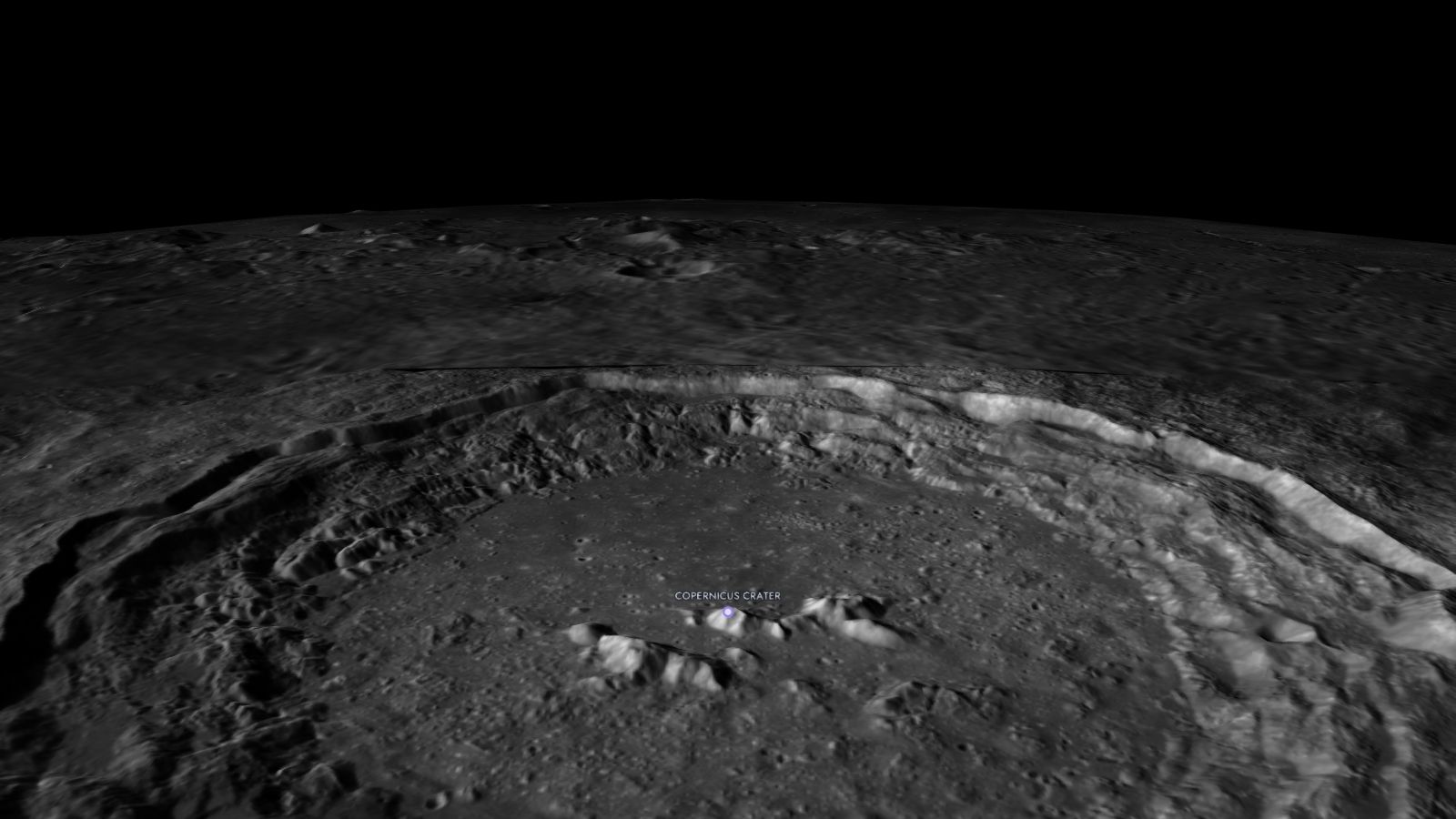 Copernicus craterTerraced walls and central peaks.South pole · ShackletonPermanent shadow, buried ice, and the Artemis target.
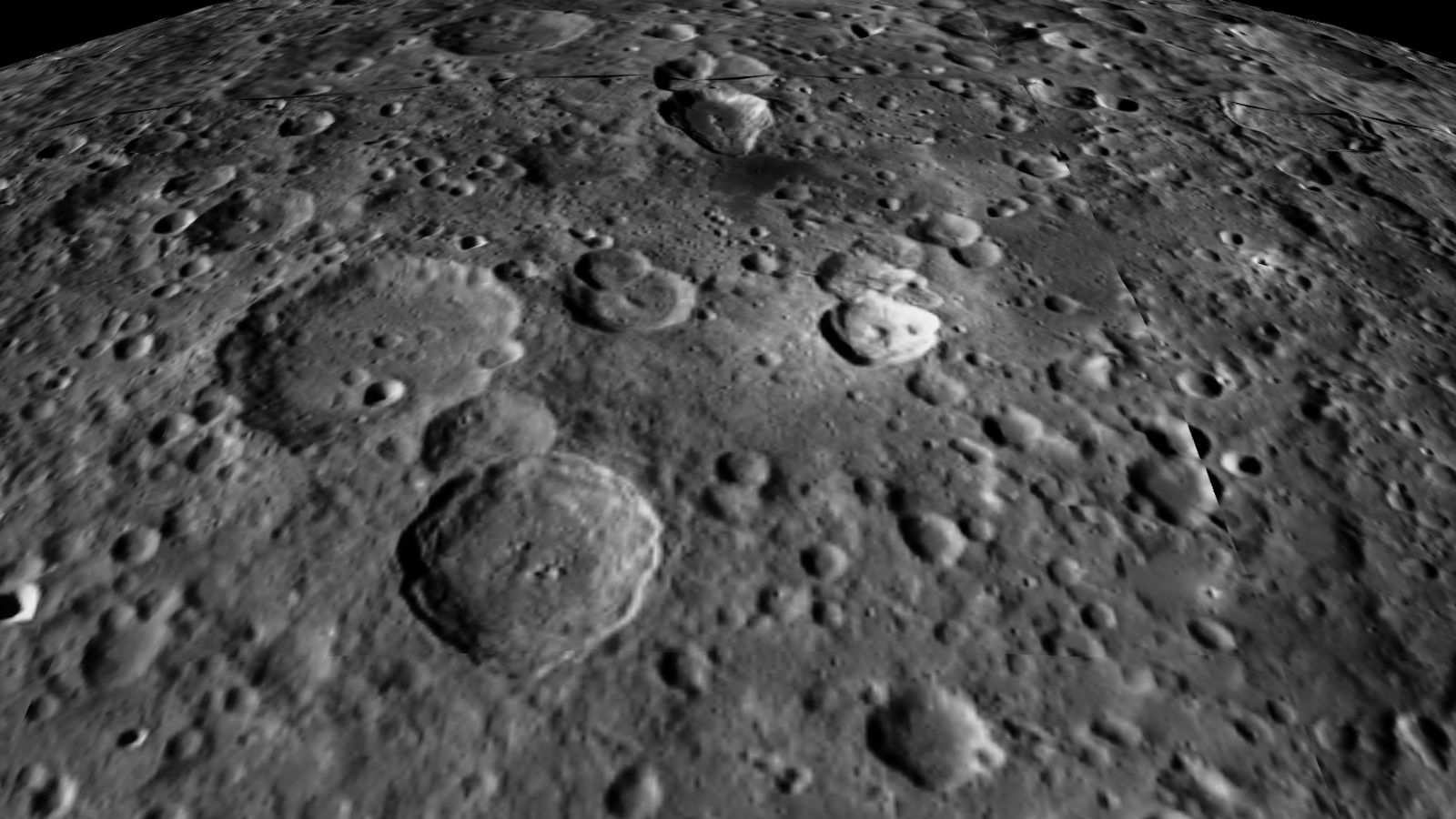 The far sideThe side that always faces away from Earth.
All places on The Moon
- Apollo 11 · Sea of Tranquility
- Apollo 12 · Ocean of Storms
- Apollo 14 · Fra Mauro
- Apollo 15 · Hadley Rille
- Apollo 16 · Descartes highlands
- Apollo 17 · Taurus Littrow
- Lunokhod 1
- Chang'e 5
- Chang'e 4 · far side
- Chandrayaan 3
- Copernicus crater
- Tycho crater
- Aristarchus crater
- Rupes Recta · Straight Wall
- Mare Orientale
- South pole · Shackleton
- The far side
Sources
- NASA Moon Fact Sheet (NSSDC)
- NASA Science: Earth's Moon
- NASA: Apollo program
- NASA: Artemis
- Canadian Space Agency: Artemis II returns to Earth
- NASA: Lunar Reconnaissance Orbiter
Facts were checked against these sources by a separate review before publishing. Spotted something out of date? Space moves fast, and this page is updated as missions report back.