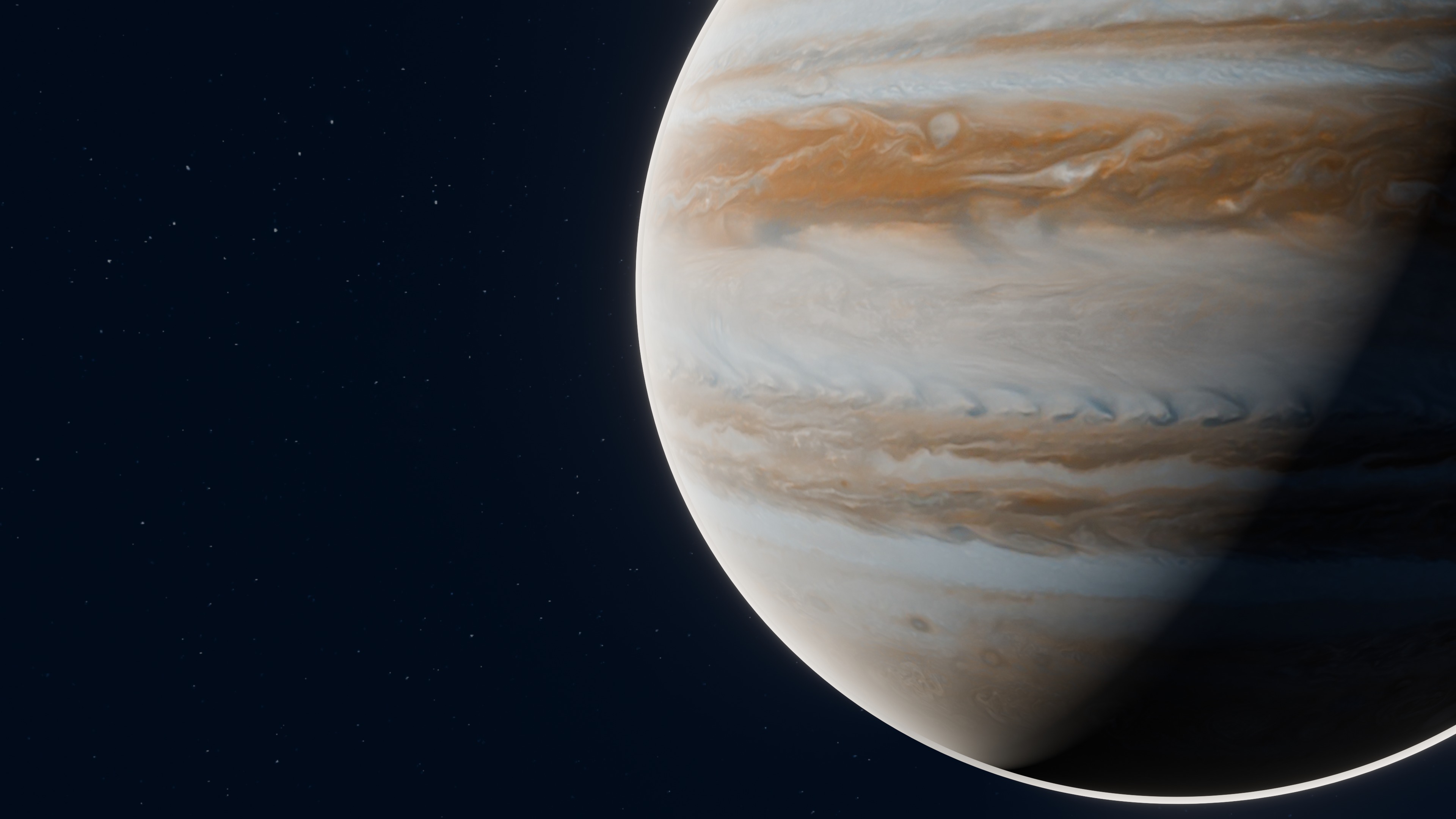
Quick facts
- Width at the equator
- about 142,980 kmabout 11 Earths across
- Mass
- 318 Earths2.5 times all other planets combined
- Gravity at the cloud tops
- 25.9 m/s²about 2.6 times Earth, averaged over the planet
- Length of a day
- 9 h 56 minthe fastest spin of any planet
- Length of a year
- 11.9 Earth years4,333 Earth days
- Distance from the Sun
- 741 to 816 million kmabout 5.2 times farther
- Temperature at the cloud tops
- about −110 °Cat the 1 bar level
- Made of
- about 90% hydrogenand about 10% helium by number of molecules
- Axial tilt
- 3.1°almost no seasons
- Fastest winds
- about 540 km/hin the bands near the equator
- Moons
- 115 officially recognisedand more being found
- Escape velocity
- 59.5 km/smore than 5 times Earth
Jupiter at a glance
Jupiter is the fifth planet from the Sun and by far the largest. More than 1,300 Earths could fit inside it, and it holds more than twice the mass of every other planet combined.
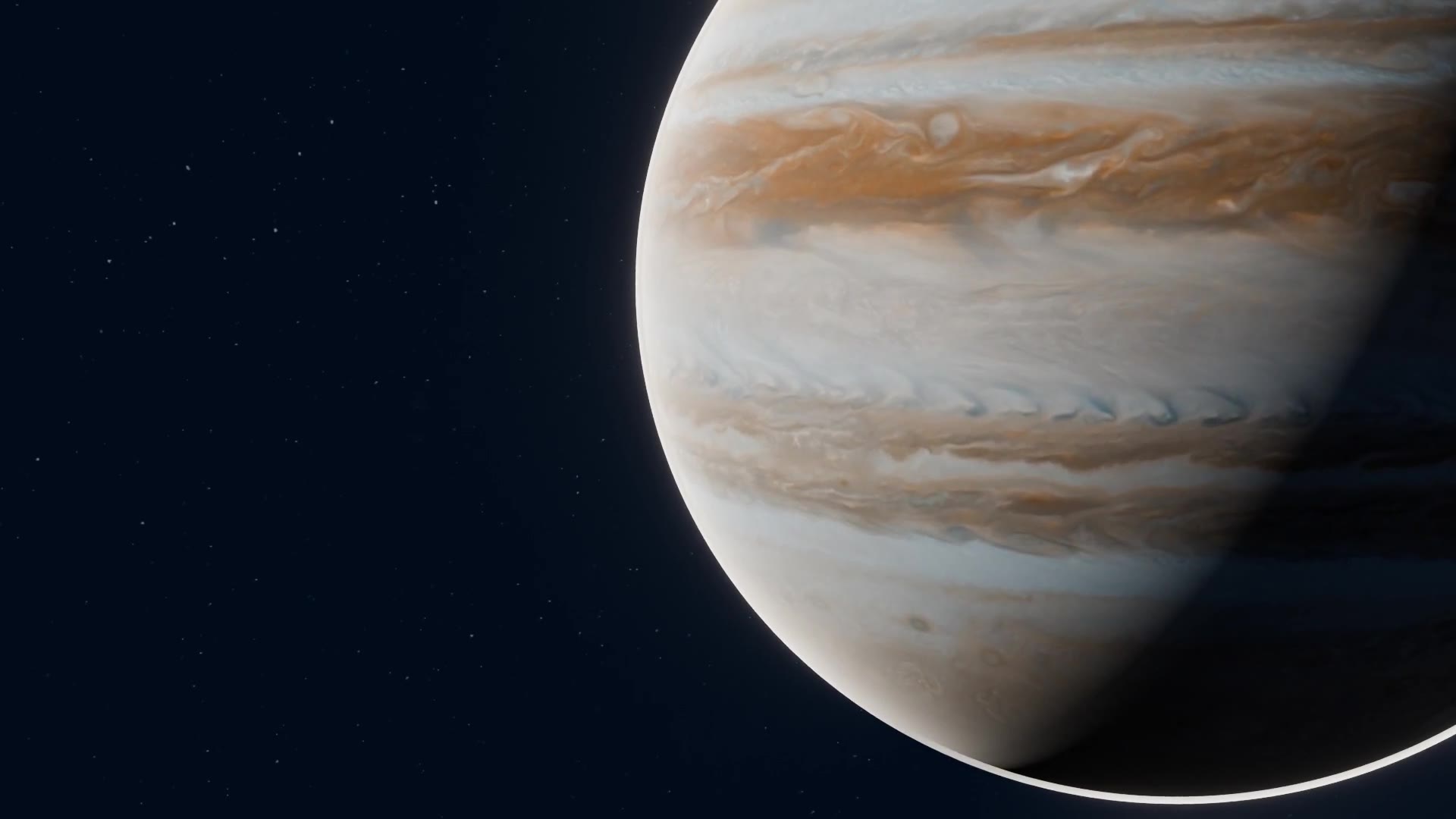
It is a gas giant. There is no ground to stand on, only clouds that get thicker, hotter and denser the deeper you go, until the gas is squeezed into strange liquid forms. The colours we see are the very top of that atmosphere.
Its gravity has shaped the whole solar system. It probably steered asteroids and comets, may have helped move water towards the inner planets, and still nudges anything that passes nearby.
Not quite a star
Jupiter is made of much the same ingredients as the Sun, mostly hydrogen and helium, which is why it is sometimes called a failed star. That is a long way from true. To squeeze its core hard enough to fuse hydrogen, Jupiter would need roughly 80 times more mass than it has.
It does glow a little in infrared, though. Jupiter gives off more heat than it receives from the Sun, left over from its formation and from the planet slowly contracting. It shrinks by about two centimetres a year.
Inside Jupiter
Under the clouds, the pressure rises so high that hydrogen turns into a liquid. Deeper still, thousands of kilometres down, it becomes metallic hydrogen, a liquid that conducts electricity like a metal. Currents swirling in that layer generate Jupiter's huge magnetic field.
Scientists expected a small, solid core at the centre. NASA's Juno spacecraft, which has been mapping Jupiter's gravity since 2016, found something stranger: a large, fuzzy or dilute core, where heavy elements seem to blend gradually into the hydrogen around them. One idea was that a giant collision early in Jupiter's life stirred it up, but recent computer simulations suggest the core more likely formed gradually as Jupiter grew.
Clouds, storms and lightning
Jupiter's stripes are bands of cloud. The pale zones are rising gas topped with ammonia ice clouds, and the darker belts are where gas sinks and we see deeper, warmer layers. Winds race east and west in opposite directions between the bands, at up to about 540 kilometres an hour.
The Great Red Spot is a storm larger than Earth that has been watched without a break since at least 1831, nearly 200 years. A spot seen in the 1600s may have been a different storm. It has been shrinking: in the late 1800s it was about 40,000 kilometres long, and today it is less than half that, though still wider than our planet. Juno found that its roots reach hundreds of kilometres down.
There are thousands of smaller storms, lightning bolts far more powerful than those on Earth, and, at both poles, clusters of giant cyclones arranged in neat geometric patterns that Juno was the first to see.
A giant magnetic bubble
Jupiter's magnetic field is the strongest of any planet. At the cloud tops it is about 16 to 54 times stronger than Earth's, and because the planet is so huge, its magnet as a whole is about 20,000 times more powerful. The bubble it creates in space, the magnetosphere, is so large that if you could see it from Earth it would look bigger than the full Moon. Its tail stretches out past the orbit of Saturn.
That field traps charged particles into intense radiation belts, deadly to people and damaging to electronics. Spacecraft that visit have to be armoured. Juno keeps its most sensitive electronics inside a titanium vault.
The trapped particles also make permanent auroras at Jupiter's poles, hundreds of times more energetic than Earth's northern lights, glowing mostly in ultraviolet.
Faint rings
Jupiter has rings, but they are thin, dark and made of fine dust rather than ice, so they are almost invisible from Earth. Voyager 1 discovered them in 1979. The dust is knocked off small inner moons by meteorite impacts.
The moons
Jupiter has 115 officially recognised moons as of 2026, and astronomers keep finding more small ones. Most are only a few kilometres across and probably captured asteroids. Four are worlds in their own right. Galileo Galilei discovered them in 1610, and seeing them circle Jupiter helped show that not everything in the sky goes around Earth.
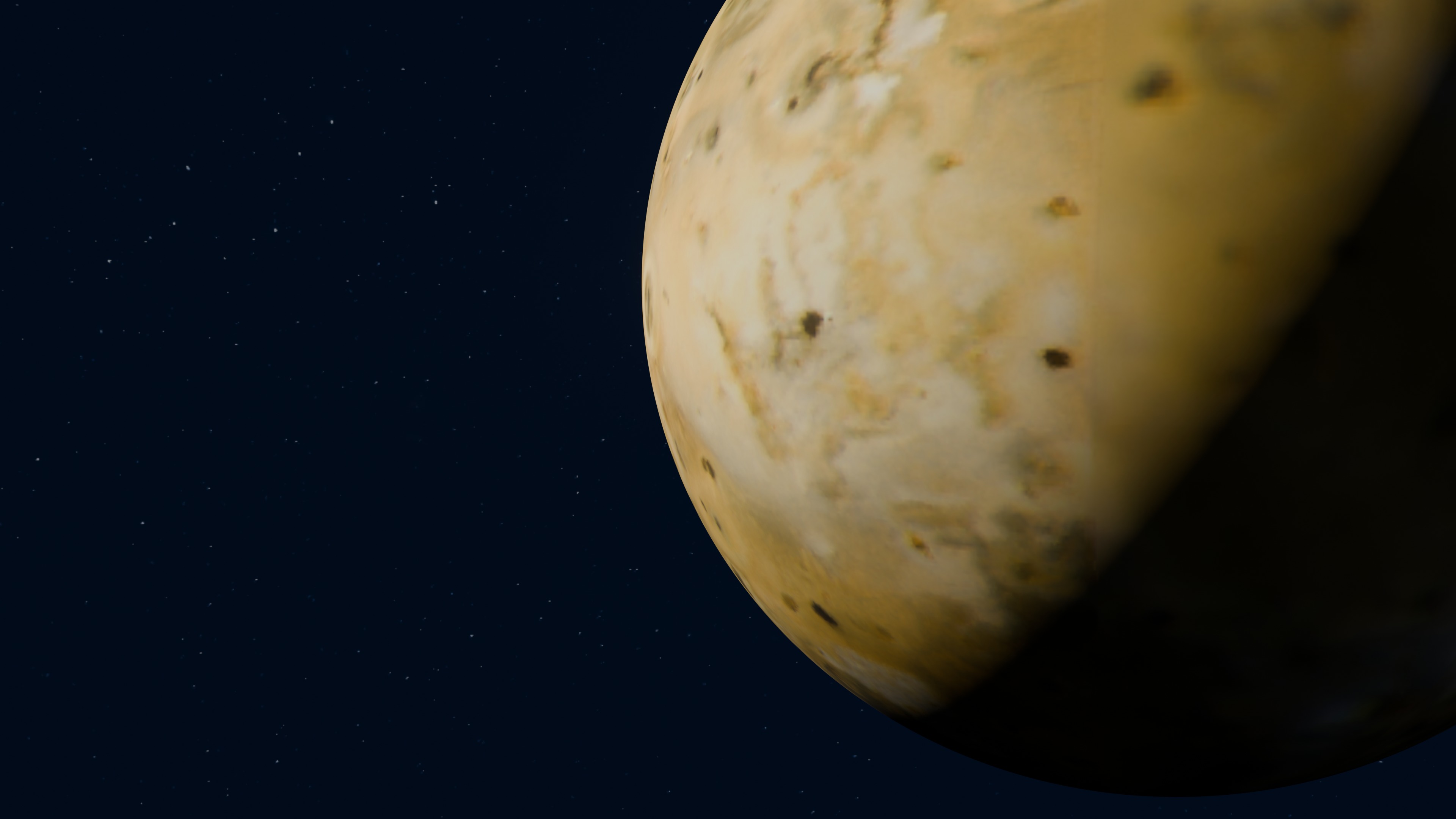
Io is the most volcanically active body in the solar system, with hundreds of volcanoes and lava lakes. Jupiter's gravity, tugged by its neighbours, flexes Io's interior constantly and keeps it molten.
Europa is covered by a shell of ice over a salty ocean that probably holds more water than all of Earth's oceans. It is one of the best places to look for life beyond Earth, and NASA's Europa Clipper is on its way to study it.
Ganymede is the largest moon in the solar system, bigger than the planet Mercury, and the only moon known to have its own magnetic field. It also seems to hide an ocean under its ice. Callisto, the outermost of the four, is one of the most heavily cratered surfaces known, and it too may have a deep ocean.
The cosmic vacuum cleaner
In July 1994, the world watched more than 20 fragments of comet Shoemaker Levy 9 slam into Jupiter, leaving dark scars in its clouds larger than Earth. It was the first time people had seen two solar system bodies collide.
Amateur astronomers have since recorded several smaller impacts as brief flashes on the planet. Jupiter's gravity captures or deflects many objects that might otherwise cross the inner solar system, though it can also fling some inwards.
Seeing Jupiter
Jupiter is usually the brightest thing in the night sky after the Moon and Venus. It comes to opposition, its best and brightest, about every 13 months.
Even a pair of steady binoculars shows the four big moons as tiny points of light in a line, changing position from night to night. A small telescope shows the cloud belts, and on good nights the Great Red Spot.
Open questions
How did Jupiter end up with a dilute core, and how did it grow so big so quickly?
How deep do the winds and storms go, and what keeps the Great Red Spot going for centuries?
Is there life, or at least the chemistry for it, in the ocean under Europa's ice?
And did Jupiter drift inwards and back out again early on, rearranging the inner solar system as some models suggest?
Missions
Every spacecraft that has visited Jupiter, by the year it arrived, plus the two now on their way.
- 1973Pioneer 10 NASA
First spacecraft to cross the asteroid belt and fly past Jupiter. Pioneer 11 followed in 1974.
- 1979Voyager 1 and 2 NASA
Discovered active volcanoes on Io and the faint rings, and returned the first detailed views of the Great Red Spot.
- 1992Ulysses ESA and NASA
Used Jupiter's gravity to swing out of the planets' plane to study the Sun's poles.
- 1995Galileo NASA
The first spacecraft to orbit Jupiter. It dropped a probe into the atmosphere and found strong evidence for Europa's ocean, then was steered into Jupiter in 2003.
- 2000Cassini NASA, ESA and ASI
Took detailed images on its way past to Saturn.
- 2007New Horizons NASA
Used a Jupiter flyby to speed up on its way to Pluto, filming a giant eruption on Io.
- 2016Juno NASA
A solar powered orbiter in a looping path over the poles, mapping the interior, the magnetic field and the polar cyclones.
- 2023JUICE launched ESA
The Jupiter Icy Moons Explorer, due in 2031. It will study Ganymede, Callisto and Europa, then orbit Ganymede.
- 2024Europa Clipper launched NASA
Due to arrive in 2030 and fly past Europa dozens of times to study its ice shell and ocean.
Sources
- NASA Jupiter Fact Sheet (NSSDC)
- NASA Science: Jupiter facts
- NASA Science: Jupiter
- NASA: Juno mission
- NASA: Europa Clipper
- ESA: JUICE
Facts were checked against these sources by a separate review before publishing. Spotted something out of date? Space moves fast, and this page is updated as missions report back.