Quick facts
- Diameter
- 3,122 kma little smaller than our Moon
- Mass
- 4.80 × 10²² kg0.8% of Earth
- Surface gravity
- 1.31 m/s²13% of Earth
- Distance from Jupiter
- 671,100 km1.7 times our Moon's distance from Earth
- One orbit (and one day)
- 3.55 Earth daysit always shows Jupiter the same face
- Surface temperature
- about −160 °C at the equatordown to about −220 °C near the poles
- Ice shell
- probably about 15 to 25 km thickestimates range more widely
- Ocean depth
- probably about 60 to 150 kmEarth's deepest ocean trench is about 11 km
- Water
- about twice the water in Earth's oceansif the ocean is as deep as models suggest
- Atmosphere
- an extremely thin layer of oxygenfar too thin to breathe
- Discovered
- January 1610by Galileo Galilei
- Order from Jupiter
- second of the four large moonsthe smallest of them
At a glance
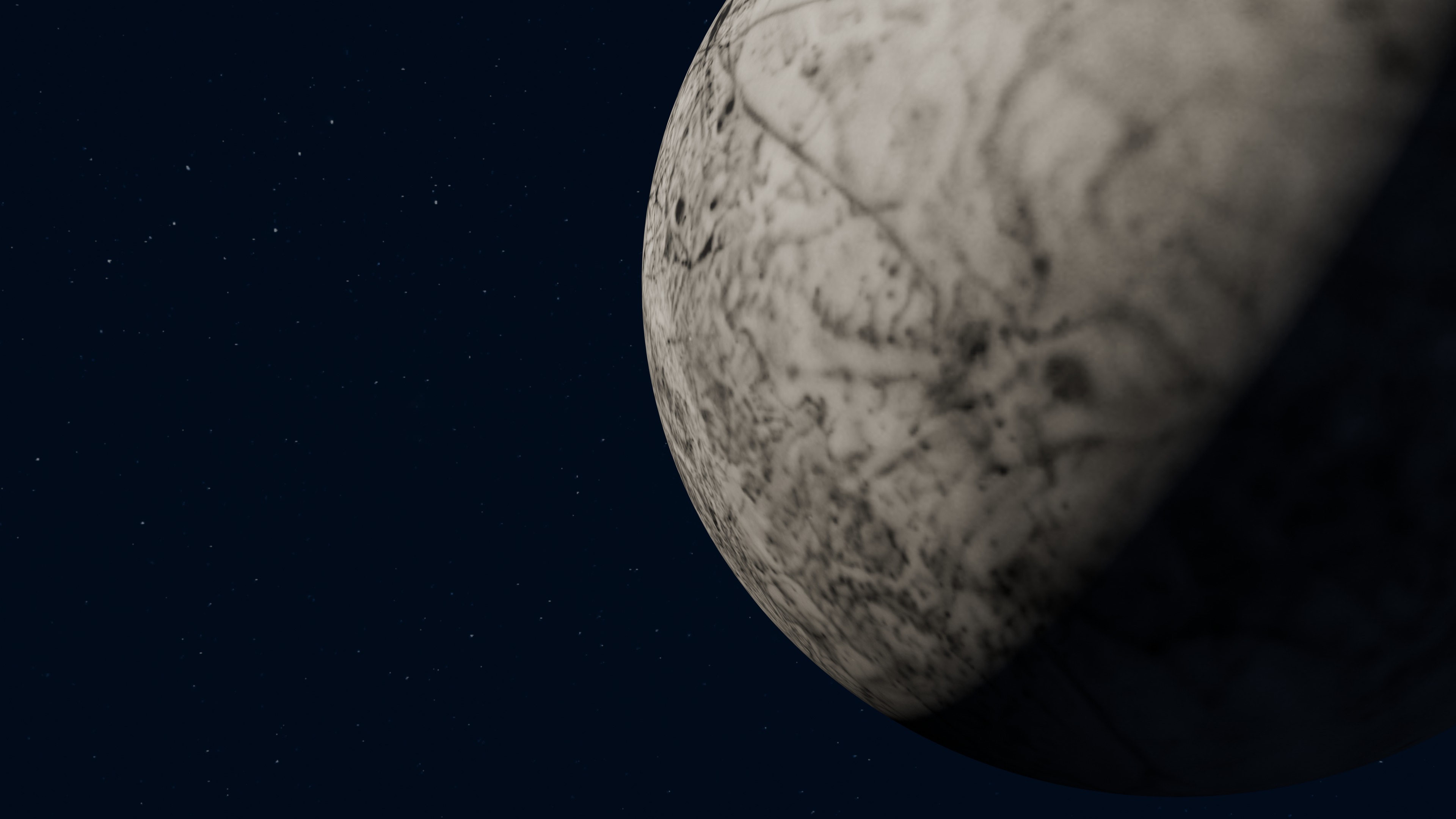
Europa is the smallest of the four large moons of Jupiter, slightly smaller than our Moon. Its surface is one of the smoothest in the solar system: bright water ice crossed by long reddish brown cracks and ridges, with very few craters.
Beneath the ice lies an ocean of liquid salt water, kept from freezing by heat generated as Jupiter's gravity flexes the moon. Scientists are confident it is there, and that it is global, wrapping all the way around the moon.
The ocean sits on top of a rocky seafloor, where water and rock could react as they do around hydrothermal vents on Earth's ocean floor. Liquid water, chemical energy and the right elements are three of the things life as we know it needs, which is why Europa is a prime target in the search for life.
There is no evidence of life on Europa. The point is that it is one of very few places where the conditions might allow it.
Orbit and tidal heating
Europa orbits Jupiter every 3.55 days, always keeping the same face towards the planet, just as our Moon does with Earth.
It is locked in a rhythm with its neighbours: Io orbits twice for each Europa orbit, and Ganymede once for every two. These regular tugs keep Europa's orbit slightly stretched, so Jupiter's pull on it changes as it goes round.
The resulting tides flex the moon's ice shell and interior and generate heat. That heat, together with heat from the decay of radioactive elements in the rock, keeps the ocean liquid. Io, closer in, is heated so strongly that it erupts with volcanoes; Europa gets enough to keep an ocean warm under the ice.
How we know the ocean is there
The strongest evidence came from NASA's Galileo spacecraft in the late 1990s. Jupiter's magnetic field sweeps past Europa, and Galileo detected that Europa responds by producing a magnetic field of its own that changes in step. The simplest explanation is a layer of electrically conducting liquid, salty water, not far below the surface.
The surface itself supports the idea. The cracks and ridges, the scarcity of craters and the jumbled areas called chaos terrain all suggest ice that moves and breaks over something soft or liquid.
Measurements of Europa's gravity show it has an iron core, a rocky mantle and an outer layer of water about 100 kilometres thick in total. Most of that is thought to be liquid, under a solid ice shell. How thick the shell is remains one of the big open questions; most estimates fall between about 15 and 25 kilometres, though some are thinner and some thicker.
If the ocean is as deep as models suggest, it holds roughly twice as much water as all of Earth's oceans combined.
Cracks, ridges and chaos
Europa's surface is covered in lineae, long dark lines that are cracks in the ice, often edged by ridges. Some run for more than a thousand kilometres. They probably form as tides stretch and squeeze the shell, and some may open and close slightly on every orbit.
In places the surface looks as if it has broken into rafts of ice that drifted and refroze, like sea ice on Earth. These regions are called chaos terrain. Conamara Chaos is the best known example. One idea is that they form where warmer ice or water from below melts or weakens the shell.
The reddish brown colour along many cracks and in chaos regions probably comes from salts and sulphur compounds, some from the ocean below and some delivered by particles from Io and altered by radiation.
Europa's surface is young, perhaps 40 to 90 million years old on average, which means it is still being renewed. Pwyll, one of its largest young craters, sprays bright rays of ice across the surface.
Chemistry and possible plumes
In 2023 the James Webb Space Telescope detected carbon dioxide on Europa's surface, concentrated in a chaos region called Tara Regio. Its distribution suggests the carbon came from the ocean below, which matters because carbon is essential for life as we know it.
Radiation from Jupiter breaks apart the ice, producing oxygen and hydrogen peroxide. In 2024, scientists using Juno's measurements estimated Europa produces about 12 kilograms of oxygen per second, less than many earlier estimates. If some of this oxygen reaches the ocean, it could provide chemical energy for life.
The Hubble Space Telescope has seen possible plumes of water vapour above Europa a few times, and a reanalysis of old Galileo data supported one event. The detections are near the limit of what the instruments can do, and plumes have not been confirmed. If they exist, a spacecraft could sample ocean material without landing.
A harsh place to visit
Europa orbits inside Jupiter's intense radiation belts. An unprotected person standing on the surface would receive a deadly dose of radiation in about a day.
That radiation is a major challenge for spacecraft. NASA's Europa Clipper keeps its most sensitive electronics in a thick walled vault and will study Europa in dozens of quick flybys rather than from orbit, spending most of its time far from the worst radiation.
Discovery and naming
Galileo Galilei discovered Europa in January 1610, along with Io, Ganymede and Callisto. The four are still known as the Galilean moons.
Simon Marius proposed the name, after Europa, a Phoenician princess loved by Zeus in Greek mythology. For centuries it was mostly called Jupiter II; the name Europa became standard in the twentieth century.
The ice on its surface was identified from Earth in the 1950s and 1960s. The Voyager flybys of 1979 revealed the cracked, almost craterless surface and made the case for an ocean beneath it much stronger.
Seeing it from Earth
Europa is visible in ordinary binoculars as one of the four tiny points of light that line up beside Jupiter. Its position changes from night to night as it orbits.
In a small telescope you can see it cross in front of Jupiter and watch its shadow move over the cloud tops. Its bright ice makes it the most reflective of the four large moons.
Open questions
How thick is the ice shell, and are there pockets of water within it close to the surface?
Is the ocean in contact with hot rock at the seafloor, and does it have the chemical energy life would need?
Do plumes really vent ocean water into space? Two spacecraft are on their way to find out: NASA's Europa Clipper, which will make about 49 close flybys, and ESA's JUICE, which will fly past Europa twice in 2032.
Missions
Europa has been studied by spacecraft passing through the Jupiter system, and two dedicated missions are now on their way.
- 1979Voyager 1 and 2 NASA
Revealed Europa's cracked, almost craterless icy surface.
- 1995Galileo NASA
Orbited Jupiter until 2003 and made eleven close Europa flybys. Its magnetic measurements gave the strongest evidence for a salty ocean.
- 2016Juno NASA
Flew about 350 km above Europa in September 2022, taking the most detailed images since Galileo, and measured how much oxygen Europa produces.
- 2023JUICE ESA
Launched in April 2023 and due at Jupiter in July 2031. It will make two Europa flybys in 2032 before settling into orbit around Ganymede.
- 2024Europa Clipper NASA
Launched in October 2024, the largest spacecraft NASA has ever built for a planetary mission. After swinging past Mars in 2025 and Earth in December 2026, it is due to reach Jupiter in April 2030 and make about 49 close flybys of Europa.
Sources
- NASA Jovian Satellite Fact Sheet (NSSDC)
- NASA Science: Europa
- NASA: Europa Clipper
- ESA: JUICE
- Kivelson et al. 2000, Galileo magnetometer measurements: a stronger case for a subsurface ocean at Europa (Science)
- Trumbo and Brown 2023, The distribution of CO2 on Europa indicates an internal source of carbon (Science)
- SwRI: Juno measures oxygen production on Europa (2024)
Facts were checked against these sources by a separate review before publishing. Spotted something out of date? Space moves fast, and this page is updated as missions report back.