Quick facts
- Diameter
- 3,643 km29% of Earth, a little larger than our Moon
- Mass
- 8.93 × 10²² kg1.5% of Earth
- Surface gravity
- 1.80 m/s²18% of Earth
- Distance from Jupiter
- 421,800 kmabout the same as our Moon from Earth
- One orbit (and one day)
- 1.77 Earth daysit always shows Jupiter the same face
- Density
- 3,528 kg/m³rock around an iron core, almost no water
- Surface temperature
- about −130 °Cbut lava erupts at over 1,200 °C
- Active volcanoes
- more than 400 knownmore than any other world
- Tallest mountain
- about 17 kmnearly twice the height of Everest
- Atmosphere
- very thin sulphur dioxideit freezes out each time Io passes into Jupiter's shadow
- Discovered
- January 1610by Galileo Galilei
- Order from Jupiter
- innermost of the four large moonsthe third largest of them
At a glance
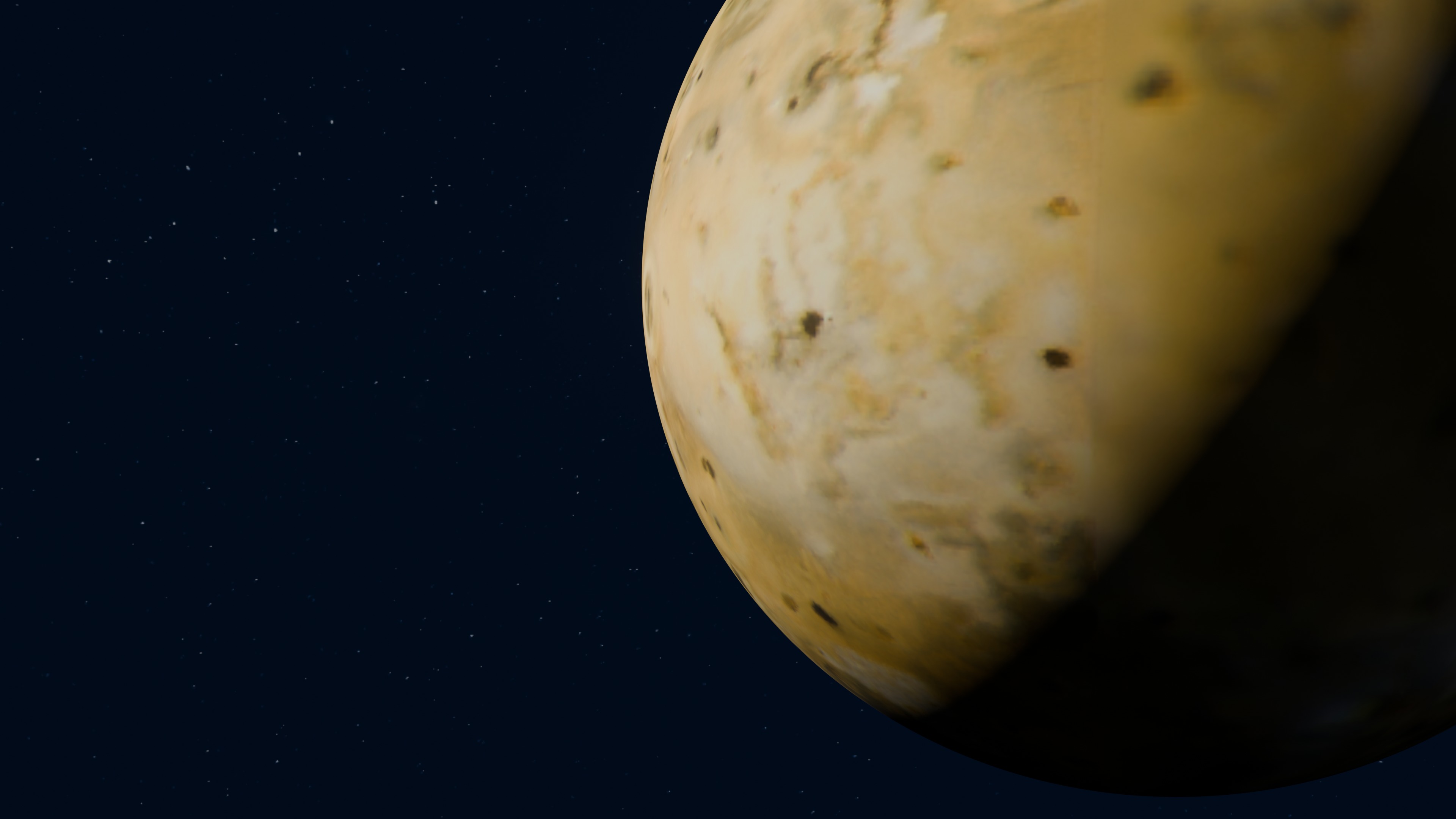
Io is the innermost of the four large moons of Jupiter that Galileo discovered in 1610. It is slightly larger than our Moon and orbits Jupiter at about the same distance as the Moon orbits Earth, but it goes round in under two days.
Unlike the other large moons of the outer solar system, Io is almost completely dry. It is made of silicate rock around an iron core, and it is the most volcanically active body known anywhere.
More than 400 active volcanoes have been identified. Some throw plumes of gas and dust hundreds of kilometres above the surface; others fill lakes of molten lava. The surface is constantly being repainted, so there are no impact craters to be seen at all.
The colours come mostly from sulphur and sulphur compounds, which take on yellow, orange, red, black and white forms at different temperatures.
Where the heat comes from
Io is far too small to have kept the heat it was born with, and the Sun is too distant to warm it. Its heat comes from tides.
Io, Europa and Ganymede are locked in a rhythm called a Laplace resonance: for every four orbits Io makes, Europa makes two and Ganymede one. The regular tugs from the other two moons keep Io's orbit slightly stretched, so its distance from Jupiter changes on every lap.
Jupiter's enormous gravity therefore squeezes Io and lets it relax again every 42 hours. The solid ground rises and falls by up to about 100 metres. That constant flexing generates heat by friction inside the moon, enough to keep huge amounts of rock molten.
Io loses this heat mainly through its volcanoes. The total heat flowing out of it is far greater, for its size, than the heat flowing out of Earth.
Volcanoes predicted, then found
In early March 1979, Stan Peale, Patrick Cassen and Ray Reynolds published a paper predicting that tidal heating should make Io volcanically active. Days later, Voyager 1 flew past Jupiter.
On 9 March 1979, Linda Morabito, a navigation engineer at NASA's Jet Propulsion Laboratory, was processing a Voyager image to pin down the spacecraft's position when she noticed a strange crescent shaped cloud rising from Io's edge. It was a volcanic plume, the first active volcanism ever seen beyond Earth. Voyager 1 spotted nine plumes in all.
It was one of the clearest cases in planetary science of a prediction being confirmed almost immediately.
Volcanoes, lava lakes and plumes
Loki Patera is the most powerful volcano on Io: a depression about 200 kilometres across filled with a lake of lava whose crust repeatedly founders and sinks. In 2023 and 2024 NASA's Juno spacecraft photographed it from as close as about 1,500 kilometres, showing islands in the lake and a surface as smooth as glass in places.
Pele is famous for its giant plume, which rises up to about 300 kilometres and showers material over a red ring about 1,200 kilometres across. Pillan Patera erupted in 1997, painting a dark spot hundreds of kilometres wide that was seen to change within months.
Io's lava appears to be mostly basalt, similar to volcanic rock on Earth, though some eruptions are hotter than any lava erupting on Earth today. Lava fountains and fissure eruptions can stretch for tens of kilometres.
Io also has some of the tallest mountains in the solar system. Boösaule Montes rises about 17 kilometres. Unlike the volcanoes, these mountains are blocks of crust pushed up as the surface is buried and squeezed by layer after layer of new lava.
Inside Io
Io has an iron or iron sulphide core surrounded by a rocky mantle and crust. Its density is the highest of any moon in the solar system.
Data from the Galileo spacecraft were once read as evidence that Io has a shallow ocean of magma beneath its crust. In December 2024, scientists measuring how Io's gravity responds to Jupiter's tides during Juno's close flybys reported that it does not: there is no global, shallow magma ocean. Instead, the magma may lie in many separate chambers.
Where exactly the heat is released, deep in the mantle or near the surface, is still debated, and it affects which regions erupt most.
Io and Jupiter's magnetic field
Io loses about a tonne of material every second to space, mostly sulphur and oxygen. Jupiter's spinning magnetic field sweeps up this material into a ring of charged particles around Jupiter called the Io plasma torus.
As Io moves through Jupiter's magnetic field, it acts like a generator, driving an electric current of millions of amperes along the field lines between Io and Jupiter. Where the current reaches Jupiter, it creates a bright spot in the auroras, known as Io's footprint.
Io's activity also gives it a cloud of sodium that surrounds Jupiter and can be detected from Earth with the right filters.
Discovery and naming
Galileo Galilei discovered Io in January 1610, along with Europa, Ganymede and Callisto. Seeing moons orbit another planet was strong evidence that not everything in the sky circles the Earth.
The name was proposed by the German astronomer Simon Marius, who claimed to have found the moons independently. Io was one of the lovers of Zeus, the Greek counterpart of Jupiter. For centuries the moons were mostly known by numbers, with Io as Jupiter I; the mythological names became standard only in the twentieth century.
In the 1670s, Ole Rømer used the timing of Io's eclipses behind Jupiter to show that light travels at a finite speed, the first measurement of the speed of light.
Seeing it from Earth
Io is easy to see with ordinary binoculars as one of the tiny points of light lined up beside Jupiter. Because it orbits so quickly, its position changes noticeably over a few hours.
With a small telescope you can watch Io pass in front of Jupiter and cast its black shadow on the cloud tops. Large telescopes with adaptive optics can now detect individual volcanic eruptions as hot spots in infrared light.
Open questions
Where inside Io is the tidal heat generated, and how does the magma reach the surface without a global magma ocean?
How hot is Io's hottest lava? Some measurements suggest temperatures that would point to unusual, very magnesium rich magmas like those that erupted on the early Earth.
How has Io's activity changed over the history of the solar system? A dedicated Io mission has been proposed to NASA, but none is currently scheduled.
Missions
Every spacecraft that has passed Jupiter has studied Io, though only a few have come close.
- 1973Pioneer 10 and 11 NASA
The first spacecraft to fly past Jupiter. Pioneer 10 discovered Io's thin atmosphere and charged particle environment.
- 1979Voyager 1 and 2 NASA
Discovered Io's active volcanoes and mapped much of its surface.
- 1995Galileo NASA
Orbited Jupiter until 2003, with several close Io flybys, recording eruptions, lava temperatures and changes over eight years.
- 2000Cassini and New Horizons NASA and ESA
Cassini, on its way to Saturn in 2000, and New Horizons, on its way to Pluto in 2007, watched Io's plumes from a distance.
- 2016Juno NASA
Orbiting Jupiter since 2016. Flew about 1,500 km above Io in December 2023 and February 2024, and showed there is no shallow global magma ocean. Its mission has been extended to 2028.
- 2031JUICE ESA
Due to reach Jupiter in July 2031. It will mainly study the icy moons but will observe Io from a distance.
Sources
- NASA Jovian Satellite Fact Sheet (NSSDC)
- NASA Science: Io
- Peale, Cassen and Reynolds 1979, Melting of Io by tidal dissipation (Science)
- Park et al. 2024, Io's tidal response precludes a shallow magma ocean (Nature)
- NASA: Juno mission
- ESA: JUICE
Facts were checked against these sources by a separate review before publishing. Spotted something out of date? Space moves fast, and this page is updated as missions report back.