Quick facts
- Event horizon of a black hole with the Sun's mass
- about 3 km in radiusthe whole Sun squeezed smaller than a city
- Size of the shadow
- 2.6 × the horizonlight bending makes the dark circle look bigger
- Sagittarius A*
- 4.3 million Sunsat the centre of our galaxy, about 27,000 light-years away
- M87*
- 6.5 billion Sunsthe first one photographed, 55 million light-years away
- Cygnus X-1
- 21 Sunsone of the first black holes found, in our own galaxy
- First gravitational waves
- 14 September 2015two black holes merging 1.3 billion light-years away
What a black hole is
A black hole is a region where so much mass is packed into so small a space that its gravity stops anything from leaving, including light. Its boundary is called the event horizon. It is not a surface you could stand on; it is a point of no return.
The size of the horizon depends only on the mass. A black hole with the mass of the Sun would be about 3 kilometres in radius. One with a million times the Sun's mass would be a million times wider.
From far away, a black hole's gravity is no stronger than that of any other object with the same mass. If the Sun were somehow replaced by a black hole of the same mass, Earth would keep the same orbit. It would just become very dark and very cold.
How they form
Stellar black holes are born when a very massive star runs out of fuel. Its core can no longer hold itself up, and it collapses in on itself, often in a supernova explosion. These black holes usually weigh a few to a few dozen times the Sun.
Supermassive black holes, millions to billions of times heavier, sit at the centres of most large galaxies, including our own Milky Way. How they grew so big so early in the history of the universe is still being worked out. They may have started from large seeds and grown by swallowing gas and merging with other black holes.
When two black holes orbit each other and merge, they shake space itself. These ripples, called gravitational waves, were first detected by the LIGO observatories on 14 September 2015, from a merger 1.3 billion light-years away.
Why it looks like this
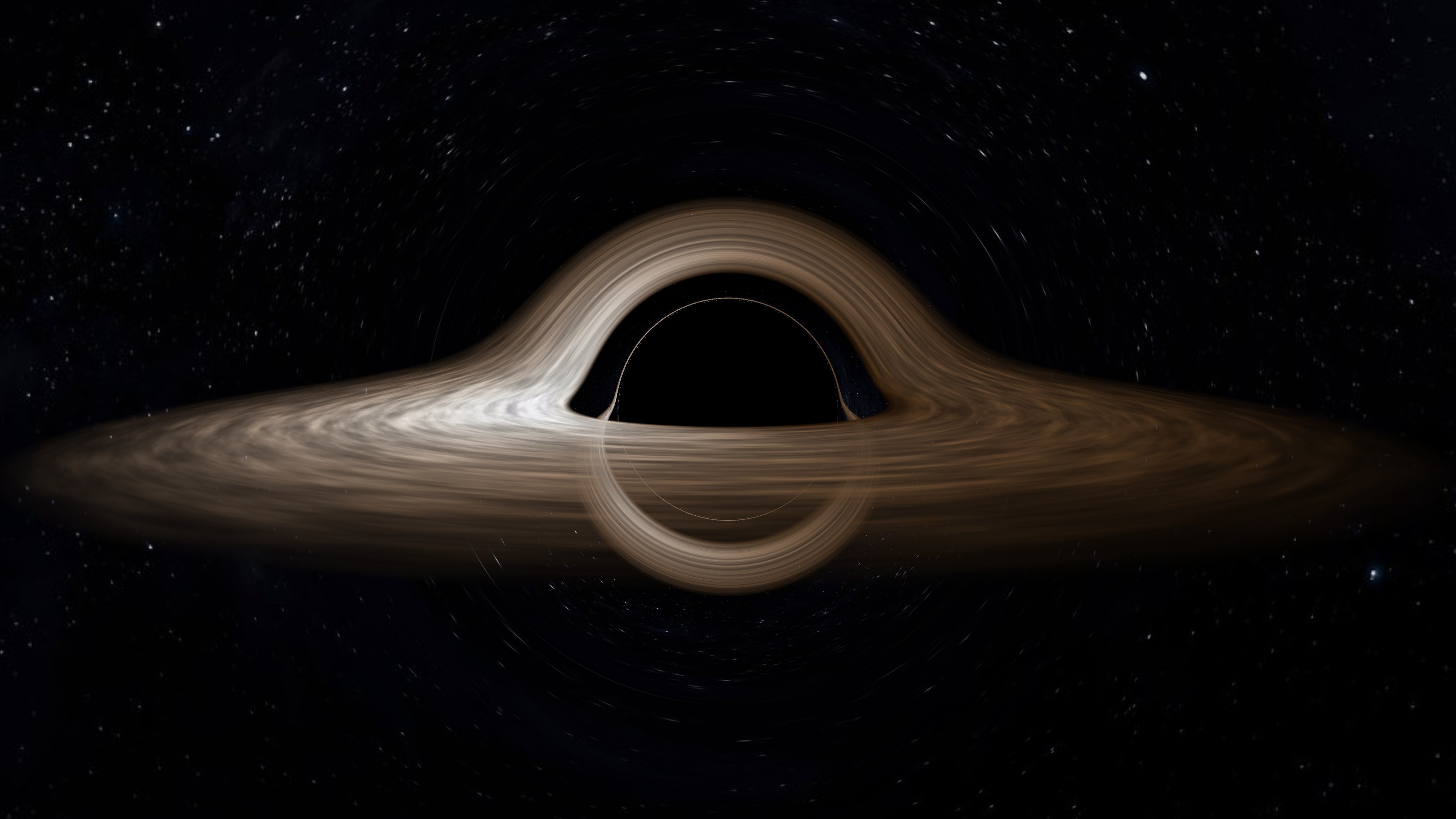
Nothing in a black hole picture comes from the hole itself. What you see is gas around it, and the way its gravity bends that light. The dark circle in the middle is the black hole's shadow. Light that passes too close is captured, so the shadow looks about 2.6 times wider than the event horizon.
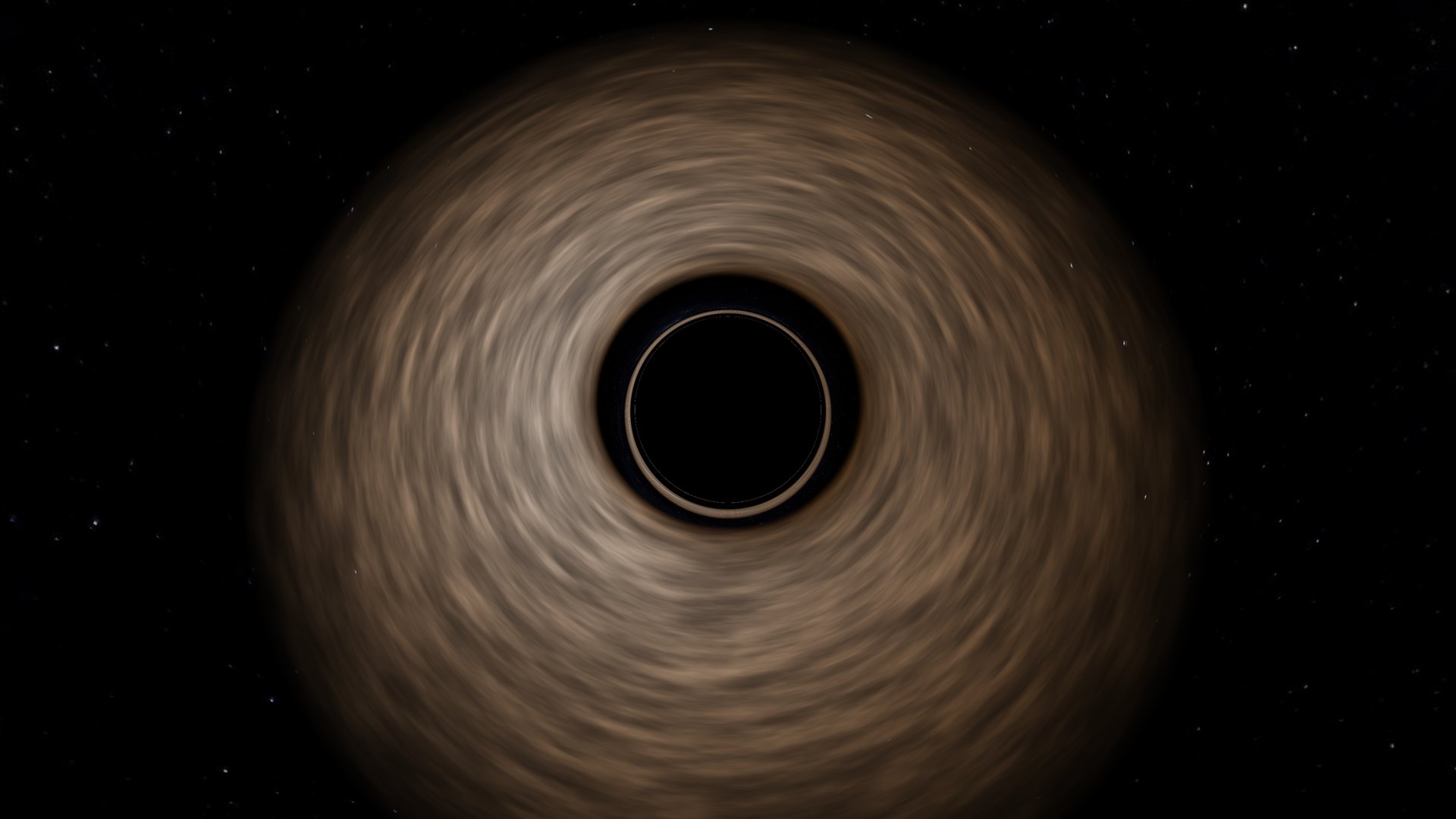
Around the shadow is a very thin ring made of light that travelled at least half way around the black hole, some of it looping several times, before escaping towards you. Physicists call it the photon ring.
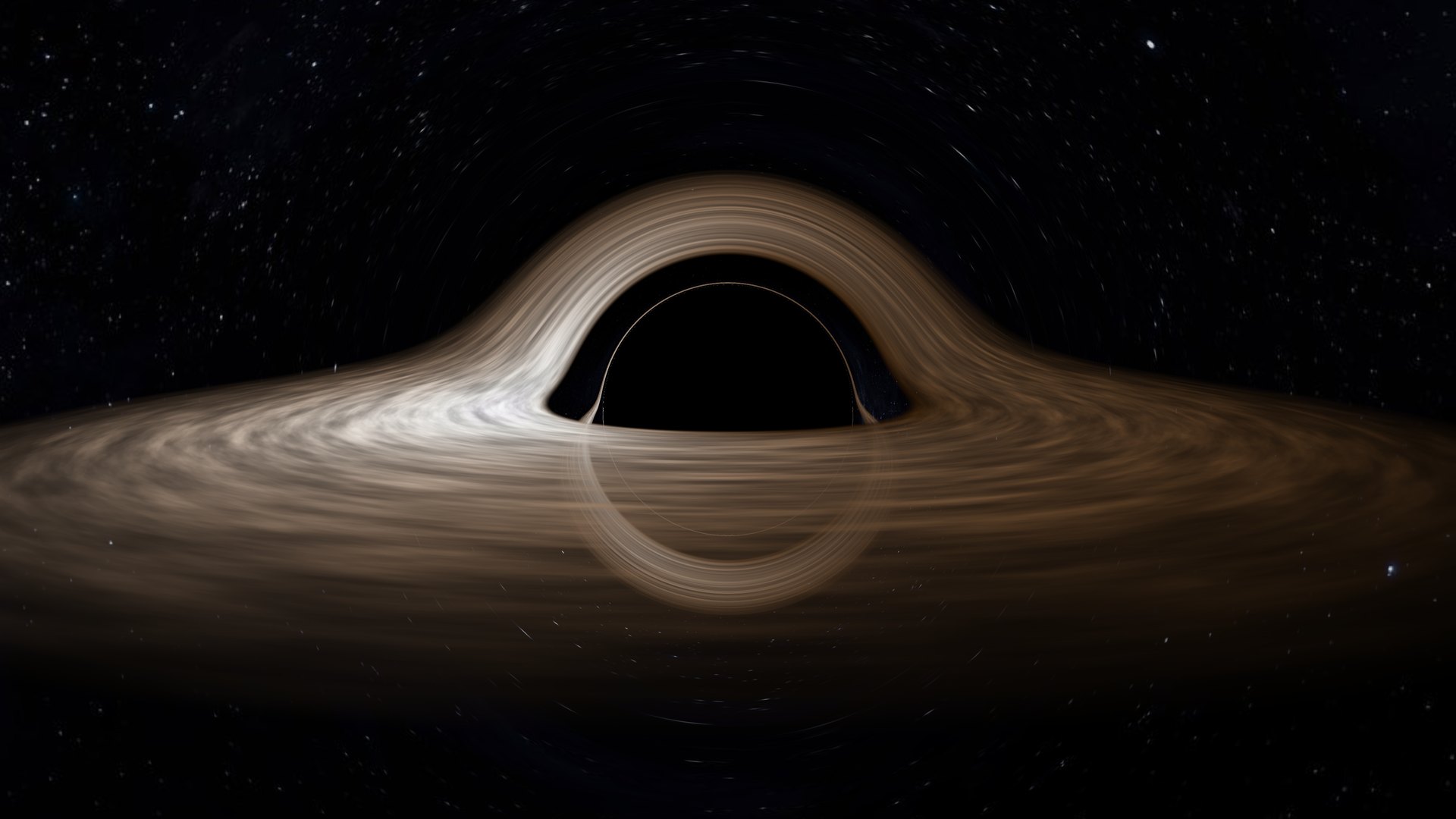
The glowing band is a disk of gas spiralling inwards. Gravity bends light from the far side of the disk up over the top and under the bottom of the shadow, so you see the back of the disk and the front at the same time. That is why a flat disk looks like a hat brim with a halo.
The gas orbits at a large fraction of the speed of light. The side coming towards you looks brighter and bluer, and the side moving away looks dimmer and redder. The first image of a black hole with its disk, showing exactly this, was calculated and drawn by hand by the French astrophysicist Jean-Pierre Luminet in 1979.
Gargantua, the black hole in Interstellar
For Interstellar (2014), physicist Kip Thorne gave the visual effects company Double Negative the equations for how light travels near a spinning black hole. Their team wrote new software to trace light along those curved paths, and the results were published as a scientific paper in 2015.
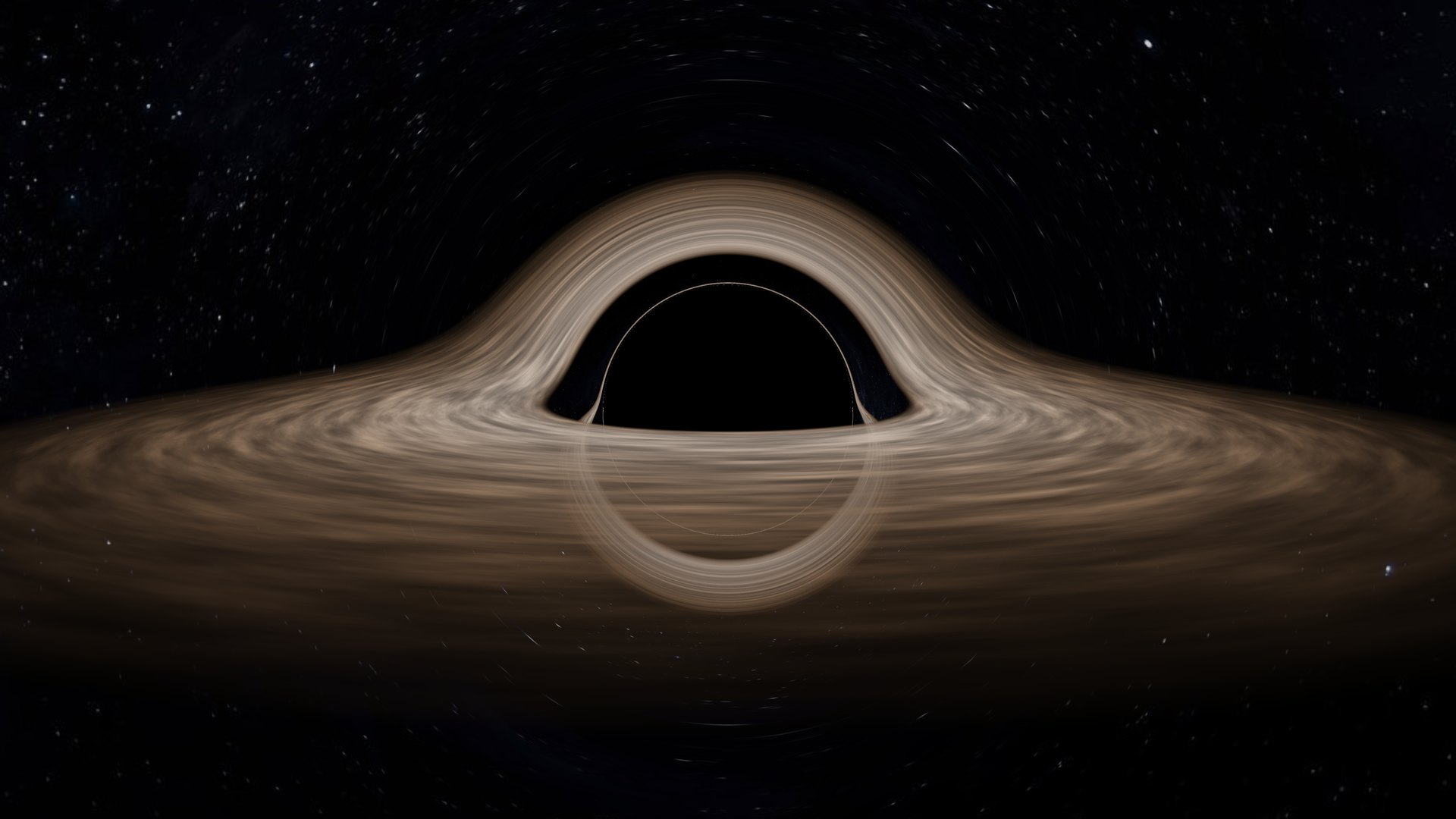
To keep the picture clear for audiences, the film left out the Doppler and gravitational shifts in colour and brightness, which make one side of the disk brighter and bluer than the other. Starfall's Film look button shows that version; the Real look shows the lopsided version a real observer would see.
In the story, Gargantua weighs about 100 million Suns and spins almost as fast as nature allows. That extreme spin is what makes Miller's planet possible, where one hour equals seven years back on Earth. Kip Thorne later shared the 2017 Nobel Prize in Physics for the detection of gravitational waves.
Time and gravity
Einstein's general relativity says clocks run slower where gravity is stronger. This is not a theory on paper: the clocks on GPS satellites would run about 38 microseconds a day fast compared with clocks on the ground, so they are built to tick slightly slow to make up for it. Without that, GPS positions would drift by kilometres every day.
Near a black hole the effect becomes enormous. A spaceship hovering just above the event horizon would see the rest of the universe speed up, while people far away would see the ship's clocks almost stop. Starfall's Time panel lets you try this at any distance.
Gravity also stretches. Because it pulls harder on the nearer end of an object, a person falling feet first would be pulled apart, an effect scientists call spaghettification. Around a small black hole this happens well outside the horizon. Around a giant one, the stretch at the horizon is so gentle you could cross it without feeling a thing.
The first photographs
On 10 April 2019 the Event Horizon Telescope, a network of radio telescopes across the world working as one Earth-sized dish, released the first image of a black hole: M87*, in the galaxy Messier 87. The ring is glowing gas, and the dark centre is the shadow, the same shape Starfall draws.
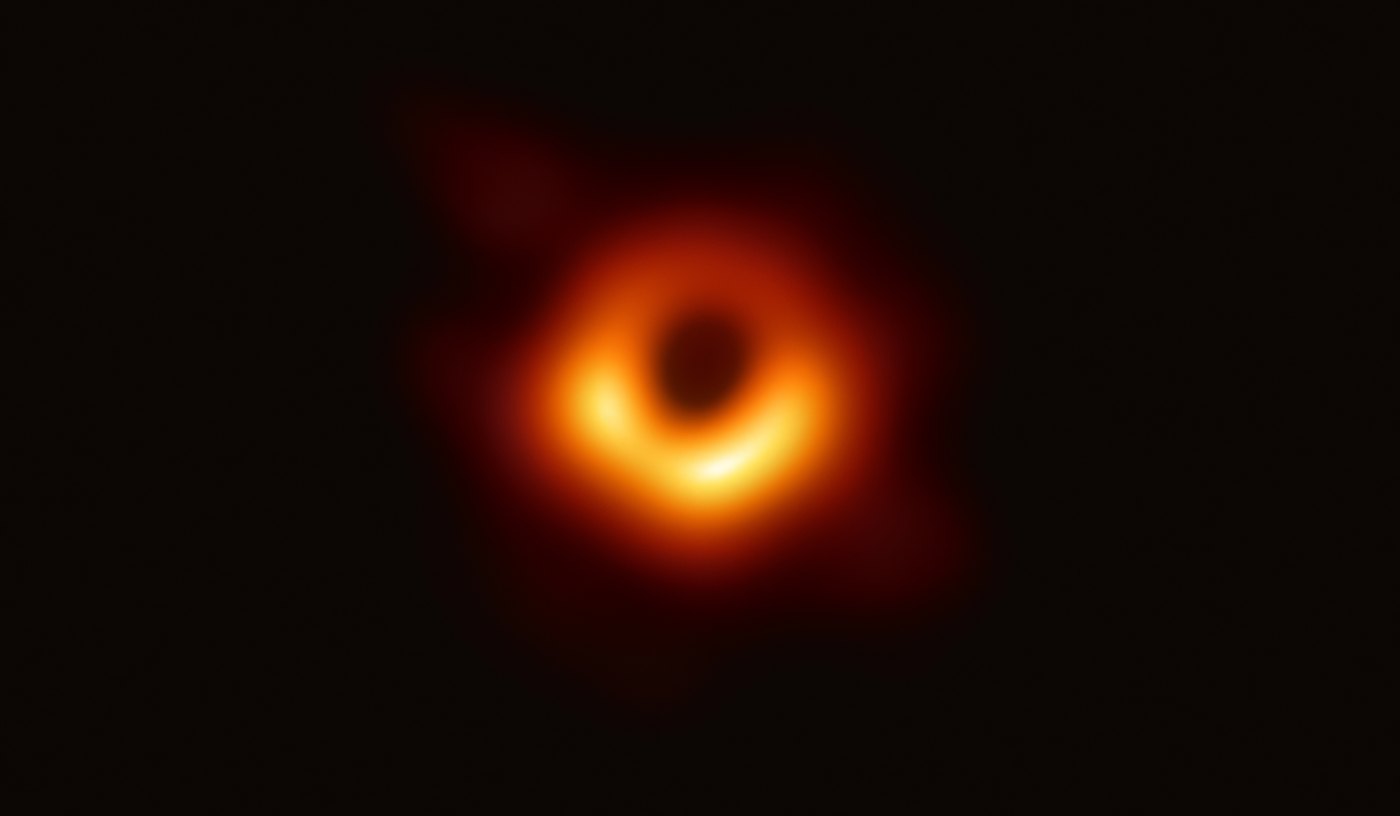
The ring is brighter at the bottom for the same reason one side of Starfall's disk is brighter: the gas there is moving towards us.
On 12 May 2022 the same team released an image of Sagittarius A*, the black hole at the centre of our own galaxy. It is over a thousand times less massive than M87* and far closer, so its shadow looks about the same size in the sky.
Our own black hole
Long before it was photographed, Sagittarius A* was weighed by watching stars race around it. One star, S2, completes an orbit every 16 years and swings within about 120 times the Earth-Sun distance of it. Reinhard Genzel and Andrea Ghez, who led the two teams tracking these stars, shared half of the 2020 Nobel Prize in Physics; the other half went to Roger Penrose for showing that black holes follow from general relativity.
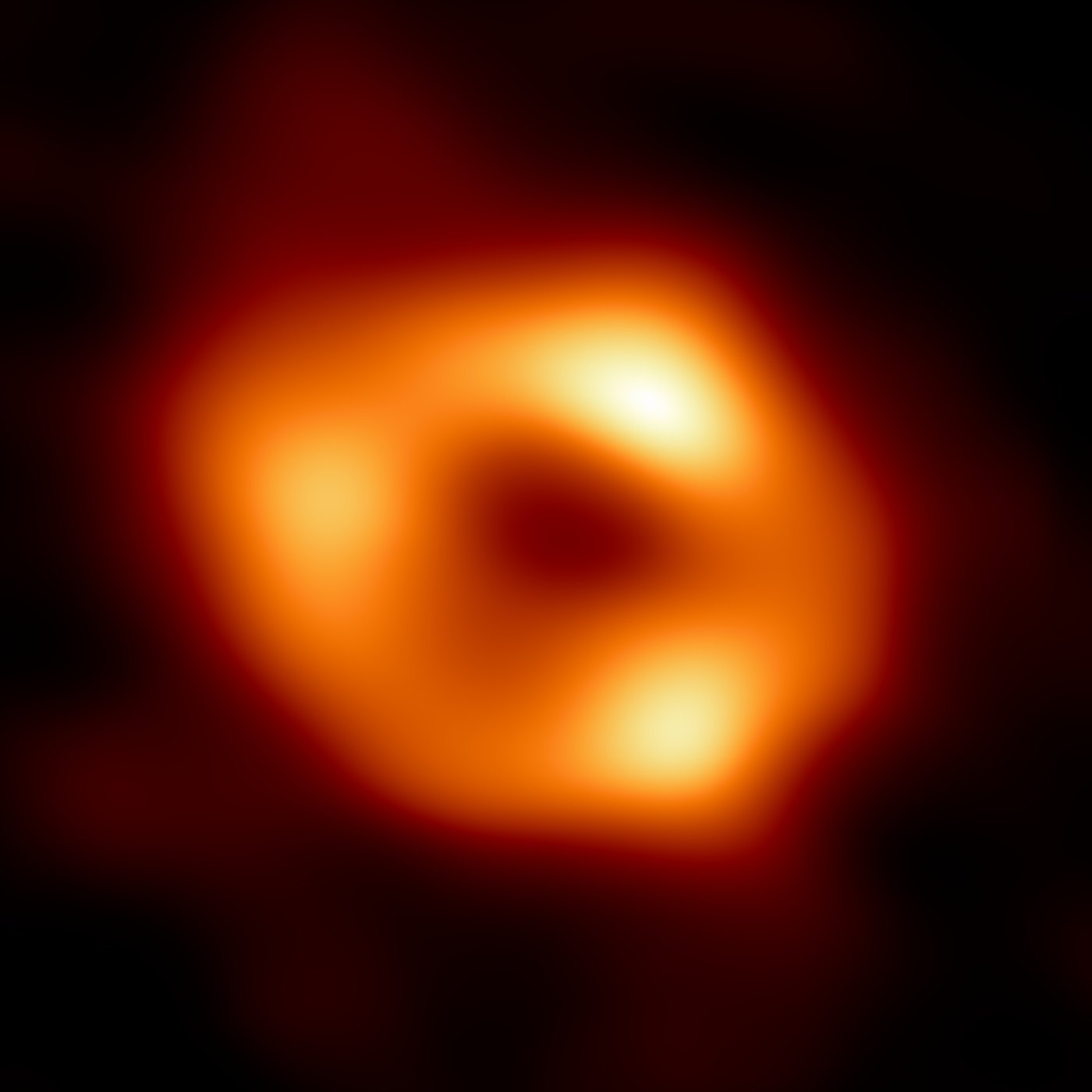
Sagittarius A* is quiet today. It swallows very little gas, so it shines faintly compared with the brightest black holes in the universe, which outshine entire galaxies.
Do black holes last forever?
In 1974 Stephen Hawking showed that quantum effects should make black holes give off a faint glow, now called Hawking radiation, and very slowly lose mass. For a black hole as heavy as the Sun this would take around 10 to the power of 67 years, far longer than the universe has existed so far.
Hawking radiation has never been observed. For any black hole we know of, it is far too faint to detect.
Milestones
How black holes went from an odd solution to Einstein's equations to objects we can photograph.
- 1915Schwarzschild's solution Karl Schwarzschild
Just weeks after Einstein completed general relativity, Schwarzschild found the exact solution that describes a non-spinning black hole, published in 1916. It is the one Starfall uses.
- 1964Cygnus X-1 discovered US sounding rocket
A rocket-borne X-ray detector found a bright X-ray source in Cygnus. By the early 1970s it was the first object widely accepted as a black hole.
- 1979First image with a disk Jean-Pierre Luminet
Calculated on an early computer and drawn by hand, it already showed the bent disk and the brighter approaching side.
- 2002Star S2 around Sagittarius A* Genzel and Ghez teams
Tracking the star S2 through its closest pass proved a compact mass of millions of Suns was hiding at the galaxy's centre.
- 2014Interstellar Kip Thorne and Double Negative
Gargantua was rendered by tracing light through the equations of a spinning black hole.
- 2015First gravitational waves LIGO
Two black holes about 36 and 29 times the Sun's mass merged 1.3 billion light-years away, and LIGO felt space ripple.
- 2019First black hole image: M87* Event Horizon Telescope
A ring of glowing gas around a dark shadow, matching the predictions of general relativity.
- 2022Sagittarius A* imaged Event Horizon Telescope
The black hole at the heart of our own galaxy, photographed for the first time.
Sources
- NASA Science: Black holes
- ESO: Astronomers capture first image of a black hole (eso1907)
- ESO: First image of the black hole at the heart of the Milky Way (eso2208)
- LIGO: Gravitational waves detected 100 years after Einstein's prediction
- James, von Tunzelmann, Franklin & Thorne (2015): Gravitational lensing by spinning black holes in astrophysics, and in the movie Interstellar
- The Nobel Prize in Physics 2020 (Genzel, Ghez, Penrose)
- The Nobel Prize in Physics 2017 (Weiss, Barish, Thorne)
- Miller-Jones et al. (2021): Cygnus X-1 contains a 21 solar mass black hole
- GRAVITY Collaboration (2019): distance to the Galactic Centre
Facts were checked against these sources by a separate review before publishing. Spotted something out of date? Space moves fast, and this page is updated as missions report back.